Showing posts with label wagashi. Show all posts

Saturday, June 24, 2023

Matsukaze


Matsukaze

¥970 / box of 10 pieces 

On my first morning in Kyoto and I headed out early enough to see tiny school children delightedly greeting their classmates and elderly joggers charging up miniature Mt. Funaoka. As I wandered east past the Daitokuji complex, I spotted a building across the street with all the classic indicators (weatherbeaten wooden sign, sliding doors, minimalist display window, verdigris lamp) that something inside is both edible and old-fashioned. 

Approaching the window I saw a hanging scroll, a single peony, and a plate with two slices of cake and a hand-painted label. Among the jumble of kanji were two that I could make out: “pine” and “wind.” And just then, through the fabric of my mask, I caught a whiff of something rich, sweet, and a little funky! 

The 250-year-old confectionery Matsuya Tobei is famed for matsukaze (“wind in the pines”) an unusually savory cake made from flour, sugar, malt, white miso, salted soybeans, and sesame seeds. The miso already nudges this moist, dense cake in a distinctly umami direction, but then it’s topped with fermented, salted black soybeans called Daitokuji natto (a “dry” natto, so no slime in sight). As an emotional eater, I am not unfamiliar with the taste of tear-soaked cake, and that’s the closest comparison I can offer. 

Matsukaze is used in autumn for tea ceremony but is very nice with coffee at any time of the year—and thank goodness! As it’s only sold by the box, I had a little more than I could handle and was able to distribute the excess at breakfast at my guest house. People from 5 different countries agreed: matsukaze was unlike any cake they’d ever had before. 


Matsuya Tobei 

Daitokuji Kitaoji, Kita-ku (in front of Daitokuji-mae bus stop) 

075-492-2850


Friday, October 5, 2012

Behind the Museum Cafe


Omanju
Behind the Museum Cafe, $2.75

Certain things about the Pacific Northwest have helped generations of homesick Japanese visitors and settlers to feel more at home:  the stands of tall, dark cedars, the intricate coastlines with little islands emerging from blankets of haze, the familiar grandeur of Mt. Rainier or Mt. Hood.  

Now add to that Portland's Behind the Museum Café. 

In the neighborhoods where I lived and worked in Tokyo there was almost always at least one gem of a coffeeshop.  While they varied wildly in style and size, all tended to be tricky to find and strongly atmospheric, with an unusual selection of carefully prepared drinks and food. 

Behind the Museum fits that description--except for it's relatively prominent location in back of the Portland Art Museum.  It's a narrow, high-ceilinged room in a modern glass highrise; a selection of Japanese antiques and contemporary crafts adds warmth to all that chrome. 

Owner Tomoe Horibuchi was a cafe manager and culinary instructor in San Francisco before feeling the pull of the Pacific Northwest.  She's dedicated to cultivating a space that's more than just a cafe, offering exhibition opportunities to artists, tables large enough to accommodate small group meetings, and regular demonstrations of Japanese traditions such as the incense ceremony and calligraphy.  

The cafe serves tea, locally-roasted coffee, Japanese beer and sake.  Appetizers and small meals are made in house, with organic ingredients wherever possible.  In addition to cookies and pastries, Horibuchi handmakes fresh Japanese confections such as the manju of the day above:  a small, soft bird filled with smooth red bean paste and flavored with toasted soybean powder.  

Behind the Museum Cafe 
1229 SW 10th Ave
Portland, OR
503/477-6625

Saturday, March 24, 2012

Sakuramochi


Sakuramochi
Tokara (above)
Umai-do (below)

S
akuramochi is named for the pale pink blossoms of the cherry tree, and like those blossoms is only around for a short time each spring.

In Japan, there are two regional variations on sakuramochi. Both types have a core of smooth koshian red bean paste and are wrapped in a brined cherry leaf, but the middle layer differs.
In the Kanto region around Tokyo, the bean paste is rolled in a tiny pancake made from pink-tinted rice flour. In the Kansai region (which includes Kyoto), the bean paste is enveloped in a ball of mochi rice dough, often made from dōmyōji-ko a "chunky" glutinous rice flour that originated at Osaka's Dōmyōji Temple; the dōmyōji-ko gives the mochi the ruffled appearance of a cluster of breeze-tossed petals.

Our Seattle wagashi makers are hewing more closely to the Kansai style. Tokara (above) makes a classic sakuramochi, with meltingly smooth koshian encased in a chewy dōmyōji pillow and jacketed in a zingy, tender leaf. At Umai-do (below), there's a homier version, with the shop's own flavorful bean paste and smooth, elastic mochi made from more widely available mochiko glutinous rice flour rather than dōmyōji-ko: a new "Seattle" style?

Friday, October 21, 2011

Umai-do Grand Opening


Umai-do

If you're in the ID or the CD today, be sure to stop by and try some fresh manju at the grand opening of Umai-do, Seattle's newest purveyor of Japanese sweets. Want the backstory on the shop or owner, Art Oki? Check out my article, "The Japanese Snickerdoodle", published last year in Edible Seattle Magazine.

Umai-do
1825 S Jackson
206/325-7888
Wednesday - Saturday: 9am-6pm
Sunday: 9am-4pm

Sunday, January 23, 2011

Suikanshuku


Suikanshuku
Minamoto Kitchoan

Persimmon season in Japan is much like zucchini season in parts of the US. In a good year, growers will have such a surplus that it becomes almost a curse, and they resort to ingenious means to deal with it. At one of the schools where I taught in Tokyo, we often found that a silent, anonymous persimmon fairy had left sacks full of ripe fruit in the waiting room while our classroom doors were closed for lessons.

There is a moment during which a fresh persimmon is sweet and juicy; before it they taste like sour dish soap and after, like insipid mush. There is, however, a laborious and specialized process that extends and magnifies that delicious moment, resulting in dried persimmons known as hoshigaki that are so succulently sweet they seem almost to have been glaceed. The ripe but firm fruit is peeled and suspended by its stem from a rack in open air. Over the course of several weeks, the fruit is massaged every few days to tenderize the pulp and prevent it from becoming tough and leathery. As the hoshigaki cures, the fruit's natural sugars migrate to the surface and crystallize, forming a delicate second skin.

Minamoto Kitchoan's Suikashuku is a premium seasonal confection that features a hoshigaki stuffed with white bean paste and coated in red bean paste. The persimmon stem protrudes from the bean paste skin, and the whole thing is dusted with granular starch that evokes the dried fruit's natural bloom. It's a delectable trompe l'oeil--the mellow sweetness of the bean paste tempering the intensity of the fruit and coaxing from it a pleasant tartness.

Slow Food USA has more on hoshigaki, including information on a growing number of US producers.

Thursday, September 16, 2010

Hyogo Confectionery Event


Yūgiri
, or "Lonely Tranquility"
Kobe Fugetsudo

On September 15th, the Ellis Pavilion at the Seattle Mariners' Safeco Field played host to a very unusual meeting: "A Special Presentation of Wagashi/Senbei Japanese Confectionery and Japanese Culture".

One of the things that I get from Japanese confectionery surprisingly often is a sense of being in the right place at the right time; this is a prime example. I happen to live in a state, Washington, that has partnered with the Japanese prefecture of Hyogo as "Sister States" since 1963. Seattle is "Sister City" to Kobe, Hyogo's largest city and an active port. Kobe is renowned in Japan for producing Japanese sweets with a European twist, a reflection of its earlier role as a designated center for international trade.

For several years, a trade group known as the Hyogo Confectionery Association has been working to promote Hyogo-made wagashi to new audiences. Their foray into Seattle was timed to coincide with a visit from Ichiro Fujisaki, Japan's Ambassador to the U.S.

So how did I find out about their "Special Presentation", much less manage to get on the guest list? I happen to be having a show of wagashi photos of here in Seattle, and, more or less on a whim, I thought to send an announcement to the Japanese consulate, not really expecting to hear anything. The consulate responded with an invitation to the event. Like I said: right place, right time. And then they gave me a gift bag along with my nametag, and I was over the moon.

The long, dim space was fitted with a row of tables covered in posters, brochures, souvenirs, and displays of sweets and rice crackers (below: white peach jellies in a presentation tray, and a beetle sculpted from sugar paste). Representatives of various Hyogo confectioners hovered behind the tables, answering questions and giving out samples.


The featured sweet, called "Lonely Tranquility" (top), was offered by confectioner Kobe Fugestu-do. One of Fugestsu-do's leading wagashi designers is also an expert on the thousand-year-old Japanese novel, The Tale of Genji; she spent several years creating a extensive collection of wagashi such as Yūgiri that reflect passages from Genji in both mood and detail:

"In the remote mountain retreat at Ono, the Princess Ichijō-no-miyasu-dokoro quietly passes away. Her daughter, the Princess Ochiba-no-miya, is overcome with grief and loneliness at being left behind all alone in this world.

"Russet and white nerikiri-kinton is used here to express the distraught princess's loneliness. Tsubu-an is enclosed within. The single autumn leaf symbolizes the Princess Ochiba-no-miya, whose name literally means 'the Princess of the Fallen Leaf.'"

Each Yūgiri sweet was sculpted to order by confectioners from Kobe Fugetsu-do (below). They make the rough outer layer by pushing paste through a woven bamboo screen; the scraps are then pressed to the bean paste core with firm but gentle pressure.


The formal part of the presentation included remarks from Association officials ("Snacks and sweets, when shared, bring people together."), a slide show on wagashi, and a quick but rousing greeting from Ambassador Fujisaki, who lived in Seattle as a teenager and clearly still has a lot of affection for the place. There were also demonstrations of tea ceremony (below) Nihon Buyo dance, koto, and marimba.


Wednesday, September 1, 2010

"Sweet Travel" Show


First there was Sweet Travel, the blog...now there's Sweet Travel, the show (not to be confused with "Sweet Travel! The Musical," debuting in 2014).

From now through September, a selection of my photographs from Japan is on display at Fresh Flours' Phinney Ridge location. The centerpiece is a 44-photo mural made up of individual wagashi portraits (above).

Fresh Flours is a lovely little coffee shop that features Japanese-inflected baked goods. It's also right across the street from Tokara and sells her wagashi on the weekends.

You can also see the show online by visiting my Flickr set.


6015 Phinney Ave N
Seattle, WA
206/297-3300

Sunday, August 8, 2010

Tokaragashi V


Tokaragashi V

Since I bought Tokara's seasonal wagashi at almost the same time last year, this box gave me the pleasure of recognizing an old favorite along with the thrill of discovering two new delights.

I was too slow to check Tokara's website for the correct names and descriptions, so apologies for being a bit vague. The modernist flower (above) was soft, translucent mochi, decorated with petal marks seared in by a branding iron and tiny cubes of kanten jelly for abstract drops of morning dew. Inside, a black sesame paste--pungent, dry, and velvety as halva.


A bundled-up bamboo leaf unfurled to reveal a fu manju (above), a dumpling of steamed wheat gluten, flavored with grassy yomogi and tucked around a core of sweet, chunky red beans.

Last but not least, the "old friend", Gourd (below): matcha-flavored white bean paste inside a molded kanten jelly textured with crushed, cooked rice.


To see more of Tokara's beautiful creations:
Tokaragashi I
Tokaragashi II
Tokaragashi III
Tokaragashi IV

Monday, July 5, 2010

Higashi III


Kingyo Higashi

Nara no Kikuya


Thanks to a kitchen moth infestation, I've been rooting around in my cupboards and making lots of highly unappetizing discoveries. One exception to that grim trend was discovering a little box of sweets that I brought back from Japan nearly two years ago and then lost among my drygoods. In it I found these tiny
higashi, dry sweets made of a very special sugar called wasambon that has been pressed into a carved wooden confectionery mold, or kashigata.

Their long shelf life is one reason that higashi are so prized, and these little goldfish didn't disappoint. Not only were they non-moth-eaten, they were fresh and sweet and a perfect texture, if perhaps a little faded. They also brought back welcome memories of my visits to
Kikuya, an ancient confectionery shop in a suburb of Nara, and to Okada Seitō-Sho, a farm and factory in rural Shikoku that is Japan's last producer of wasambon.

Monday, May 10, 2010

Tokaragashi IV


Tokaragashi
Tokara, $10/3

The May "
touryanse" assortment of Kyoto-style wagashi from Seattle's Tokara sweetshop: 

"Azalea" (above) is white kinton tinted with green tea, filled with chunky bean paste. 


"Iris" steamed cake of rice and yam with a smooth red bean paste center; the design is applied with a tiny branding iron.


"Violet's Whisper"  is thickened bean paste wrapped around a ball of smooth red bean paste.   

Wednesday, April 7, 2010

Umai-do Update


In the year since I had my first, addictive taste of Umai-do's homestyle Japanese sweets, I've been keeping a hungry eye on this young business. My article on Umai-do's proprietor, native Seattleite Art Oki, appeared in the January/February issue of Edible Seattle magazine; if you weren't able to catch it in print, the full text is now available on Edible Seattle's webpage.

While the Umai-do storefront isn't yet open, renovations are coming along, and in the meantime Oki is happy to take special orders. You'll also have a chance to enjoy Umai-do products at Seattle Center's Cherry Blossom Festival, April 16-18. Try the "pink" manju (above), a delicate dumpling of homemade white bean paste wrapped in fresh mochi, or any of the other treats pictured on my original post.

Umai-do
3046 South Dawson St.
Seattle, WA
206/850-5306

In search of other tasty posts? Check out Wanderfood Wednesday!

Wednesday, March 24, 2010

Setsuko Pastry


Green Tea and Cream Mochi
Setsuko Pastry, from $3

For two years, Osaka native Setsuko Tanaka has been supplying Seattle with the sort of Japanese-inflected French pastries that have become so popular in Japan (as well as in France). When she moved to Seattle 6 years ago, Tanaka hungered for treats she couldn't find: fresh Japanese sweets, light French desserts, and something in-between.  Having studied wagashi and pastry in Japan, Tanaka began to make the sweets she craved.  Gradually, her hobby became a new career.  

The featured sweet for March provides a great introduction to Setsuko Pastry's products.  The green tea and cream mochi (pictured above) is a delicate hybrid of East and West, old and new.  The mochi gets its verdant color from a generous amount of green tea, while the red bean paste filling is lightened by a non-traditional layer of whipped cream; the finishing touch is a preserved cherry blossom.  Like all Setsuko pastries, the green tea and cream mochi is fresh, made from scratch, and free of preservatives.  

The dessert platter pictured below displays some of the other items on Setsuko's menu:  a Mont Blanc topped with red bean paste and pureed candied French chestnuts, a green tea "rare" cheesecake, a syrup garnish made from a dark Japanese sugar, the green tea mochi, and two rounds of black sesame shortbread.

Setsuko pastries are currently available at Shun, Village Sushi, Issian, Kozue, Root Table, and the Panama Hotel.  Contact Tanaka via her website to be notified of monthly specials.  She also accepts special orders for birthday and wedding cakes, with vegan options available. 

Setsuko Pastry
206/816-0348

Hungry for more?  Check other food- and travel-related posts over at Wanderfood Wednesday


Tuesday, March 16, 2010

Sakura Daifuku


Sakura Daifuku

To understate the obvious, cherry blossoms are a big deal in Japan. Every spring newspapers and tv programs deliver breathless up-to-the minute reports on the best viewing spots. Photographers offer tips for capturing all that fluttering beauty on film. Friends and co-workers camp out to secure the best spots for ohanami (flower viewing parties), enjoying picnic lunches and sake (and sometimes portable karaoke) under canopies of frothy, pale pink blossoms.

But there's also a somber side to this blossom worship. As the short sakura season wears on, every puff of wind releases showers of loose petals, which drift like tenacious snowflakes onto the picnics and parties below. Short-lived sakura are a reminder of mortality (albeit a fluffy, pink reminder) and therefore a traditional favorite of samurai, yakuza, and all those who aspire to a short, beautiful life.

Every year around this time the global wagashi purveyor Minamoto Kitchoan sells sakura daifuku, little balls of white bean paste wrapped in mochi that has cherry blossom petals mixed into it. The petals infuse the mochi with a delicate but unmistakable perfume. It might not be one of the loveliest Japanese sweet, but it's one of my favorites.

Since I'm nowhere near a Minamoto right now, I decided to try making my own. While it's hard to harvest petals without feeling like a scoundrel, I quashed my guilt by wandering the long way home and taking a single blossom from each tree I passed. At home I rinsed them and separated the petals from the stamen and calyx (I guessed that these would be unpleasantly crunchy).

For the outer casing, I cooked up some short grained sweet rice (mochigome), then worked it over with a potato masher until it became a coherent but lumpy mass (having seen how much labor goes into real mochi, I hesitate to apply the term to my mush). Then I stirred in a little salt and sugar, a touch of beet food coloring, and a handful of petals. I formed my shiroan into small balls and encased each one in the rice paste, then topped each ball with a single petal.

I put a few in the freezer to taste when my diet is over and I can eat sugar again, and distributed the rest to friends.  Mmmm, mortality.  

Sunday, February 14, 2010

Happy Valentine's Day!!


Happy Valentine's Day to you and yours! As a token of my regard, here's a little wagashi bouquet made from homemade shiro-an and beet-stained nerikiri. I pressed each ball into a mold carved to look like a peony bud on the cusp of blooming, and dotted the buds with with kanten dewdrops.

And the black sesame seeds? While I was looking up pictures for the mold, I was surprised to see many peony buds crawling with ants--the suggestion of which makes my skin crawl in sympathy. Digging a little further I learned of an "old gardeners' tale" that says the ants actually encourage the buds to open.

I decided to throw in a few ersatz ants because I can't think of any better Valentine's wish than this: whatever temporary discomforts you may be experiencing, I hope that they will help you, in the end, to bloom bigger and brighter than ever!

Thursday, December 10, 2009

Tokaragashi III


Tokara's December touryanse collection.

Monday, August 10, 2009

Tokaragashi II


Tokaragashi, $10/3

It's a lovely coincidence that Tokara's monthly "open house" and my birthday both happen on the 10th.  This year, instead of the usual chocolate-on-chocolate cake, I enjoyed a small box of three of Tokara's high summer sweets.  

Gourd (above) has a core of matcha-flavored smooth bean paste encased in cast kanten (agar jelly) with domyoji (crushed rice) for extra texture and a suggestion of snow flurries.

Summer Shade (below) is a single adzuki bean nestled on white bean paste, wrapped in a shimmering skin of gold-tinted kanten:  no need for candles when your birthday treat generates its own glow!

Gourd and Summer Shade are still available through the retail outlets listed on Tokara's website.  Tokara's next touryanse happens September 10th.  Call ahead to reserve a box of seasonal sweets as beautiful as they are delicious. 

6208 Phinney Avenue North
Seattle WA 98103
 
206/784-0226

Thursday, March 5, 2009

Tokaragashi


Tokaragashi

from $3.30 each at retail outlets
$10/3 at monthly "Open House"

They say it's the reverse culture shock that really gets you, and I would have been petrified to return to Seattle after 3 months in Japan on a strict diet of wagashi (Japanese sweets) if I didn't know I could rely on tokaragashi to get me through the withdrawal pangs. Chef Tokara-san is Seattle's only professional producer of fresh, seasonal wagashi, and we are lucky to have her. So what if Tokara-san teases that I am a "wagashi freak"? After all, she's the one who enables me to get my freak on.

As a girl in Sapporo, Tokara-san was first attracted to western-style baking. Her family invested in an oven when she was in second grade (ovens still aren't all that common in Japanese homes) and from then on she was "always making sponge cake!"


As an adult, Tokara-san moved to Kyoto and learned to make wagashi.
Following another relocation to Seattle, she began producing sweets for tea ceremony gatherings. I had my first Tokaragashi during a class at the Urasenke tea school in the summer of 2004; a pale green paste of young soybeans, wrapped in a rippled sheet of golden kanten jelly, "Firefly Dreaming" was like a bright spark in the shadowy tearoom. The sweet catalysed the gathering, allowing all the guests to join together in mutual delight.

Local businesses soon began to clamor for Tokaragashi, and in A
ugust 2007 Tokara-san opened her commercial kitchen in a small building on Phinney Ridge. She now travels to Japan a few times a year, returning with suitcase-loads of ingredients. She makes all her products from scratch and by herself; not many people have the patience to start cooking at 5:30, the stamina to stir for hours, and and the sensitivity to tell, just by looking, whether a sweet meets Tokara's high standards.

Tokara's products are modeled on
kyōgashi, Kyoto-style artisanal sweets renowned for their abstract elegance and poetic layers of meaning. Although a complete understanding of all those layers would require a broad knowledge of Japanese history, art history, and classical poetry, Tokara-san finds that her customers understand more than enough to appreciate her designs, and that they are hungry to learn more.

Tokara-san makes slight changes to traditional designs to reflect Seattle's own seasons and flora, but she doesn't dumb her sweets down for the non-Japanese customers who make up about half of her clientele.
Tokara's menu of sweets changes monthly, and this seasonality, perhaps even more than gelatinous textures or the combination of beans and sugar, has proved tough to translate to customers raised on strawberries in January; people love something one month and can't understand why its not there the next time. According to Tokara-san, wagashi remind us to live in the moment: "You have to buy now or wait a year."

Tokaragashi are available at several local restaurants and coffee shops, including Fresh Flours and the Panama Hotel. On the tenth of every month, Tokara holds a touryanse, a low-key open house that gives fans a chance to peek inside her wholesale premises. Call well ahead to reserve a box of 3 tokaragashi; pick them up any time between 1 and 6.

The sweets in the above left picture made up January's touryanse assortment. Tokara's website describes
Early Plum, at the bottom, as "Soft silky mochi with White bean paste. Rice flour, white beans, sugar, coloring, wheat flour." The Crane is a "Rice sponge cake with Adzuki paste. Japanese yam potato, Adzuki, rice flour, sugar, coloring," its shape and markings suggesting those of the auspicious bird. My favorite of the bunch was the Rice sack, a "Soft bean paste candy with egg flavor. White bean, rice flour, egg, butter, sugar"; it was rich, mildly sweet, and meltingly tender.

Of the March assortment (above right), I was especially fond of Ancient Camellia (at the top): "Cinnamon flavor is everybody’s favorite. Rice flour, sugar, adzuki, cinnamon, camellia leaf." The rice paste was slightly chunky, the bean paste smooth as suede; the camellia leaf itself, sadly inedible.

Tokara
6208 Phinney Avenue North
Seattle WA 98103

206/784-0226

Tokara-san was featured on KUOW's Sound Focus program last year; hear her interview here.


Wednesday, September 3, 2008

Jōnamagashi


Day forty-four:
Jōnamagashi /上生菓子
7jyo-Kanshundo, ¥2100 for 4 sweets and lesson
Tsuruya Yoshinobu,
¥800 for sweet and tea


Of the many different ways of categorizing the range of Japanese sweets (wagashi), one of the most prevalent is the division between higashi, "dry" sweets with a low moisture content and a relatively long shelf life, and namagashi, sweets that are fresh, raw, or "rare" (in the bloody steak sense). Out of the moisture content criterion grow other, less quantifiable characteristics, with namagashi tending to be more seasonal, more artisanal, and more expensive.

Jōnamagashi, then, are the freshest of the fresh, soft, sweet symbols of the present moment, tenderly made by hand, and, ideally, eaten immediately thereafter. Kyoto is famous for its namagashi makers, a few of whom also offer tourists the rare opportunity to try their own hand at jōnamagashi.

The Gion branch of Shichijyo-Kanshundo offers regular classes to groups of any size who book ahead. The lesson takes between 60 and 90 minutes, and since the materials are ready and waiting, is less a cooking class than a sculpture workshop. For ¥2100 you get the lesson, enough raw materials to make 4 sweets, a cup of matcha with which to wash down your ugliest creation, and boxes for all the rest. Not bad at all when you consider that the sweets themselves could cost ¥300-450 each.

I talked my hostess Miko and one of her friends in coming with me and they were good sports and great translators. The class took place around a low table in a tatami room on the top floor of what must have been an old house. Our teacher, Suganuma-sensei, was a surprisingly young man with a ponytail like a long silk tassel trailing from under his uniform cap (below, left).

Sensei got us started on the sweet in the foreground of the picture above, "Hanano" (花野). The exterior is nerikiri, a mixture of gyuhi (a more delicate, less common cousin of mochi) and shiroikoshian (smooth white bean paste) that's as smooth and elastic as Play-doh, and as dyable as those white satin prom shoes. After watching sensei turn out a perfect example, we each started in on a large green ball, adding a yellow section by smoothing the perimeter of a flattened yellow ball onto the green, then rolling the thing between our palms to make it spherical again. The we flattened it out, placed a ball of red bean paste in the center, and stretched and coaxed the nerikiri until it completely enrobed the core (below, center). We pressed three small pink dots onto the top, then held the ball aloft and upside down, draping a damp cheesecloth over it. Finally, we brought the ends of the cloth together at the top center of the ball and twisted gently (this technique is called "chakin shibori") while giving the bunched cloth a three-fingered pinch.

We also made "Kikuyo", a deep purple Chinese bellflower, and "Shukaidou", a haystack of kinton extruded through a bamboo screen and gently arranged over a ball of tsubuan paste. Everyone was very complimentary about my output and I may or may not have mentioned that this was not my first attempt at sculpting jōnamagashi. When the ladies explained the extent of my love for wagashi, Suganuma-sensei gave me one of the sculpting tools that he had carved himself from aged bamboo.

I was still feeling a little full of myself the next day, when I headed over to
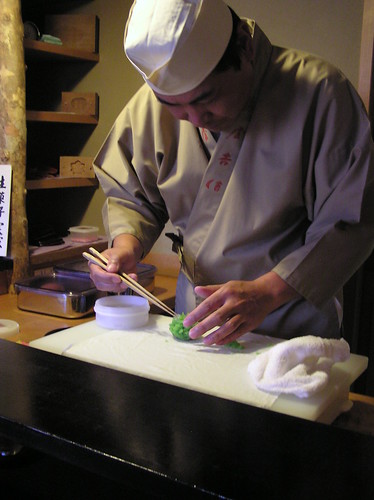
Tsurya Yoshinobu's beautifully appointed jonamagashi "bar" with Oya, a new friend and fellow enthusiast. For ¥800 you choose one of a small selection of sweets, then belly up to the bar as the master on the other side does a low-key Benihana routine (below, right). As you watch he creates complicated and poetic seasonal sweets; mine depicted a just-opened chrysanthemum stuffed with cotton wool, an old aristocratic method of collecting perfume to tuck into their kimonos. The impassive wagashi maker went about his work with balletic grace and a minimum of fuss as I sat, elbows on the bar, mouth hanging open, savoring just how easy he made it look.