Showing posts with label rice. Show all posts

Sunday, September 24, 2023

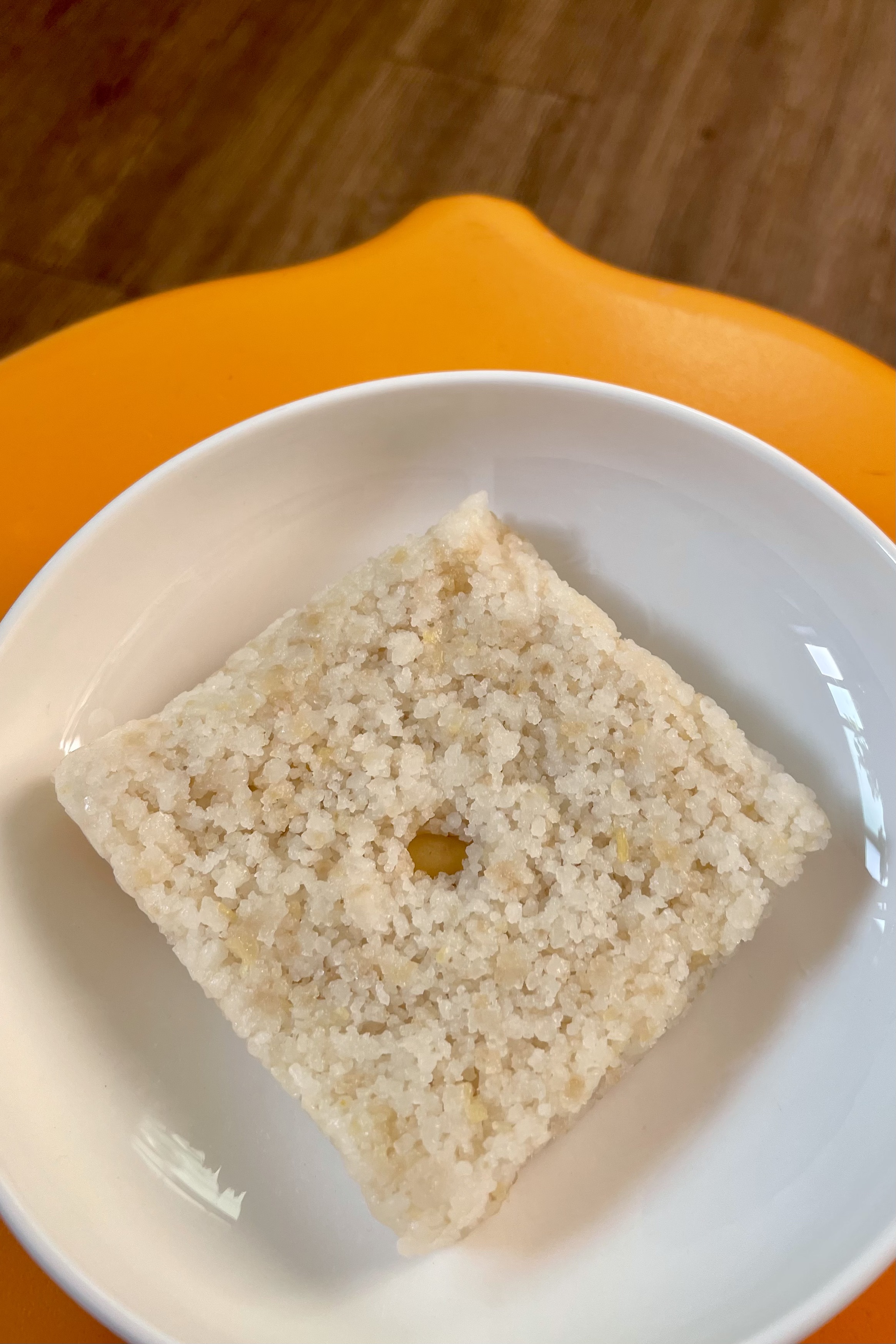
Duteoptteok and Jatseolgi


Duteoptteok, 3500 won 
Jatseolgi, 2500 won
Biwon Tteokjip

If you’re in shopping in Seoul and want to also indulge in a little time-travel, check out the shops officially designated as “oraegagye” by the local government. Since 2017, this program has celebrated “oldest” shops that have been open for more than 30 years, have had more than two generations of leadership, or have an owner recognized as a holder of intangible cultural heritage.   

Biwon Tteokjip is a oraegagye shop selling traditional Korea confectionery near the Gyeongbokgung Palace. The business was founded in 1949 on the strength of royal court recipes shared by the last imperial cuisine master of the Joseson Dynasty. As far as I can tell, Biwon is still operated by the original owner’s extended family. 

The shop looks extremely modern and rather bland from outside, but when you get through the glass doors there’s a gleaming display case covered in black lacquer and lavishly inlaid with mother-of-pearl. The case holds the day’s offerings—all conveniently labeled in both Korean and English. 


Plump and plushy duteoptteok is a dumpling about the size of sleeping hamster, made from sticky rice, white beans, walnuts, pine nuts, chestnuts, jujube, honey, and citron—it’s a lot of textures and flavors in a cuddly little package! Jatseolgi is a comparatively stripped-down square of just white rice and pine nuts; the texture is both sticky and cake-like, with the clean sweetness of the rice allowing the scent and flavor of the pine nuts to shine. 

Biwon Tteokjip
33-1 Bukchon-ro
Jongno-ku
Seoul

Friday, January 10, 2014

Jat Juk


Jat Juk

With every graphite-colored day that drags by I find myself grasping for new winter survival strategies.  Currently, I'm leaning on homemade pudding and awkward song parodies. 

This recipe for Korean jat juk, an intensely comforting pinenut-rice-date porridge, comes from Mark Reinfeld and Jennifer Murray's excellent "The 30 Minute Vegan's Taste of the East."  I added only this optional theme song, sung to the tune of Lovin' Spoonful's "Summer in the City":

"Hot pudding!  Winter in the city!  Back of my spoon feelin' really cinnamon-y!"

Jat Juk

1/2c lightly toasted pine nuts 
1 1/2c water 
pinch of salt 
1/4 c brown rice flour 
3T agave or other sweetener 
4 finely chopped dates 
pinch of cinnamon 

Blend the nuts and 1c of water in a blender or processor until smooth; pour into saucepan and place over medium heat.  

Meanwhile, use a frying pan to dry fry the rice flour over medium-high heat for 3 minutes, stirring frequently; slowly add 1/2c of water, whisking for a smooth paste.  

Add the pine nut mix and salt to the rice mix; cook until it thickens, about 5 minutes, whisking well, then stir in the sweetener. 

Pour into serving bowls and top with chopped dates and a sprinkle of cinnamon.

"Hot pudding!"

Saturday, August 17, 2013

Kue Wajik


Kue Wajik

A favorite street snack in both Indonesia (kue wajik) and Malaysia (kuih wajik), this simple rice cake showcases the quality of its three main ingredients:  sticky rice, coconut milk, and palm sugar.  Made from the sweet sap of various types of palm tree, the color, flavor, and texture of palm sugars can vary enormously according to the trace minerals that remain after processing.  Search for images of kue wajik and you'll see cakes that look golden, tan, rusty, or as if they've been doused in barbecue sauce, thanks to minimally refined palm sugars like gula melaka or gula jawa.  Made with the paler, more processed palm sugar from a Seattle grocery, my kue a little anemic-looking--but still delicious.  


Wednesday, July 17, 2013

Xôi Lá Cẩm II


Xôi Lá Cẩm
Lam's Seafood $1.50


More usually bright purple from the addition of magenta plant leaves, xôi lá cẩm is a sweet-and-savory Vietnamese snack of tinted glutinous rice topped with shredded coconut, toasted sesame seeds, velvety mung bean paste, and salt.  A taco-like format makes this particular variation a little more user-friendly by encasing the extremely sticky steamed rice in an edible rice flour wafer. 

Tuesday, June 18, 2013

Valerios


Ube Halaya
Valerio's Tropical Bakeshop, $6.50

When you've grown up associating bright colors with bland sweetness (think cupcake sprinkles or grocery store frosting) the riotous colors at Valerio's Tropical Bakeshop are unexpectedly flavorful.  The golden yellow that makes rolls and pies shine like small suns comes from shreds of cheese, pats of butter, or salted egg yolks.  Shades of green are contributed by leaves including bamboo (used as wrappers) and pandanus (most often used as an extract), both of which impart an exotic aroma.  The root vegetable ube is an intense shade of purple that makes ube-based treats like ube halaya pudding ($6.50) a visible and indispensable feature of special occasion buffets. 


Putsinta ($1.99/4) are Valerio's mash-up of two Filipino favorites:  soft, fluffy puto rice-flour rolls and and chewy kutchinta rice cakes.  Here the purple marbling comes from festive food coloring, rather than actual ube.  


Maruya ($1.25) are fritters of ripe mashed banana, fried until golden and dusted with sugar. 


The addition of lye water gives the sticky rice in suman sa lihia cakes ($1.50) a creamy color and extra-chewy texture; enfolding the rice in bamboo leaves before steaming adds aroma and a tidy, environmentally-friendly wrapper that makes suman a cinch for picnics (like the cemetery-side meals enjoyed during the Undas holiday).  

Valerio's rainbow-colored offerings also include pan de sal, biko, ensaymada, buko pie, egg pie, cassava cake, and sapin-sapin.  

Valerio's Tropical Bakeshop
1368 Southcenter Mall Ste 150
Tukwila WA
206/246-6166


Friday, April 5, 2013

Xôi Sầu Riêng and Xôi Gấc


Xôi sầu riêng and xôi gấc
Deli Chu Minh, $1.75/each

Deli Chu Minh in Seattle's little Saigon neighborhood sells a variety of sweet and savory products featuring its own housemade tofu, as well as selected Vietnamese treats from local producers.  Made by Cô Thu Ba, these confections combine xôi, steamed sticky rice, with two potent flavorings. 

Golden yellow xôi sầu riêng is flavored with durian, the huge spiky fruit that's both a delicacy and an outlaw in Southeast Asia.  Known as "the King of Fruits" for its compelling flavor, it is also, in many areas, banned from hotels, buses, and subways due to its penetratingly fetid aroma. 

Rusty red xôi gấc also features a regional fruit.  An off-the-charts carotene content gives the pulp of the gấc or "baby" jackfruit an intense red color; the fruit stains any dish to which it is added (and also to the cook's hands, clothes, kitchen walls, etc.).  Because bright red is the color Vietnamese most associate with luck and celebration, xôi gấc is a staple of New Year's tables and wedding buffets.   

Deli Chu Minh
1043 S Jackson St
Seattle, WA
206/228-5449

Sunday, July 15, 2012

Bánh Bò Hấp


Bánh bò hấp
White Center Supermarket, $1.25 

 Bánh bò, or "cow cakes", are the Vietnamese version of a steamed rice cake that originated in China.  Bánh bò batter includes rice flour, coconut milk, sugar, and a leavener--traditionally yeast, but baking powder is sometimes used as a shortcut--which causes the batter to bubble dramatically when cooked.  The resulting texture is as spongy as beef liver, earning these cakes their unexpected name.  

Baked bánh bò nướng has a thin golden crust and is usually cut into wedges before serving.  Steamed bánh bò hấp are usually smaller, round, and colorful; natural extracts of pandanus or magenta plant produce pastel green or purple, whereas the neon hues of the banh bo pictured hint at artificial food coloring.  As sold in Seattle's Asian groceries, bánh bò hấp come snuggled onto a deli tray along with a tiny cup of creamy dipping sauce (coconut milk thickened with tapioca flour). 

White Center Supermarket
9828 15th Ave SW
Seattle, WA
206/768-8087


Friday, June 24, 2011

Shikhye


Shikye
Yakult

Shikye is a sweet Korean beverage made from cooked rice that is quickly fermented with malt water, then sweetened and flavored with ginger. This commercial version made by Yakult (tagline: "Nostalgia drink since 1993") is as sweet as syrup but oddly watery and clouded by bloated rice particles. It tastes almost like it would be a hit with hummingbirds.

Friday, June 10, 2011

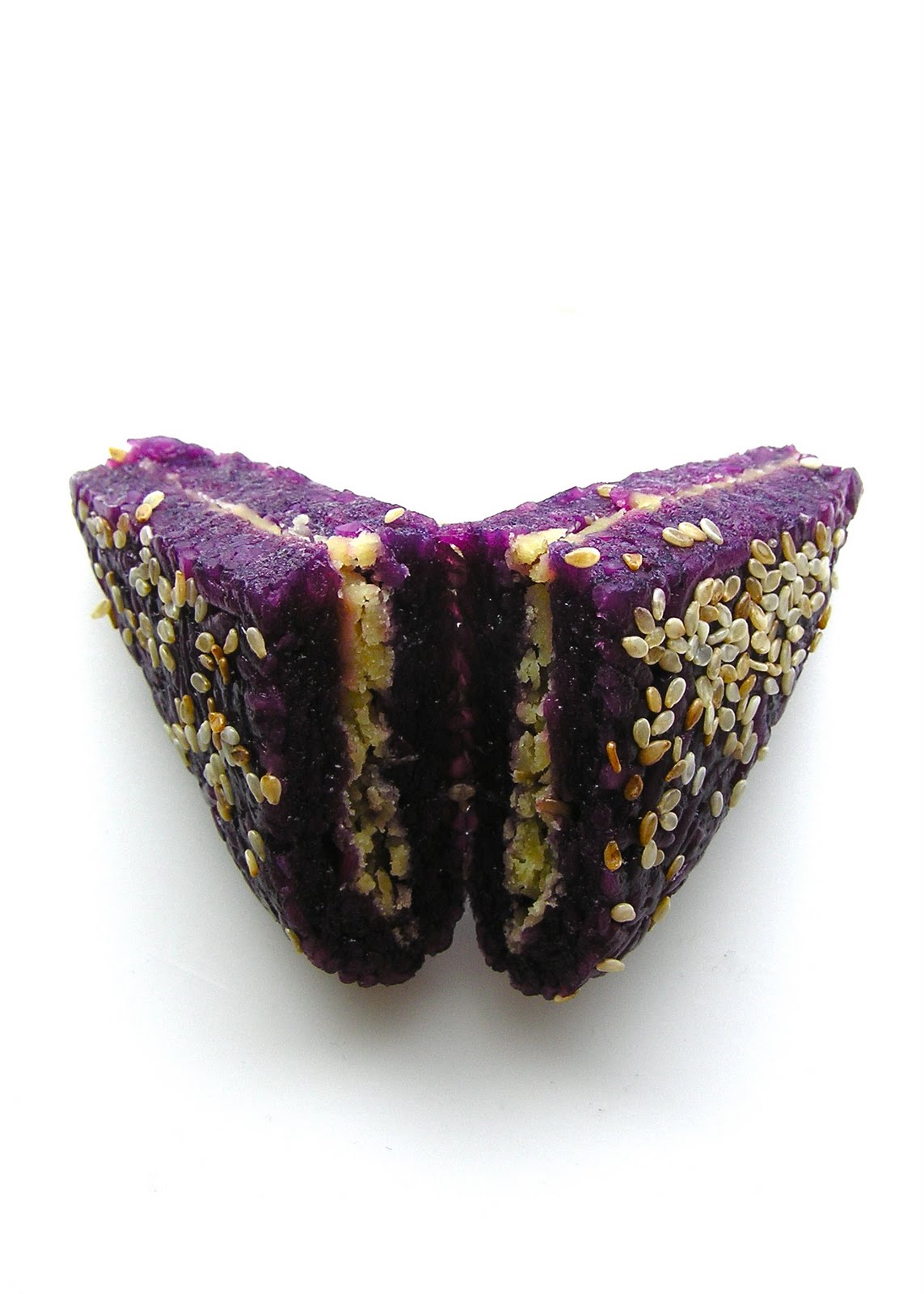
Xoi Vi La Cam


Xoi Vi La Cam
available at Viet Wah grocery, $1.95

I think that one of the most relevant measures of human ingenuity is the number of delicious ways in which we as a species manage to combine beans and rice. To that long list add xoi vi la cam, a Vietnamese sweet sandwich (and close cousin of xoi nep than).

A thin, crumbly layer of sweetened mung beans is held in place by chewy slabs of sticky black rice, which turns an intense violet color when cooked. Because of its pigmentation, black rice is up for membership in the fabled "superfood" club--but more importantly, it has a rich, nutty flavor that brings out the soft sweetness of the beans. A sprinkle of toasted sesame seeds on the surface adds crunch and more nuttiness.

Thursday, August 20, 2009

Xoi Nep Than


Xoi Nep Than
Mekong Grocery, $1.65

I recently took a joyride on Seattle's new light-rail train, which currently runs from downtown to almost Seatac airport (the airport terminal is due to open soon, followed by more northern stations). It was a great ride--smooth enough for my creaky bones, but bumpy enough to delight David, a talkative 12-year-old fellow joyrider seated across the aisle (he was so adorably excited to take his first train trip that he high-fived the ticket inspectors).

Somehow rocketing along either far above or far below ground level messes with my internal map, so it wasn't until the trip back towards town that I realized the Mount Baker station is mere blocks from one of my favorite Asian shops, the Mekong Rainier Grocery. When I was housesitting in the neighborhood several years ago I made almost daily trips for single-serving portions of spongy duck egg custard, cut in thick golden slabs and laid across a little bed of black sticky rice cooked with coconut milk.

Alas, things have changed. The Mekong is bigger and more bustling, but the slabs of custard are no more. The salesgirl I asked said that it just didn't sell well enough (starting the moment my housesitting gig ended, presumably). So I had a pack of xoi nep than instead; the same mass of coconut black rice, but topped with a schmear of sweetened mung bean paste and sprinkled with flaked coconut. Not quite as luscious as custard, but good enough fuel for a train trip.

Mekong Rainier Grocery
3400 Rainier Ave S
Seattle, WA

Monday, January 26, 2009

Champorado


Champorado
Ranch 99 Asian Superstore, $1.50/single-serving pack

A common snack or breakfast food in the Philippines, champorado is a soft, sweet cereal of overcooked sticky rice, chocolate, and sugar. Although I'd probably pass on the traditional accompaniment of dried fish, there's little not to like about the idea of "cocoa flavored rice porridge". I always imagined it would fall somewhere between chocolate rice pudding and the delicious dregs of all-to-infrequent childhood bowls of Cocoa Pebbles.

So I snagged a packet of Family Recipes' heat'n'eat champorado from the Asian Superstore up the road and spent the next few weeks using it for entertainment whilst in the kitchen waiting for other things to happen; I passed several happy hours gently squeezing the pouch as if building up my hand muscles or mulling over a cheap breast implant, tunefully imploring Champorado to "come to your senses". Finally hunger brought me to my own senses.

If you're out on maneuvers, it's perfectly possible to eat this S.R.E cold and "straight from the pouch"; for a more Martha approach, immerse the pack in boiling water (below) or nuke it in the microwave. Champorado can be dressed up even further with a swirl of condensed milk.

Although Family Recipes promises that when you tear into their packet, "...you are assured of the perfect champorado," I sincerely hope that they are exaggerating. Their champorado might best be described as "primordial", both in terms of its slimy texture and the impression it gives of wanting to be something else without quite making it.

It may be that champorado, like fellow regional comfort foods ochazuke and grits, really needs to be slaved over a little. And I do mean "a little"; from the looks of this recipe, making champorado from scratch isn't that much more demanding than heating and decanting a pre-fab packet.

Tuesday, August 26, 2008

Shiratama Dango


Day thirty-six: Shiratama Dango

When my jeweler friend Shinji Nakaba’s children were small he used to make them shiratama dango, little boiled rice flour dumplings, as a special treat. Today he made them again for the first time in 15 years, but luckily this seems to be one of those “once learned, never forgotten” skills. Even better, dango-making is an easy skill to acquire; the recipe is simple and quick and the main ingredient, shiratama flour, is often available in Asian groceries outside Japan. Made from mochigome (glutinous rice), shiratama-ko looks like white fish tank gravel and comes in 200g plastic sacks.

To make shiratamadango, pour about 100g of shiratamako into a mixing bowl. Make well in the center of the flour and add about 190ml of cold water (*this seems like a little much to me, but I haven’t had a chance to test it yet). Fold the flour into the water with your hands and once it is well mixed, begin kneading. Add more water a tablespoon at a time until the dough is smooth and of earlobe-like consistency. The dough will be very opaque, almost chalky looking.

The package shows a whole range of serving suggestions, but for shiratama dango á la Nakaba, you’ll need to make a small amount of simple syrup. As the syrup is heating, stir in a good dollop of grated ginger pulp. When it has thickened slightly, remove from heat and chill in an ice bath.

Roll the dough into hot-dog-sized logs. Pinch off 1” sections and roll between your palms to make small balls. Many dango are spherical but Shiji says his cook better if he flattens them by holding the ball in the palm of one hand and poking with a finger (so bobbing around in the water they look like huge white blood cells). If you or any small sous-chefs are so inclined, you can also form the dango into small sculptures of animals, snakes, Presidential candidates, local landmarks, etc.

Gently drop each dango into a saucepan of boiling water. Boil 2-3 minutes, then lift out and transfer to a bowl of cold water (leave a small stream of cold water running into the bowl as you work). Spoon cooled dango into bowls and top with syrup, a few ice cubes, and a sprig of mint.

These versatile dango can also be filled with small amounts of sweet fillings such as sesame or chocolate, served with shaved ice or warm sweet bean soup, or eaten with savory foods like vegetable or chicken noodle soup.

Saturday, August 23, 2008

Shiogama


Day thirty-three: Shiogama

In the last year or so I read an article about gourmands, a quirky category of perfumes that evoke things one would like to eat--cake or bacon, say--rather than things one would usually just sniff--e.g. flowers, twigs, old ladies. Of all the perfumes dicussed, the one that really struck me is called Sel de Vetiver; the writer was in raptures over its ability to smell so powerfully like something--salt--that doesn't actually smell like anything at all by smelling like things that we associate with salt.

Shiogama pulls off much the same trick. Named for a town that was once a center of salt (shio) production, shiogama looks like an old-fashioned salt tablet and smells like sea air. The bulk of the sweet is powdered uruchi-mai, non-glutinous rice, and such is shiogama's simplicity that the raw flavor of the the rice is pleasantly perceptible. The rice powder causes a bite of shiogama to foam slightly in the mouth, while sugar and a tiny amount of actual seasalt add flavor and grit. What really brings it all together is the sprinkling of dried shiso (perilla) leaves, which gives shiogama a refreshing flavor and a tangy aroma.

Friday, August 22, 2008

"Amai, shoppai, amai..."


Day thirty-two:
Left: Kurumi mochi
Motsu-ji teahouse, ¥400
Right: Amazake
Chuson-ji teahouse, ¥450

Waking in Tōno to blue skies and a black-and-blue arm, I decided not to venture too far. I took the train a little south to Hiraizumi, another tiny town with two formidible tourist attractions.

My first stop was the Motsu-ji temple, where the relatively modern buildings take a backseat to the Jōdo-teien, the country's best- (or only, depending on your guidebook) preserved Heian-period garden. In the millineum since the complex was first constructed, all of the original buildings surrounding the lovely ornamental lake have burnt or fallen, granting the strolling visitor uninterrupted views of its sculpted islands and scrolling shoreline. The recent discovery and restoration of an original, pebble-lined "feeder" stream stretching down from the surrounding hills has allowed for the reinstatement of another Heian legacy; once a year participants in Heian dress seat themselves on the lawn and compose spontaneous haiku poems while drinking sake floated down the stream in tiny lacquer cups.

I ended my stroll by the teahouse, where a group of middle-aged ladies were rather racuously digging in to a range of unfamiliar treats. I searched the menu board for something identifiable and asked for kurumi mochi; with a name like "walnut rice paste" I was pretty sure I knew what I would be eating, but I had no idea what form these versatile ingredients would take. I was presented with a lacquer bowl containing three large balls of (remarkably tenacious!) rice paste blanketed by a paste of creamed walnuts and sugar, alongside a cup of tea and a tiny dish of utterly confounding white goo. I was just about to dump the goo into the mochi when the woman across the table stopped me; it turns out that the pickled daikon (radish) paste should be eaten alternately with the mochi, enhancing the sweet creaminess of the walnuts. My savior mimed eating out of first one dish, then the other, chanting, "Amai, shoppai, amai..." ("Sweet, salty, sweet...").

On the other side of town, I hiked up a steep and heavily wooded ridge to see the Chuson-ji complex's stunning centerpiece, the Konjiki-do. This ancient (1124), small-scale (15-20 feet wide) temple is filled with beautifully carved deities and coated inside and out with gold foil so thick you could use it to wrap chocolate bars. I was still seeing stars when I spotted a banner advertising amazake, a hot, sweet drink that I find even more comforting that cocoa. Making amazake can be as complicated as infecting cooked rice with a particular mold to create fuzzy/lumpy koji, mixing it with water and heating the mix for 12-24 hours before sweetening and serving, or as simple as adding hot water to a packet of dehydrated sake lees. The resulting beverages aren't really the same at all, but both are creamy in color and texture, sweet, lightly perfumed, and slightly chewy (heads up, bubble tea lovers!).

I'm no expert, but I'd guess that this amazake was made by the more painstaking of the two methods. Again the "main course" was accompanied by tea and a dish of pickles, which were a mixture of finely diced cucumber and the tiny buds of a bracing, aromatic herb called shiso. And again, the constrast of flavors and textures was a delight.

Thursday, August 21, 2008

Yaki Mochi


Day thirty-one: Yaki Mochi

Kobiru teahouse at Tōno Furusato Mura, ¥120

Tōno is surely the nicest little town that I will never visit again--at least not until all its current residents are dead, gone, or too senile to remember me.

Tōno sits in a wide, wedge-shaped valley of fertile farmland bordered by lush green mountains. I arrived too late at night to see much of it, after a 12-hour slog on more than a dozen trains. (I'm currently traveling on a bargain rail ticket known as the "Youth 18" Kippu. For ¥11500 you get a book of 5 tickets, each good for 24 hours of unlimited travel on local trains during academic holidays. Despite the name, it's actually availble to all comers, presumably on the perverse understanding that even if you were 18 or youthful when you started your trip, you won't be by the end of it.)

When I called the Tōno youth hostel to make a booking, the warden explained that the hostel could be reached via a $60 taxi ride or a 1-hour walk; since I had a map, a tight budget, and restless legs, I opted for the walk and promised to check in by 10pm. In under five minutes I was free of the knot of neon-lit bars and restaurants surrounding the station, and within ten minutes I had passed the last quiet, curtained houses on the outskirts of the town proper. It was just me, my overloaded wheelie bag, a cartoonishly inaccurate map, and the crickets...or was it?

Stopping at each dim streetlight to consult my "map" I couldn't help thinking of what I had read about Tōno in my guidebooks. In 1909 the folklorist Yanagita Kunio discovered that ancient rituals, beliefs, and tales long since forgotten elsewhere in Modern Japan were still thriving in this insular area. Many of the folktales he recorded are violent or sinister in tone, such as that of a farmer who hangs the family horse when it becomes his son-in-law. Although in contemporary Tōno most sprites and spirits have been tamed by the tourist industry, there's something oddly disquieting about being directed to local attractions by Hello Kittified depictions of kappa, slimy, beaky, pond-dwelling creatures better known for drowning children, horses, and lone travelers.

At about 10:15 I was approaching the middle of nowhere when I spotted three points of light coming my way; they turned out to be a rescue party of young hostel employees on bikes. "We worried you might be scared, " said the girl in charge. Not "lost", not "hurt", but "scared". I sidestepped the implied question with a feeble kappa joke and thanked them profusely.

Back at the hostel it was clear that I had been labeled a nutter by the management. The manager explained the house rules to me in exhaustive detail (how to bathe, how to change shoes, how to put sheets on the bed), breaking off periodically to shake his head in disbelief that such an incompetent had made it this far on her own. I got the the same treatment the next morning when I asked to rent a bike, despite the glowering sky. I was determined to visit the Furosato Mura, a reconstructed folk village, some 8km away in the foothillls.

I had been peddling for about 10 minutes when the skies opened and I discovered that simultaneously biking and holding an umbrella is not as easy as Japanese grandmothers make it appear. I had to stop every 2 or 3 minutes to wipe my glasses and by the time I arrived at the village every scrap of my clothing from underwear up was completely saturated. In the visitor center bathroom I peeled off most of my clothes and rung them out over the squat toilet. When I emerged the gift shop attendant tied a small towel around my neck, swapped by exhausted umbrella for a new one, and waved me out into the dripping village.

Over the years, Tōno's better-to-do farmers built large L-shaped farmhouses called magariya, and many fine examples are now gathered into artificial villages such as Furosato Mura, and peopled by local pensioners employed to tell stories or demonstrate crafts. At the first house I met a man and a woman who had put aside their strawcrafting in favor of sitting next to the hearth. When they realized how wet I was they invited me to sit with them and share their lunches while we roasted my socks over the coals. While I was inside some helpful sprite took my soaked shoes from the porch and replaced them with a pair of rainboots (in the largest available men's size).

On warm and dry feet, I trooped through a few more magariya before finding my sweet of the day at Kobiru, a no-frills rural teahouse. From a number of plastic-wrapped treats next to the register, I picked the yaki mochi, a rubbery pocket of rice paste grilled just enough to raise warts and scabby patches, and filled with splinters of walnut and semi-crystallized black sugar that managed to be both gritty and squirty at the same time(the shoplady advised me to leave the plastic on while I ate). It looked like a baby cane toad but tasted like heaven--solid, comforting, and somehow warming, despite not actually being warm.

Buoyed by the yaki mochi's generous glycemic index, I continued on a circuit around the village and came to a wooden boardwalk leading to a small tree-ringed pond supposedly inhabited by a kappa. Umbrella clutched on one hand, camera in the other, I clambered up on the sodden, green-tinged boards and took exactly two steps forward in my slick plastic rainboots.
I fell so hard and fast that it came as a total surprise to find myself flat on the boardwalk with no breath in my lungs and rain falling into my gaping mouth. After a few minutes of wailing like a newborn, I came to the conclusion that while much was battered, nothing was broken. I had banged my head, shoulder and left forearm, and whacked myself in the leg with my camera. For only the second time in my life, I wished I knew how to say "concussion" in Japanese.

Back in the visitor center I set up camp in the bathroom (again) discovered that while squat toilets are fine places to pee or wring out wet clothes, they don't compare to Western loos as places to hide and have a comforting cry. My left forearm, just below the elbow, was already ballooning, so I dried my face, begged a bag of ice off the kitchen staff, and spent a good 45 minutes applying it to my arm. Since the last bus had left for the day and the bike was a rental, there was nothing for it but to pedal off into the first break in the rain.

I know, I know, I should have gone straight back to the hostel, but the eight km back was mostly downhill and by the time I got to the turnoff the sun was blazing and I was feeling rather chipper. So I proceeded to bike another 12 or so km around the valley, looping around various spots of tourist interest. I arrived back at the hostel just in time for dinner, tired and sore but ready to forget about my fall--until I took of my coat and realized that my left forearm was twice its normal size and darkening faster than the night sky. The hostel staff didn't look in the least bit surprised.

I spent the rest of the evening with my arm in the air, icing when ice was available, fretting when it wasn't, and wishing that I'd stashed an extra yaki mochi in every pocket. I could certainly have used a little comfort.

Wednesday, August 20, 2008

Ume Shiso Dango


Day thirty: Ume Shiso Dango
Kanameya, ¥90

Mellow, chewy dango slathered in bean paste stirred with sweet/salty/sour pickled plum and chopped leaves of shiso herb: a kick on a stick.

Monday, August 11, 2008

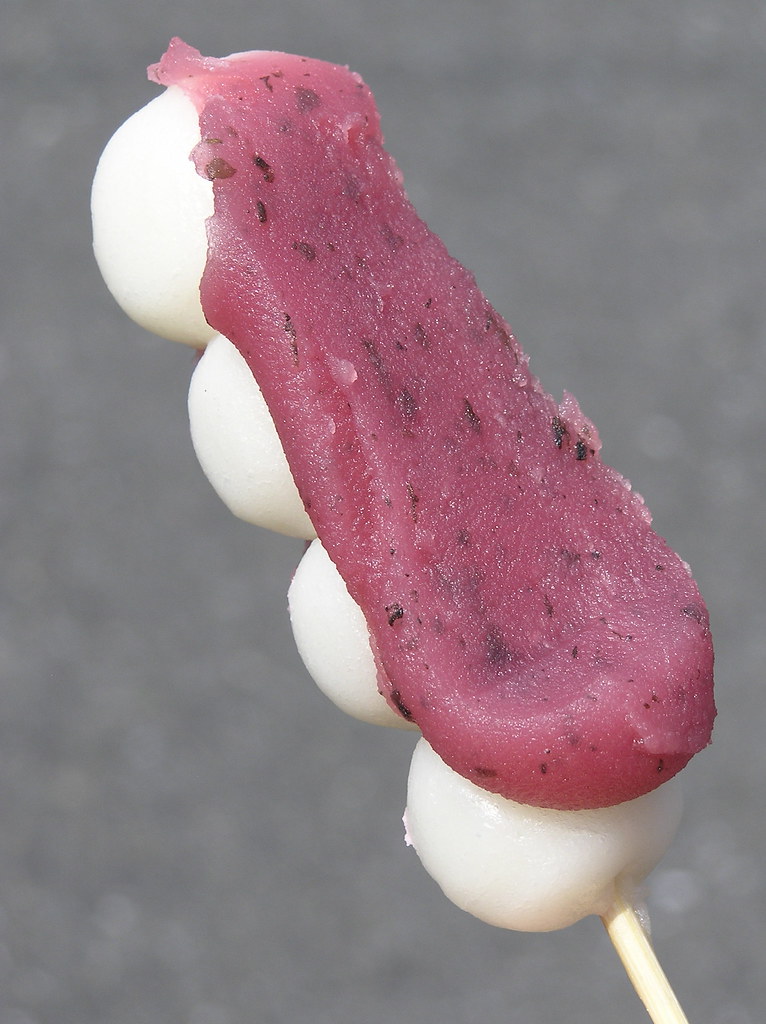
Dango


Day twenty-one: Dango / 団子

Furuya-Koganean, 3-2-4 Hatagaya, Shibuya-ku, ¥945/box of 5


From 1936 until about 10 years ago, Furuya-Koganean operated out of a single shop, doing a respectable trade in sweet staples such as yōkan and monaka. Then one of its products was “discovered” by a Mitsukoshi depachika buyer, and, ta-da, a star was born. Like a hit TV show, Furuya spun off one company (Hideki) and then another (Koganean—of which, more later), and today boasts 20 outlets. Unlike many spinoffs, all of Furuya’s offshoots are known for maintaining the quality of the original.

But jewel in the company crown in still the product chosen by Mitsukoshi as the best of the best, their dango, seen above in a picture that doesn’t begin do them justice. That heap that looks like salt and pepper is actually crushed black sesame seeds and wasambon sugar. Something like 98% of the sesame consumed in Japan was grown in China for oil extraction; Furuya’s toasty, aromatic black sesame is grown in Japan with just this end in mind. Wasambon sugar, as previously mentioned, is a rare and delicate sugar coaxed out of tiny Chinese canes on the island of Tokushima.

Buried under that delicious detritus are three pale, chubby dango on a bamboo skewer. There are almost limitless variations, but dango are basically balls of flour-based dough that are steamed or boiled until translucent and succulent; these are made using sweet rice flour, hot water, and nothing else. Dango are a bland but adhesive core that can be doused in a range of sauces, pastes and powders, such as salty/sweet crushed goma. At first I was cursing the powdery mixture for flying up my nose but by the end I was mopping up the spillage with a damp finger.


Furuya starts production at 3 o’clock every morning, and advises that their dango must be eaten the same day. Well, if you say so…


The pictures below show the packaging for the dango 5-pack, and the premises of the original shop.

Thursday, July 24, 2008

Temari Suama


Day three: Temari suama / 手まりすあま

7-11, ¥60

“Handball sweets” may sound unappetizing, but for once the google translator has it right. Temari are traditional cloth balls wrapped in intricate webs of overlapping colored thread, which are imitated here by the alternating wedges of white and pink (I think the ghostly radiation symbol is unintentional). This "border crossing" tendency is one of the things I find so appealing about Japanese sweets, the idea that something delightful will only be more so if reproduced in sugar (like the bubblegum tacos of my youth, only classier).

Like so many Japanese sweets, suama start out as rice, and I’m not exactly sure what chain of events transforms them into balls of sticky, stretchy, translucent dough; this is an area I will definitely be investigating further. It’s a beautiful little sweet that I find clings unpleasantly to the roof of the mouth, but maybe that’s my fault for buying one at 7-11.

According to the internet chat, suama are a nostalgic and summery treat for many Japanese, but they inevitably make me think of plump woman dusting herself down with talcum after a hot bath (although perhaps this is what they mean by “nostalgic” and “summery”). The powder is a some kind of starch (probably katakuriko, from potatoes) liberally applied to keep the suama from adhering to everything within reach like a universal magnet.


Alice and Drew took off for the States today, and I went for a wander around the neighborhood. I headed up to our local temple complex, which was quite spooky in the dusk, with strings of unlit paper lanterns. At the top of the hill, I found farms, a huge high school, and standing sentinel over it all, the towering chimney of our local incinerator. One of the things I still find very hard to accept about Japan is that they prefer to burn most garbage rather than recycle materials of which they have no natural native sources. In our neighborhood, they are at least starting to separate out PET bottles and cans, but that doesn’t seem to be common. The miniature garbage trucks come around every single day, blaring odd minor-key calliope music so that I wake up thinking, “yeah, I could go for some ice cream…’.