Showing posts with label Norway. Show all posts

Friday, May 17, 2013

Bløtkake


Bløtkake
Nordic Heritage Museum, $4

In honor of the Syttende Mai constitutional holiday, many Norwegians work up an appetite by parading through the streets carrying the national flag, then sit down to a well-deserved slice of bløtkake, the beloved "wet cake" whose patriotic layers of white sponge, whipped cream, and strawberry jam echo two of the Norwegian flag's three colors. 

Saturday, March 23, 2013

Norwegian Heritage Day


Rømmegrøt
Leif Erikson Hall, $4

Although the programming at the annual Norwegian Heritage Day at Seattle's Leif Erikson Hall focused on parades, prizes, dances, and speeches, it was sometimes be hard to hear what was happening over the sounds of crispbreads being crunched, lutefisk being sampled, and spoons scraping the bottom of bowls. 

Visitors to the upstairs lunch buffet could cap off a light meal of soup and open-faced sandwiches with one of the most stupefying desserts ever created.  Rømmegrøt is literally "sour cream porridge," a soup of sour cream, whole milk, and butter thickened with flour, seasoned with salt, and dressed for the table with melted butter, sugar, and cinnamon.  It's an historic and traditional Norwegian dish, eat both as a meal in itself, and as a special occasion dessert.  

I could barely keep my eyes open after finishing my bowl, an one woman I spoke with suggested that might have been part of the point.  During Norway's short but glorious summers it was common practice to send young people out to country to keep an eye on the grazing herds.  Back in their camps for the evening, a bowl of sleep-inducing rømmegrøt served as dessert might have helped to discourage the young people from engaging in any late-night hanky panky. 


At the Kaffestua downstairs, a busy team of volunteers offered made-to-order Norwegian treats.  Lacy krumkake wafers ($.50/each) were cooked in a special iron, then wrapped around conical wooden forms while still warm and pliable. 


Another specialty iron produced Norwegian waffles ($.50/section or $2/whole) with a distinctive heart shape.  


Over at the lefse station, rounds of dough were rolled out paper-thin, griddled until puffy and covered in brown patches, then covered in butter, sugar, and cinnamon and rolled into tubes for convenient snacking.  

The volunteer pictured made it look so easy that I imagined she must have been making lefse since infancy--but not so.  She explained that rolling out the dough was considered by her family to be such an important task, it was only entrusted to the most mature and responsible women.  Her own grandmother refused to teach her the secrets of the rolling pin until she was married with children of her own. 

Saturday, August 18, 2012

Viking Days


Æbleskiver
Danish Hearth, $3

As populations shift and tastes change, the mark of the Scandinavian cultures that shaped many of neighborhoods on Seattle's north side seems to be fading:  the Van de Kamp's windmill in lower Queen Anne is a distant memory, the Scandinavian Bakery building is now a Thai restaurant, and Scandinavian Specialties is Ballard's last remaining source for Nordic imports

But the frenzy of the Nordic Heritage Museum's " Viking Days" celebration suggested that while those cultures may be less obvious today, they are neither gone nor forgotten.  The Museum's parking lot was crowded with Viking reenactments and historical displays, demonstrations of traditional crafts, retail stalls, and plenty of food.  In addition to the usual beer and grill tents, there were regional "hearths," booths dedicated to the foods of a particular country. 

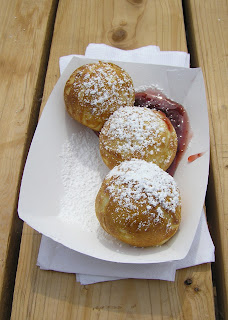
The Danish Hearth's line was longest and slowest, but it gave customers a front row seat as expert volunteers cranked out the only item on the menu:  æbleskiver.  Cooked in special cast iron skillets with dome-shaped indentations, these spherical pancakes are served with jam and a sprinkling of powdered sugar (above).


One volunteer worked non-stop to meet the demand for fresh batter (left), which was then passed down the line to the cooks stationed at portable stoves (right).  


Each new batch started with a hemisphere's worth of batter (left).  As the underside of the batter skinned over, the cook used a skewer to lift the cooked section partway out of the pan, allowing more of the uncooked batter to contact the skillet. 


Little by little, the hemispheres became bowls, then Pac-Men (left), then spherical golden-brown æbleskiver.


At the Icelandic Hearth, there were thin slices of vínarterta ($1), sawed off of a towering stack of cardamom shortcake layered with spicy prune jam.  The recipe for "Vienna cake" dates back to at least the mid-19th century, when European pastry chefs began to have access to refined white "Vienna flour."  It's been a popular cake for Icelandic celebrations ever since, with even fancier rainbow-striped versions made by using a variety of different jams.  After the cake is baked and constructed it is wrapped tightly, then set aside to age for up to two months.  


 After running out of Finnish rice pudding early on, the Finnish Hearth substituted a Norwegian almond cake ($1), as moist and rich as slightly aerated marzipan.

Monday, August 6, 2012

Sluy's Bakery


Fatigmand (above)
Pepperkakor (below)
Sluys Bakery


Read more here: http://www.thenewstribune.com/2012/05/18/v-printerfriendly/2149054/where-the-vikings-shop.html#storylink=cp
"Giv os idag vort daglige brod."
                       -Motto on the Sluys' Bakery wall

The Norwegian immigrants who settled the area around Poulsbo in the 1880s were reportedly drawn to the familiar fjord-like contours of its hills, waterways, and distant mountains. 

If their descendants are similarly sentimental, they must be irresistibly drawn to the familiar aromas wafting from Sluy's Bakery in downtown Poulsbo's "Little Norway" commercial district.  Many of the buildings that line the narrow street are embellished with conspicuously Scandinavian touches, but for me it's the chance to "share" an experience with those pioneering Norwegians that breathes life into the town's decorative facades. 

Since 1966 Sluys has been owned and operated by the same local family.  They turn out famous products such as "Troll House" cookies, fresh "Poulsbo" bread loaves, iced sugar cookies shaped like Swedish dala horses, and "Viking Cups"--gargantuan cinnamon rolls smothered in snowdrifts of frosting. 

Pepperkakor (below) are a gingerbread cookie familiar throughout Northern Europe but particularly associated with Sweden and the winter holidays.  Each little square packs such a spicy punch it seems like hydraulics must have been involved in jamming a critical mass of cinnamon, ginger, and cloves into the dough.  The sparkling sugar topping this historic cookie harks back to the days when sugar was a rare luxury, used as a spice or garnish rather than a staple ingredient. 

On the other end of the spectrum are fatigmand (above), a palate-cleansing cookie that seems almost austere by comparison with pepperkakor.  Known as "poor man's cookies", these fried twists are crisp and restrained, relying on frying oil for a touch of richness and on the barest hint of cardamom for flavor.  Like pepperkakor, fatigmand are made in many countries, but they are most strongly linked to Norway, a country that only gained its independence from Sweden in 1905 and was known as Europe's third-world country for much of the 20th century.  Fatigmand are an edible reminder of the conditions that drove Poulsbo's founders to strike out in search of new opportunities. 

Sluys Poulsbo Bakery
18924 Front St NE
Poulsbo, WA
360/779-2798

Sunday, April 22, 2012

Verdens Beste Kake


Verdens Beste Kake
Scandinavian Specialties, $3.75

Too many hours of cooking shows have trained me to equate quality with complexity: flavors aren't flavors unless they're squired by at least a dozen partners, textures aren't worth their weight unless they're tussling against crunchy toppings, runny reductions, and chunky compotes.

This might be why a particular item at Scandinavian Specialities pulled me up short. Verdens Beste Kake translates to "World's Best Cake," but it wasn't the boast alone that got to me: it was the combination of superlative and simplicity. As the menu sums it up, Verdens Best Kake is no more or less than "Almond meringue with vanilla cream." Baked in large sheets, the crunchy almond-topped meringue becomes the "bread" for this simple sandwich, slathered with at least an inch of thick, cool, sweetened cream.

The cake first appeared in northern Norway in the 1930s, and was then known as Kvæfjordkaka, after the local fjord. From there, the recipe gained ground and popularity, earning first its impressive new name, and then, in 2002, recognition as the official cake of Norway.

6719 15th Ave NW
Seattle WA
206/784-7020