Showing posts with label bean paste. Show all posts

Saturday, June 8, 2013

Hotteok and Bungeoppang


Hotteok and Bungeoppang
"Ho Duck" stall, $1 each

Look to the left as you enter the Boo Han Korean Market in Edmonds and you'll get one of the best deals in town on dinner and a show--assuming you can justify having waffles or pancakes for dinner. 

While you wait and watch, the cook in the "Ho Duck" stall crafts two of Korea's best-loved street-style sweets.  The eponymous hotteok (above) are crusty, golden pancakes of yeasted wheat and rice flours, filled with caramelized sugar and nuts.  It's a simple enough operation but made mesmerizing by the cook's practiced moves and enviable patience.  

The hotteok start out as a ball of sticky, bubbly dough.  The cook kneads it a little, then fills a dent in the center with a a mixture of brown sugar and crushed nuts.  He pinches the dough closed to seal in the filling, then uses a special metal tool to flatten the ball on a well-oiled griddle.  


Once the hotteok are underway, it's time to get going on the bungeoppang.  "Fish bread" is really more of a fish-shaped waffle, cooked a whole school at a time in fancy high-volume griddle.  To get exactly the right amount of batter, the cook spoons a little into each fish-shaped void, then tops it up with a seam applied with a squeeze bottle. 

On top of each batter cloud goes a dollop of sweetened red bean paste.   

Then the lid is closed up to seal the waffle around the filling.  As soon as the cook deems them ready, he uses a small metal hook to flicks them out of the iron and into a waiting box; it's not at all unusual to order six or a dozen at a time.  

Boo Han Korean Market 

22618 Hwy 99
Edmonds, WA
425/778-7400


Friday, October 5, 2012

Behind the Museum Cafe


Omanju
Behind the Museum Cafe, $2.75

Certain things about the Pacific Northwest have helped generations of homesick Japanese visitors and settlers to feel more at home:  the stands of tall, dark cedars, the intricate coastlines with little islands emerging from blankets of haze, the familiar grandeur of Mt. Rainier or Mt. Hood.  

Now add to that Portland's Behind the Museum CafĂ©. 

In the neighborhoods where I lived and worked in Tokyo there was almost always at least one gem of a coffeeshop.  While they varied wildly in style and size, all tended to be tricky to find and strongly atmospheric, with an unusual selection of carefully prepared drinks and food. 

Behind the Museum fits that description--except for it's relatively prominent location in back of the Portland Art Museum.  It's a narrow, high-ceilinged room in a modern glass highrise; a selection of Japanese antiques and contemporary crafts adds warmth to all that chrome. 

Owner Tomoe Horibuchi was a cafe manager and culinary instructor in San Francisco before feeling the pull of the Pacific Northwest.  She's dedicated to cultivating a space that's more than just a cafe, offering exhibition opportunities to artists, tables large enough to accommodate small group meetings, and regular demonstrations of Japanese traditions such as the incense ceremony and calligraphy.  

The cafe serves tea, locally-roasted coffee, Japanese beer and sake.  Appetizers and small meals are made in house, with organic ingredients wherever possible.  In addition to cookies and pastries, Horibuchi handmakes fresh Japanese confections such as the manju of the day above:  a small, soft bird filled with smooth red bean paste and flavored with toasted soybean powder.  

Behind the Museum Cafe 
1229 SW 10th Ave
Portland, OR
503/477-6625

Friday, October 21, 2011

Umai-do Grand Opening


Umai-do

If you're in the ID or the CD today, be sure to stop by and try some fresh manju at the grand opening of Umai-do, Seattle's newest purveyor of Japanese sweets. Want the backstory on the shop or owner, Art Oki? Check out my article, "The Japanese Snickerdoodle", published last year in Edible Seattle Magazine.

Umai-do
1825 S Jackson
206/325-7888
Wednesday - Saturday: 9am-6pm
Sunday: 9am-4pm

Thursday, June 16, 2011

Coffee Daifuku


Coffee Daifuku


Two days ago my beloved family dog died; today I made coffee daifuku. It was the most fitting tribute I could come up with. (If you want to skip the backstory and head straight to the recipe, it's at the bottom of the post.)

Tucker was a rescue who ended up at the Nashville Humane Society after his previous "family" moved out their apartment in the middle of summer and left him locked up inside with no food or water. When the landlord found him three days later he was in pretty bad shape, and when my mom and I spotted him at the shelter he was about as energetic and engaged as a wet rag; all the other dogs jumped and wriggled and twinkled, but Tucker just laid in the corner of his cage, avoiding eye contact. The same impulse that compels Mom and me to buy stained, one-eyed stuffed animals and spindly Christmas trees led us to take the world's most depressed dog home for a trial adoption.

It was awkward from the get-go. Tucker was ferocious towards strangers, but a whiny crybaby around us, so fearful of separation he'd keen and jam his front paws under the closed bathroom door if you just wanted to pee in private. Neither extreme was attractive. Eventually we had a dog therapist come in, and she said some things that made sense. We humans changed our ways and gradually Tucker transitioned from impossible to merely difficult to, finally, an awesomely affectionate little dog with some residual quirks. He was devoted to my dad and the two of them developed a program of entertainingly elaborate rituals; here's what would happen every morning when Tucker saw Dad for the first time:


One problem that we never really sorted out: Tucker was a binge eater. Our previous family dog, Mac, was a classic Westie, with stumpy legs, a pig body, and a piggish attitude towards food; he'd eat almost anything, but given his limited vertical range, it was usually easy to keep him out of trouble. Tucker, in comparison, could practically levitate. He was roughly the same size as Mac, but leggier by inches.

The first weekend we had Tucker we briefly left him alone in the kitchen; first, he climbed onto the counter and took a polite but dismissive nibble out of every item in the fruit bowl before discovering the real prize, a boxed Derby pie (pecan with chocolate chips), bought at a church sale that morning. When I wandered into the kitchen a little later, hankering for a slice of pie, I was confused to see a brand-new empty pie pan shining in a patch of sun on the floor: no dents, no marks, not a single crumb. The solution to the mystery was around the corner; our catatonic 15-pound dog lying on his side with his emaciated legs stuck straight out and an entire Derby pie swelling his belly like a cow inside a cobra.

On the vet's advice, I took Tucker outside and proceeded to funnel hydrogen peroxide into him at 10-minute intervals until the pie reappeared. If I thought he'd looked dejected at the pound, I hadn't seen anything yet. That pie was probably the best thing that had happened to him in years, and it had gone horribly wrong. He was stoic about the treatment but the look on his face could have been used to solicit charitable donations.

That was only the first of many crises stemming from Tucker indulging in too much of a bad thing. I know this makes me and my parents sound horribly irresponsible, but Tucker was devilishly quick, silent, and so dexterous you'd swear he had thumbs.

Once when he was accompanying my dad on a car trip, they made a few stops on the way out of town: first at Starbucks, where Dad bought an enormous latte for the drive, and then to drop something in the mail slot outside the post office. In the seconds it took for my dad to walk from the car to the building and turn around, Tucker had lifted the venti cup out of the console between the seats, flipped off the lid, and commenced slurping. Dad didn't make a sound ("I knew if I startled him he'd spill the whole thing"), just walked calmly back to the car as Tucker watched him over the rim of the cup, lapping for dear life. By the time Dad reached down and took the cup from between Tucker's paws he'd drunk about half--but hadn't spilled a drop. As they drove off, Tucker curled into a little ball on the passenger-side floor and went to sleep. My dad finished the coffee.

So there's something right about the fact that I was at a chocolate and coffee tasting when Tucker had a stroke. When my parents called with the news, there was sadness but no shock. Over the last couple of years, Tucker's much-abused body had begun to shut down. When I last saw him, about a week before he died, he was totally deaf and blind, his bony little frame studded with lumps and growths, his smile gummy, his coat--to quote my dad--"moth-eaten".

And yet he was still so cute people in cars would slow down and grin out their windows as we jaunted around the block, me as "seeing eye person" trying to keep him from running into trees or spilling off curbs as he clipped along. Even more impressive, he was seemed happier than he had been in his anxiety-riddled prime; sure, he slept 23 hours a day, but every single time you roused him he'd deliver an abbreviated version of the joyful dance in the above video.

The first stage of mourning a rescue dog is raw sadness, and the second is this: "At least I gave him/her a better life than he/she would have had." But that's where my mourning process derailed. Tucker was certainly better off with us than with his first owners, and probably better off than with many other potential adoptive families. So he had a better life--but I didn't really give it to him.

About four months after I incited my family to adopt Tucker, I packed up and moved to Tokyo. As an irresponsible act it wasn't perhaps on par with leaving behind a baby or even a horse, but it wasn't particularly fair to either parents or dog. Tucker's death got me thinking about that stage in my life, about the fine line I walked between adventure and escape, about the things that helped me to adjust to my new life just as Tucker was adjusting to his.

Which is where coffee daifuku finally comes in. Daifuku are basic Japanese sweets, balls of bean paste skinned in fresh rice dough. As an illiterate vegetarian, I was initially drawn to the rack of daifuku at my neighborhood grocery store on the assumption that I could expect them not to contain meat. I visited more regularly when I realized that just around the time I got off work, the day's unsold daifuku were marked down to half-price. And then, eating my way through the rainbow of options, I got to the brown one: it was coffee and it was delicious.

After that I ate them every time I got the chance, sometimes even paying full price. My habit ran for months, until one day, the coffee daifuku were gone. The next day, none again. And the next.

Emboldened by my addiction, I cornered a clerk and in shaky Japanese asked about my treat. He said there were none, which of course I already knew.

"Tomorrow?" I pleaded.

He responded with a clear shake of the head and a well-enunciated "No" (rare in Japan). I never saw those daifuku again.

So today I was feeling sad about Tucker and thinking about Japan and the fact that I hadn't eaten coffee daifuku in almost exactly eleven years when I suddenly realized that I had all the ingredients to make them sitting in my kitchen. And whereas I would normally mull and research and make lists until the impulse passed, today, in Tucker's honor, I made them right away.

I've learned a lot of things from dogs in general and from Tucker in particular: the importance of a good stretch, the need to trust one's instincts, the nobility of expressing unrestrained affection. And whether because of their short lives or their tiny bladders, dogs are also masters of the immediate: they don't make to-do lists, and they don't let things drag on. So with that I headed into the kitchen for a date with coffee daifuku, feeling the ghostly touch of a wet black nose goading the back of my leg.

Spur-of-the-Moment Coffee Daifuku

for filling:
250g (freezer-burned) shiroan white bean paste; you could also use store-bought red bean paste
1 tsp instant coffee

for mochi:
1 1/4 c water
1/4 c sugar
pinch salt

1/2 tsp instant coffee
1 1/2 c (not-too-expired) mochiko sweet rice flour
starch for dusting (eg cornstarch or more mochiko)

Let's say you had big plans to make fancy Japanese sweets last year so you spent a couple of days making a stockpile of white bean paste and that cured you of your urge to make wagashi; unearth a package of forgotten shiroan from the freezer and defrost. Mix the instant coffee with just enough water to make a smooth paste and blend into the shiroan (photo below).

You might also have some mochiko, with which you planned to make microwave mochi, but then the microwave died and you were intimidated by the idea of making stovetop mochi so you pushed the box of mochiko into a dark corner of the cupboard; dig it out and dust it off.

Combine the water, sugar, salt, and coffee over medium heat, stirring until everything has dissolved. Use a dampened wooden spoon to stir in the mochi about 1/3c at a time. Once it's all in, continue to stir the gluey mass vigorously for 2-3 more minutes.

Dump the mochi out onto a surface heavily dusted with cornstarch or more mochiko. Allow to cool for a couple of minutes, until you can handle it without wincing. Roll into a fat snake and divide into 10 pieces. Dust your hands well, then roll each piece into a ball and flatten into a small patty. Top that with about 1 Tbs of the bean paste, and stretch the edges of the mochi up until they meet and pinch them together to seal the shiroan inside. Set the daifuku seam-side down on the starched surface to cool.

You can tweak the daifuku to make them as round as possible but don't expect them to look like something a machine plopped onto a conveyor belt; you are not a machine. They will be lopsided and lumpy but you will enjoy the hell out of them anyway, as will the friends you share them with.

Friday, June 10, 2011

Xoi Vi La Cam


Xoi Vi La Cam
available at Viet Wah grocery, $1.95

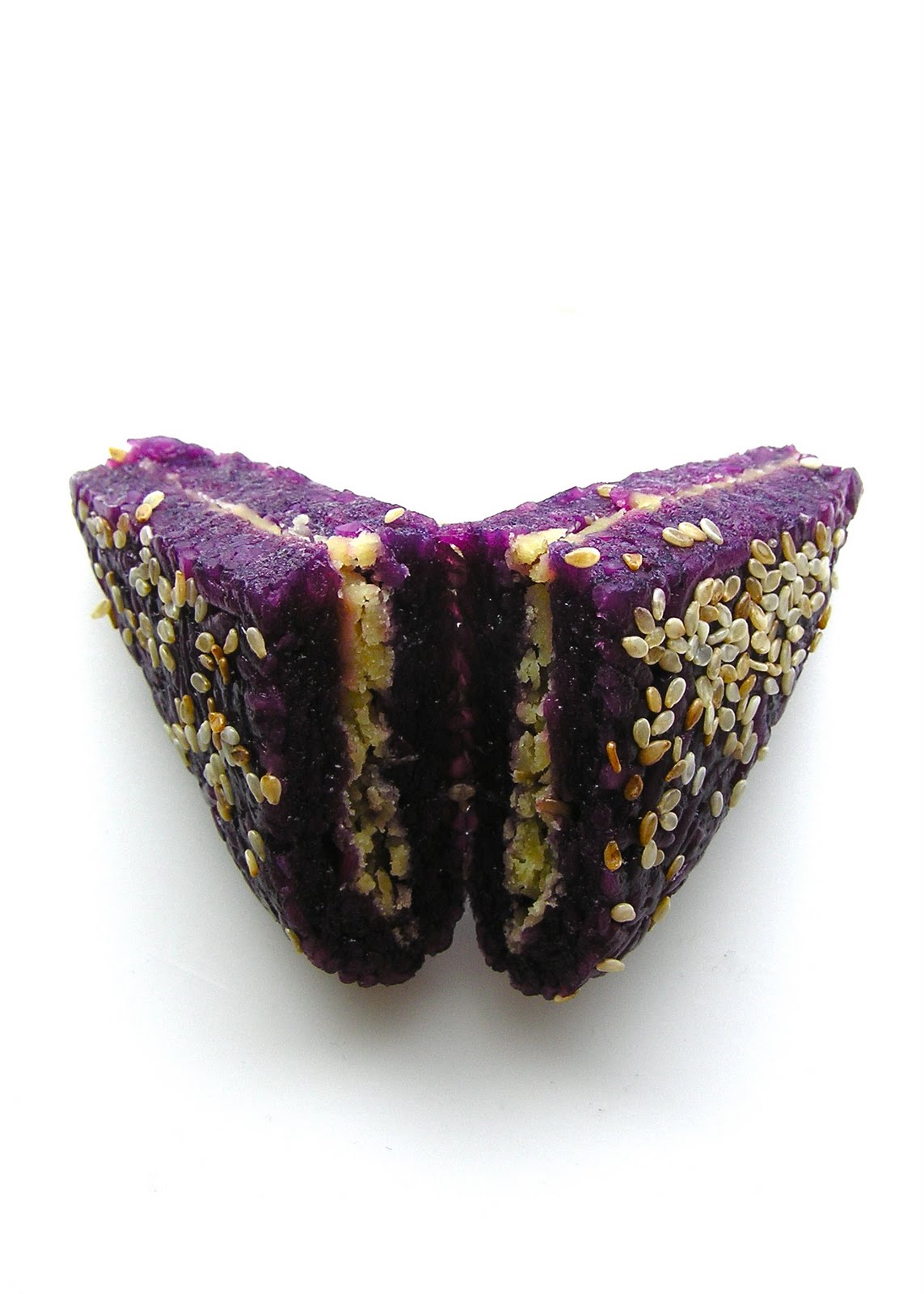
I think that one of the most relevant measures of human ingenuity is the number of delicious ways in which we as a species manage to combine beans and rice. To that long list add xoi vi la cam, a Vietnamese sweet sandwich (and close cousin of xoi nep than).

A thin, crumbly layer of sweetened mung beans is held in place by chewy slabs of sticky black rice, which turns an intense violet color when cooked. Because of its pigmentation, black rice is up for membership in the fabled "superfood" club--but more importantly, it has a rich, nutty flavor that brings out the soft sweetness of the beans. A sprinkle of toasted sesame seeds on the surface adds crunch and more nuttiness.

Sunday, January 23, 2011

Suikanshuku


Suikanshuku
Minamoto Kitchoan

Persimmon season in Japan is much like zucchini season in parts of the US. In a good year, growers will have such a surplus that it becomes almost a curse, and they resort to ingenious means to deal with it. At one of the schools where I taught in Tokyo, we often found that a silent, anonymous persimmon fairy had left sacks full of ripe fruit in the waiting room while our classroom doors were closed for lessons.

There is a moment during which a fresh persimmon is sweet and juicy; before it they taste like sour dish soap and after, like insipid mush. There is, however, a laborious and specialized process that extends and magnifies that delicious moment, resulting in dried persimmons known as hoshigaki that are so succulently sweet they seem almost to have been glaceed. The ripe but firm fruit is peeled and suspended by its stem from a rack in open air. Over the course of several weeks, the fruit is massaged every few days to tenderize the pulp and prevent it from becoming tough and leathery. As the hoshigaki cures, the fruit's natural sugars migrate to the surface and crystallize, forming a delicate second skin.

Minamoto Kitchoan's Suikashuku is a premium seasonal confection that features a hoshigaki stuffed with white bean paste and coated in red bean paste. The persimmon stem protrudes from the bean paste skin, and the whole thing is dusted with granular starch that evokes the dried fruit's natural bloom. It's a delectable trompe l'oeil--the mellow sweetness of the bean paste tempering the intensity of the fruit and coaxing from it a pleasant tartness.

Slow Food USA has more on hoshigaki, including information on a growing number of US producers.

Wednesday, September 22, 2010

Moon Cake


Mini Mooncake
Mon Hei, $1.40


The Chinese Mid-Autumn festival has its roots in an ancient imperial practice of making special offerings to the moon every autumn. In the year 420, the date for observing this festival was set as the 15th day of the 8th lunar month.

Pastries known as "mooncakes" are now so strongly associated with the Mid-Autumn Festival that it is perhaps better known by the name "Mooncake Festival". Friends and family share the rich golden pastries when they gather to admire the moon.

A typical mooncake is round or rectangular, with a pastry crust baked golden and shining with oil. On top there is an embossed design, usually auspicious characters or a commercial logo framed by a decorative border. The most traditional fillings are dense, rich pastes based on ingredients such as lotus seeds, jujube fruit, or red beans. The salted yolk of a hard-boiled duck egg is often baked into the center; when the pastry is sliced open, the yellow yolk appears like the moon emerging from clouds.

Changing tastes and the tradition of giving mooncakes to clients and business associates have spurred ongoing innovation and experimentation. It is now possible to find modern mooncakes made with almost any kind of novel or luxury ingredient, or suitable for any type of dietary restriction.

Like so many sweets that began as special occasion treats, mooncakes are now available year-round. In the the weeks leading up to the Autumn Festival, they seem to be everywhere; a brightly colored mooncake gift bag or box becomes a de rigeur accessory in certain parts of town. I bypassed the glitzier mass-produced and packaged mooncakes in favor of Mon Hei, the oldest Chinese bakery in Seattle's International District. At Mon Hei, several sizes of mooncake are availble with either lotus seed or bean paste filling, and either eggless or with up to 3 yolks inside.

Thursday, September 16, 2010

Hyogo Confectionery Event


Yūgiri
, or "Lonely Tranquility"
Kobe Fugetsudo

On September 15th, the Ellis Pavilion at the Seattle Mariners' Safeco Field played host to a very unusual meeting: "A Special Presentation of Wagashi/Senbei Japanese Confectionery and Japanese Culture".

One of the things that I get from Japanese confectionery surprisingly often is a sense of being in the right place at the right time; this is a prime example. I happen to live in a state, Washington, that has partnered with the Japanese prefecture of Hyogo as "Sister States" since 1963. Seattle is "Sister City" to Kobe, Hyogo's largest city and an active port. Kobe is renowned in Japan for producing Japanese sweets with a European twist, a reflection of its earlier role as a designated center for international trade.

For several years, a trade group known as the Hyogo Confectionery Association has been working to promote Hyogo-made wagashi to new audiences. Their foray into Seattle was timed to coincide with a visit from Ichiro Fujisaki, Japan's Ambassador to the U.S.

So how did I find out about their "Special Presentation", much less manage to get on the guest list? I happen to be having a show of wagashi photos of here in Seattle, and, more or less on a whim, I thought to send an announcement to the Japanese consulate, not really expecting to hear anything. The consulate responded with an invitation to the event. Like I said: right place, right time. And then they gave me a gift bag along with my nametag, and I was over the moon.

The long, dim space was fitted with a row of tables covered in posters, brochures, souvenirs, and displays of sweets and rice crackers (below: white peach jellies in a presentation tray, and a beetle sculpted from sugar paste). Representatives of various Hyogo confectioners hovered behind the tables, answering questions and giving out samples.


The featured sweet, called "Lonely Tranquility" (top), was offered by confectioner Kobe Fugestu-do. One of Fugestsu-do's leading wagashi designers is also an expert on the thousand-year-old Japanese novel, The Tale of Genji; she spent several years creating a extensive collection of wagashi such as Yūgiri that reflect passages from Genji in both mood and detail:

"In the remote mountain retreat at Ono, the Princess IchijĹŤ-no-miyasu-dokoro quietly passes away. Her daughter, the Princess Ochiba-no-miya, is overcome with grief and loneliness at being left behind all alone in this world.

"Russet and white nerikiri-kinton is used here to express the distraught princess's loneliness. Tsubu-an is enclosed within. The single autumn leaf symbolizes the Princess Ochiba-no-miya, whose name literally means 'the Princess of the Fallen Leaf.'"

Each Yūgiri sweet was sculpted to order by confectioners from Kobe Fugetsu-do (below). They make the rough outer layer by pushing paste through a woven bamboo screen; the scraps are then pressed to the bean paste core with firm but gentle pressure.


The formal part of the presentation included remarks from Association officials ("Snacks and sweets, when shared, bring people together."), a slide show on wagashi, and a quick but rousing greeting from Ambassador Fujisaki, who lived in Seattle as a teenager and clearly still has a lot of affection for the place. There were also demonstrations of tea ceremony (below) Nihon Buyo dance, koto, and marimba.


Sunday, August 8, 2010

Tokaragashi V


Tokaragashi V

Since I bought Tokara's seasonal wagashi at almost the same time last year, this box gave me the pleasure of recognizing an old favorite along with the thrill of discovering two new delights.

I was too slow to check Tokara's website for the correct names and descriptions, so apologies for being a bit vague. The modernist flower (above) was soft, translucent mochi, decorated with petal marks seared in by a branding iron and tiny cubes of kanten jelly for abstract drops of morning dew. Inside, a black sesame paste--pungent, dry, and velvety as halva.


A bundled-up bamboo leaf unfurled to reveal a fu manju (above), a dumpling of steamed wheat gluten, flavored with grassy yomogi and tucked around a core of sweet, chunky red beans.

Last but not least, the "old friend", Gourd (below): matcha-flavored white bean paste inside a molded kanten jelly textured with crushed, cooked rice.


To see more of Tokara's beautiful creations:
Tokaragashi I
Tokaragashi II
Tokaragashi III
Tokaragashi IV

Monday, May 10, 2010

Tokaragashi IV


Tokaragashi
Tokara, $10/3

The May "
touryanse" assortment of Kyoto-style wagashi from Seattle's Tokara sweetshop: 

"Azalea" (above) is white kinton tinted with green tea, filled with chunky bean paste. 


"Iris" steamed cake of rice and yam with a smooth red bean paste center; the design is applied with a tiny branding iron.


"Violet's Whisper"  is thickened bean paste wrapped around a ball of smooth red bean paste.   

Wednesday, April 7, 2010

Umai-do Update


In the year since I had my first, addictive taste of Umai-do's homestyle Japanese sweets, I've been keeping a hungry eye on this young business. My article on Umai-do's proprietor, native Seattleite Art Oki, appeared in the January/February issue of Edible Seattle magazine; if you weren't able to catch it in print, the full text is now available on Edible Seattle's webpage.

While the Umai-do storefront isn't yet open, renovations are coming along, and in the meantime Oki is happy to take special orders. You'll also have a chance to enjoy Umai-do products at Seattle Center's Cherry Blossom Festival, April 16-18. Try the "pink" manju (above), a delicate dumpling of homemade white bean paste wrapped in fresh mochi, or any of the other treats pictured on my original post.

Umai-do
3046 South Dawson St.
Seattle, WA
206/850-5306

In search of other tasty posts? Check out Wanderfood Wednesday!

Wednesday, March 24, 2010

Setsuko Pastry


Green Tea and Cream Mochi
Setsuko Pastry, from $3

For two years, Osaka native Setsuko Tanaka has been supplying Seattle with the sort of Japanese-inflected French pastries that have become so popular in Japan (as well as in France). When she moved to Seattle 6 years ago, Tanaka hungered for treats she couldn't find: fresh Japanese sweets, light French desserts, and something in-between.  Having studied wagashi and pastry in Japan, Tanaka began to make the sweets she craved.  Gradually, her hobby became a new career.  

The featured sweet for March provides a great introduction to Setsuko Pastry's products.  The green tea and cream mochi (pictured above) is a delicate hybrid of East and West, old and new.  The mochi gets its verdant color from a generous amount of green tea, while the red bean paste filling is lightened by a non-traditional layer of whipped cream; the finishing touch is a preserved cherry blossom.  Like all Setsuko pastries, the green tea and cream mochi is fresh, made from scratch, and free of preservatives.  

The dessert platter pictured below displays some of the other items on Setsuko's menu:  a Mont Blanc topped with red bean paste and pureed candied French chestnuts, a green tea "rare" cheesecake, a syrup garnish made from a dark Japanese sugar, the green tea mochi, and two rounds of black sesame shortbread.

Setsuko pastries are currently available at Shun, Village Sushi, Issian, Kozue, Root Table, and the Panama Hotel.  Contact Tanaka via her website to be notified of monthly specials.  She also accepts special orders for birthday and wedding cakes, with vegan options available. 

Setsuko Pastry
206/816-0348

Hungry for more?  Check other food- and travel-related posts over at Wanderfood Wednesday


Tuesday, March 16, 2010

Sakura Daifuku


Sakura Daifuku

To understate the obvious, cherry blossoms are a big deal in Japan. Every spring newspapers and tv programs deliver breathless up-to-the minute reports on the best viewing spots. Photographers offer tips for capturing all that fluttering beauty on film. Friends and co-workers camp out to secure the best spots for ohanami (flower viewing parties), enjoying picnic lunches and sake (and sometimes portable karaoke) under canopies of frothy, pale pink blossoms.

But there's also a somber side to this blossom worship. As the short sakura season wears on, every puff of wind releases showers of loose petals, which drift like tenacious snowflakes onto the picnics and parties below. Short-lived sakura are a reminder of mortality (albeit a fluffy, pink reminder) and therefore a traditional favorite of samurai, yakuza, and all those who aspire to a short, beautiful life.

Every year around this time the global wagashi purveyor Minamoto Kitchoan sells sakura daifuku, little balls of white bean paste wrapped in mochi that has cherry blossom petals mixed into it. The petals infuse the mochi with a delicate but unmistakable perfume. It might not be one of the loveliest Japanese sweet, but it's one of my favorites.

Since I'm nowhere near a Minamoto right now, I decided to try making my own. While it's hard to harvest petals without feeling like a scoundrel, I quashed my guilt by wandering the long way home and taking a single blossom from each tree I passed. At home I rinsed them and separated the petals from the stamen and calyx (I guessed that these would be unpleasantly crunchy).

For the outer casing, I cooked up some short grained sweet rice (mochigome), then worked it over with a potato masher until it became a coherent but lumpy mass (having seen how much labor goes into real mochi, I hesitate to apply the term to my mush). Then I stirred in a little salt and sugar, a touch of beet food coloring, and a handful of petals. I formed my shiroan into small balls and encased each one in the rice paste, then topped each ball with a single petal.

I put a few in the freezer to taste when my diet is over and I can eat sugar again, and distributed the rest to friends.  Mmmm, mortality.  

Sunday, February 14, 2010

Happy Valentine's Day!!


Happy Valentine's Day to you and yours! As a token of my regard, here's a little wagashi bouquet made from homemade shiro-an and beet-stained nerikiri. I pressed each ball into a mold carved to look like a peony bud on the cusp of blooming, and dotted the buds with with kanten dewdrops.

And the black sesame seeds? While I was looking up pictures for the mold, I was surprised to see many peony buds crawling with ants--the suggestion of which makes my skin crawl in sympathy. Digging a little further I learned of an "old gardeners' tale" that says the ants actually encourage the buds to open.

I decided to throw in a few ersatz ants because I can't think of any better Valentine's wish than this: whatever temporary discomforts you may be experiencing, I hope that they will help you, in the end, to bloom bigger and brighter than ever!

Wednesday, January 20, 2010

Kyung-dan


Kyung-dan
Uwajima, $3.19/15

Teeth still on edge after several disappointing purchases of grocery store sweets (eg
choco coffee mochi, banh xu xe), when I spotted the Uwajimaya superstore's display of Korean cakes, I almost kept walking. Something snagged my attention though--the colors? the textures? a whiff of cinnamon escaping the plastic-styrofoam trays?--and I lingered long enough to realize that these rice cakes were fresh and tender, not the thawed blobs I was expecting.

I chose a pack of small round
kyung-dan (also spelled gyung-dan), dumplings made of boiled rice flour dough (much like Japanese shiratama dango). They were filled with an impeccably smooth red bean paste and rolled in five different but equally delicious toppings: confectioner's sugar, black sesame, two kinds of bean powder, and cinnamon.

Kyung-dan are among the many Korean confections manufactured at Han Yang Oriental Food in Lakewood, Washington (yep,
that Lakewood) and sold in Asian markets around the Pacific Northwest. Judging from this cooking lesson, they're also reasonably easy to make at home.

Han Yang Oriental Food Mfg
3819 94th St.
Lake Wood, WA 98400

Tuesday, September 15, 2009

Banh Xu Xe


Banh Xu Xe
Oaktree Market, $1.99/4

I try not to poke fresh produce, but since squishy treats won't bruise, I prod the little darlings with impunity until I find the tenderest batch on offer. Although I gave these banh xu xe a thorough once-over, the texture was a big disappointment. The padanus-tinted tapioca flour exterior was unpleasantly rubbery--just on the edible side of chewing on a fishing lure. Since another on-line review described banh xu xe as "jelly-like" (and "amazing" and "addictive"), I'm willing to belive that my experience wasn't typical. More likely the trip from Mai's Bakery in Montery Park, CA to the Oaktree Grocery in Seattle, WA didn't do the texture any favors. The paste inside was a tasty blend of mung bean, coconut and vanilla; I managed to think of the green part as just a disposable wrapper.

Banh xu xe appears to be a close relative of banh phu the, a sweet with very particular role in tradtional Vietnamese culture. Because the cakes' sticky texture is considered to symbolize the tenacious bonds of marriage, banh phu the can be given as part of a marriage proposal, distributed to announce an engagement, exchanged by new in-laws, or served at a wedding. The name refers to a tiny origami box folded from fresh coconut leaves for each cake; ideally, the box, lid, and cake should be a perfect fit.

Vietnam-beauty.com has a recipe for a cake that looks almost exactly like my banh xu xe, but calls for entirely different ingredients. Hmm...

Thursday, August 20, 2009

Xoi Nep Than


Xoi Nep Than
Mekong Grocery, $1.65

I recently took a joyride on Seattle's new light-rail train, which currently runs from downtown to almost Seatac airport (the airport terminal is due to open soon, followed by more northern stations). It was a great ride--smooth enough for my creaky bones, but bumpy enough to delight David, a talkative 12-year-old fellow joyrider seated across the aisle (he was so adorably excited to take his first train trip that he high-fived the ticket inspectors).

Somehow rocketing along either far above or far below ground level messes with my internal map, so it wasn't until the trip back towards town that I realized the Mount Baker station is mere blocks from one of my favorite Asian shops, the Mekong Rainier Grocery. When I was housesitting in the neighborhood several years ago I made almost daily trips for single-serving portions of spongy duck egg custard, cut in thick golden slabs and laid across a little bed of black sticky rice cooked with coconut milk.

Alas, things have changed. The Mekong is bigger and more bustling, but the slabs of custard are no more. The salesgirl I asked said that it just didn't sell well enough (starting the moment my housesitting gig ended, presumably). So I had a pack of xoi nep than instead; the same mass of coconut black rice, but topped with a schmear of sweetened mung bean paste and sprinkled with flaked coconut. Not quite as luscious as custard, but good enough fuel for a train trip.

Mekong Rainier Grocery
3400 Rainier Ave S
Seattle, WA