skip to main |
skip to sidebar
Omanju
Behind the Museum Cafe, $2.75
Certain things about the Pacific Northwest have helped generations of homesick Japanese visitors and settlers to feel more at home: the stands of tall, dark cedars, the intricate coastlines with little islands emerging from blankets of haze, the familiar grandeur of Mt. Rainier or Mt. Hood.
Now add to that Portland's Behind the Museum Café.
In the neighborhoods where I lived and worked in Tokyo there was almost always at least one gem of a coffeeshop. While they varied wildly in style and size, all tended to be tricky to find and strongly atmospheric, with an unusual selection of carefully prepared drinks and food.
Behind the Museum fits that description--except for it's relatively prominent location in back of the Portland Art Museum. It's a narrow, high-ceilinged room in a modern glass highrise; a selection of Japanese antiques and contemporary crafts adds warmth to all that chrome.
Owner Tomoe Horibuchi was a cafe manager and culinary instructor in San Francisco before feeling the pull of the Pacific Northwest. She's dedicated to cultivating a space that's more than just a cafe, offering exhibition opportunities to artists, tables large enough to accommodate small group meetings, and regular demonstrations of Japanese traditions such as the incense ceremony and calligraphy.
The cafe serves tea, locally-roasted coffee, Japanese beer and sake. Appetizers and small meals are made in house, with organic ingredients wherever possible. In addition to cookies and pastries, Horibuchi handmakes fresh Japanese confections such as the manju of the day above: a small, soft bird filled with smooth red bean paste and flavored with toasted soybean powder.
Behind the Museum Cafe
1229 SW 10th Ave
Portland, OR
503/477-6625

 Umai-doIf you're in the ID or the CD today, be sure to stop by and try some fresh manju at the grand opening of Umai-do, Seattle's newest purveyor of Japanese sweets. Want the backstory on the shop or owner, Art Oki? Check out my article, "The Japanese Snickerdoodle", published last year in Edible Seattle Magazine. Umai-do1825 S Jackson206/325-7888Wednesday - Saturday: 9am-6pmSunday: 9am-4pm
 In the year since I had my first, addictive taste of Umai-do's homestyle Japanese sweets, I've been keeping a hungry eye on this young business. My article on Umai-do's proprietor, native Seattleite Art Oki, appeared in the January/February issue of Edible Seattle magazine; if you weren't able to catch it in print, the full text is now available on Edible Seattle's webpage.While the Umai-do storefront isn't yet open, renovations are coming along, and in the meantime Oki is happy to take special orders. You'll also have a chance to enjoy Umai-do products at Seattle Center's Cherry Blossom Festival, April 16-18. Try the "pink" manju (above), a delicate dumpling of homemade white bean paste wrapped in fresh mochi, or any of the other treats pictured on my original post.
Umai-do
3046 South Dawson St.
Seattle, WA
206/850-5306

If you are in Seattle, please check out my article, "The Japanese Snickerdoodle: Art Oki and Umai-do Manju Bakery" in the January/February issue of Edible Seattle magazine. In it I profile Art Oki, a fellow wagashi enthusiast forging a second career in home-style Japanese sweets (above, his dorayaki, kinako manju, and imogashi). At some point the issue will also be available online, and I will be sure to post the link. 3/4/10 update: This article is now available on Edible Seattle's webpage.

Day thirty-nine: Sake Manju
Owari Seto, ¥105
From its clay-seamed soils to retaining walls built of retired kiln shelves to the faux-bronze pottery bell hanging in a local temple, the town of Owari Seto is totally ceramic-centric and the perfect home base for my friend, ceramicist Shozo Michikawa.
Following a memorable lunch at a restaurant that looked and felt like somebody's living room, Shozo and his wife treated me to sake manju for dessert. Although there are many variations, manju are typically steamed or baked stuffed buns of leavened flour dough; they may be sweet or savory, hot or cold.
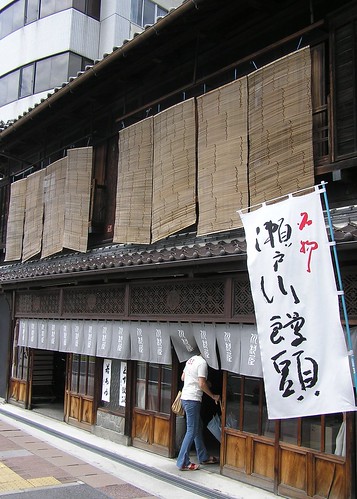
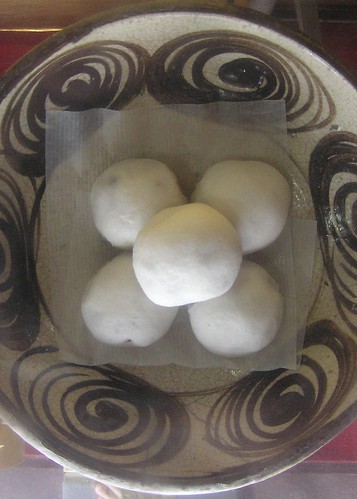
In this case, the pale and puffy buns were stuffed with bean paste and delicately flavored with sake. They came from a local specialist bakery; the shop premises are 90 years old, but the business dates back to the late Edo period and is currently run by the 6th generation proprietor. Thanks to reed screens over the windows the interior was cool and dim, lined with old display cases of worn wood and smoked bamboo, filled with prime examples of local pottery and seemingly lit from within by panels of old gold leaf. This being Owari Seto, even the manju case became a ceramics showcase; the stack of sweets shown below rest on a local dish decorated with a classic uma no me ("horse-eye") design.