Showing posts with label Seattle. Show all posts

Thursday, December 19, 2013

Buttermilk Pie


Mini Buttermilk Pie
Emerald City Fish and Chips, $2

At Emerald City Fish and Chips, the emphasis on Southern style and family recipes extends from the entrees to the desserts.  An in-law bakes the four-bite mini pies, filled with either sweet potato or a rich, sweet, golden custard that the name "buttermilk" doesn't quite do justice to.

Emerald City Fish and Chips
3756 Rainier Ave S
Seattle WA
206 / 760-3474


Sunday, November 17, 2013

Pie in a Bowl

 
Pie in a Bowl
Skillet, $6

Acknowledging that baking pie filling inside a pie shell isn't always worth the risk, Skillet takes a surer route to satisfaction by cooking the components separately.  Not until you place an order for "pie in a bowl" do the tender chocolate pudding and shards of perfectly cooked crust come together in the eponymous bowl, where their sweetness is balanced out by a smattering of sea salt and bitter cocoa nibs. 

Monday, November 11, 2013

Nab Vam


Nab Vam 
Seattle Center's Hmong New Year, $2

Food is a big component of Hmong New Year or Xyoo Tshiah, the only major holiday observed throughout the Hmong diaspora.  There's pork in several formats, there's a spicy salad of pounded green papaya, there's the chewy confection ncuav, a mochi cousin made from pounded sticky rice.

And there's nab vam, a dessert-drink hybrid so colorful it rivals the appliqued costumes worn by many of the young celebrants.  Although nab vam is often translated as "three color dessert," the variety of textures in each cup is at least as important and often more numerous.  As Sami Scripter and Sheng Vang explain in their excellent Hmong cookbook, Cooking from the Heart, "Westerners are  used to solid and liquid food being separate.  That is not so for the Hmong (and Asians in general), who delight in a variety of slippery, crunchy, chewy, and watery sensations all happening in the same dish.”

Nab vam's textural delights usually include crunchy crushed ice, runny caramel syrup, unctuous coconut cream, slippery strings of rice flour jelly, and bubbly balls of "frog egg" tapioca.  Extras might include crisp water chestnuts, soft-cooked beans, or juicy bits of chopped fruit.  How popular is it?  Scripter and Vang's standard recipe makes 40 servings.    

Sunday, October 6, 2013

Hrustule


Hrustule
Seattle Center's CroatiaFest 

Crackly, deep-fried hrustule cookies are a Croatian favorite, popular at Christmas and other happy occasions.  The cookies are simple strips or twists of thin dough, which, depending on the family, may be flavored with combinations of vanilla, rum, whiskey, anise, orange, or lemon. 

 
But although hrustule are simple to make, they are time-consuming and labor intensive.  For Seattle Center's CroatiaFest, members of the Martinis family demonstrated skills honed over many years of working together to make huge batches of holiday hrustule.  

First the cousins demonstrated blending the dough in a standing mixer, adding flour a little at a time until just the right texture is achieved, then rolling it so thin that the pattern of the tablecloth underneath shows through.  They used a serrated pastry wheel to cut the dough into strips, and before dropping the strips in hot oil, gave each strip a gentle stretch to make a little thinner--and so a little crisper.  Out of the fryer, the cookies are drained on paper tools, then sprinkled with powdered sugar once cool. 


Other booths sold fresh palacinke (Croatian crepes), and slices of povitica, a sweet bread swirled with nuts, cinnamon, and chocolate. 

Friday, August 2, 2013

Seafoam


Seafoam
Boehm's Chocolates 

Isn't science wonderful?  The same volcanic combination of vinegar and baking soda that I rely on to de-gunk my drains gives seafoam candy its distinctive honeycomb texture.  Molasses adds a rich depth to the flavor and a dark chocolate coating seals in the foamy freshness so each bite is crisp and crunchy.  

Boehm's Chocolates
255 NE Gilman Blvd, Issaquah, WA 98027
425 / 392-6652

Thursday, July 18, 2013

Karume


Karume
Daiso Japan, $1.50

Thanks to Daiso, the Japanese "dollar" store, you can try a treat that would have been familiar to children living in Japanese cities more than 100 years ago.  

Karume are feather-light hard brown lumps with hexagonal sides and ravaged-looking tops.  Pop one in your mouth for a rather straightforward brown sugar flavor and a comparatively intricate textural experience:  the porous sweet slowly erodes from the inside out and collapses in on itself in a jumble of shards and syrup.  

Karume are a kind of dagashi, a category of "cheap sweets" that became popular among urban children during Japan's Meiji period, when increased foreign trade made sugar affordable for the masses. 

According to Eric Rath in Food and Fantasy in Early Modern Japan, the historic precursor to our modern factory-formed karume was called karumeyaki, and it was then as much as taste of the future as karume is now a taste of the past.  Although the -yaki suffix is more usually attached to something that has been cooked or grilled, these candies get their bubbled appearance and hard shell from a chemical reaction caused by the addition of baking soda--an ingredient first introduced to Japan in the Meiji period.

This reaction is so spectacular that a university handout I found characterizes karume-making as a science experiment rather than a recipe.  In essence, you beat egg whites to a soft froth, stir in baking soda, then combine the egg with melted brown sugar.  The mixture foams furiously, and the bubbles can be hardened by cooking over a gentle flame. 

Wednesday, July 17, 2013

Xôi Lá Cẩm II


Xôi Lá Cẩm
Lam's Seafood $1.50


More usually bright purple from the addition of magenta plant leaves, xôi lá cẩm is a sweet-and-savory Vietnamese snack of tinted glutinous rice topped with shredded coconut, toasted sesame seeds, velvety mung bean paste, and salt.  A taco-like format makes this particular variation a little more user-friendly by encasing the extremely sticky steamed rice in an edible rice flour wafer. 

Saturday, July 13, 2013

Makowiec


Makowiec
Seattle Center Polish Festival, $2

From the dozen-plus temptations on the Polish Festival's dessert table, I chose a fat slice of makowiec, a bready roll coiled around poppy seed paste filling as dense and dark as asphalt, topped with slivered almonds pasted down with royal icing. 


Saturday, June 22, 2013

El Zocalo Tortas and Bakery

 
El Zocalo

The nice young woman behind the counter warned us that the tortas might be bigger than we were used to, but I was skeptical.  Minutes later, I learned my lesson: biggest Mexican sandwich ever = no room for dessert.  

It hurt even to look at the racks of fresh cakes, cookies, and breads surrounding the dining room.  And I'm not the first to feel that way, judging by the fact that El Zocalo pre-packages to-go cups of its tres leches, diced cake soaked in evaporated and condensed milk, mixed with pineapple chunks and strawberry gel, topped with whipped cream, sprinkles, and a strawberry:  dessert for the road.

El Zocalo Tortas and Bakery
701 S 38th St
Tacoma WA 
253/474-9000 

Tuesday, June 18, 2013

Valerios


Ube Halaya
Valerio's Tropical Bakeshop, $6.50

When you've grown up associating bright colors with bland sweetness (think cupcake sprinkles or grocery store frosting) the riotous colors at Valerio's Tropical Bakeshop are unexpectedly flavorful.  The golden yellow that makes rolls and pies shine like small suns comes from shreds of cheese, pats of butter, or salted egg yolks.  Shades of green are contributed by leaves including bamboo (used as wrappers) and pandanus (most often used as an extract), both of which impart an exotic aroma.  The root vegetable ube is an intense shade of purple that makes ube-based treats like ube halaya pudding ($6.50) a visible and indispensable feature of special occasion buffets. 


Putsinta ($1.99/4) are Valerio's mash-up of two Filipino favorites:  soft, fluffy puto rice-flour rolls and and chewy kutchinta rice cakes.  Here the purple marbling comes from festive food coloring, rather than actual ube.  


Maruya ($1.25) are fritters of ripe mashed banana, fried until golden and dusted with sugar. 


The addition of lye water gives the sticky rice in suman sa lihia cakes ($1.50) a creamy color and extra-chewy texture; enfolding the rice in bamboo leaves before steaming adds aroma and a tidy, environmentally-friendly wrapper that makes suman a cinch for picnics (like the cemetery-side meals enjoyed during the Undas holiday).  

Valerio's rainbow-colored offerings also include pan de sal, biko, ensaymada, buko pie, egg pie, cassava cake, and sapin-sapin.  

Valerio's Tropical Bakeshop
1368 Southcenter Mall Ste 150
Tukwila WA
206/246-6166


Sunday, June 9, 2013

Budapest Bistro and Schnitzel House


Cheese Pocket and Almond Cookie (top)
Cheese Strudel (below)
Budapest Bistro and Schnitzel House

Growing up in Hungary in her grandparents' home taught Elizabeth Muszka a particular kind of self-reliance.  Since there wasn't much money to spare on restaurants or fancy ingredients, Elizabeth learned young that in order to eat well, they had to cook well. 

Today the owner of Mukilteo's Budapest Bistro and Schnitzel House specializes in Hungarian, German, and Gypsy dishes--and in cooking well.  Starting with traditional recipes and simple ingredients, Elizabeth lavishes attention on each item. 

The pastry case stuffed with fresh zserbo (apricot-walnut-chocolate pastry), dobos torte (layered sponge with chocolate and caramel), sour cherry cake, German chocolate cake, strudels (below), and cookies (above) is even more of a marvel when you consider that the strudel dough alone takes three hours to make.  


But for ex-pats who hunger for something other than home cooking, Elizabeth also stocks a large selection of packaged European candies and treats (below).   

Budapest Bistro and Schnitzel House
12926 Mukilteo Speedway
Lynwood WA
425/513-9846


Saturday, June 8, 2013

Hotteok and Bungeoppang


Hotteok and Bungeoppang
"Ho Duck" stall, $1 each

Look to the left as you enter the Boo Han Korean Market in Edmonds and you'll get one of the best deals in town on dinner and a show--assuming you can justify having waffles or pancakes for dinner. 

While you wait and watch, the cook in the "Ho Duck" stall crafts two of Korea's best-loved street-style sweets.  The eponymous hotteok (above) are crusty, golden pancakes of yeasted wheat and rice flours, filled with caramelized sugar and nuts.  It's a simple enough operation but made mesmerizing by the cook's practiced moves and enviable patience.  

The hotteok start out as a ball of sticky, bubbly dough.  The cook kneads it a little, then fills a dent in the center with a a mixture of brown sugar and crushed nuts.  He pinches the dough closed to seal in the filling, then uses a special metal tool to flatten the ball on a well-oiled griddle.  


Once the hotteok are underway, it's time to get going on the bungeoppang.  "Fish bread" is really more of a fish-shaped waffle, cooked a whole school at a time in fancy high-volume griddle.  To get exactly the right amount of batter, the cook spoons a little into each fish-shaped void, then tops it up with a seam applied with a squeeze bottle. 

On top of each batter cloud goes a dollop of sweetened red bean paste.   

Then the lid is closed up to seal the waffle around the filling.  As soon as the cook deems them ready, he uses a small metal hook to flicks them out of the iron and into a waiting box; it's not at all unusual to order six or a dozen at a time.  

Boo Han Korean Market 

22618 Hwy 99
Edmonds, WA
425/778-7400


Friday, June 7, 2013

Buko Pandan Polvorones


Polvorones
Aling Conching at Seafood City, $1.99/10

Based on a Spanish cookie named for its dusty texture, these Filipino polvorones are bite-sized blocks of compressed flour, milk powder, sugar, and butter, given a faintly tropical flavor with the addition of buko (young coconut) and pandan (screwpine) extracts. 

Friday, May 17, 2013

Bløtkake


Bløtkake
Nordic Heritage Museum, $4

In honor of the Syttende Mai constitutional holiday, many Norwegians work up an appetite by parading through the streets carrying the national flag, then sit down to a well-deserved slice of bløtkake, the beloved "wet cake" whose patriotic layers of white sponge, whipped cream, and strawberry jam echo two of the Norwegian flag's three colors. 

Friday, April 5, 2013

Xôi Sầu Riêng and Xôi Gấc


Xôi sầu riêng and xôi gấc
Deli Chu Minh, $1.75/each

Deli Chu Minh in Seattle's little Saigon neighborhood sells a variety of sweet and savory products featuring its own housemade tofu, as well as selected Vietnamese treats from local producers.  Made by Cô Thu Ba, these confections combine xôi, steamed sticky rice, with two potent flavorings. 

Golden yellow xôi sầu riêng is flavored with durian, the huge spiky fruit that's both a delicacy and an outlaw in Southeast Asia.  Known as "the King of Fruits" for its compelling flavor, it is also, in many areas, banned from hotels, buses, and subways due to its penetratingly fetid aroma. 

Rusty red xôi gấc also features a regional fruit.  An off-the-charts carotene content gives the pulp of the gấc or "baby" jackfruit an intense red color; the fruit stains any dish to which it is added (and also to the cook's hands, clothes, kitchen walls, etc.).  Because bright red is the color Vietnamese most associate with luck and celebration, xôi gấc is a staple of New Year's tables and wedding buffets.   

Deli Chu Minh
1043 S Jackson St
Seattle, WA
206/228-5449

Saturday, March 30, 2013

Honey Coconut Marshmallows


Honey Coconut Marshmallows
Sweet Coconut Bakery, $7.75/bag

A single bag of fresh honey coconut marshmallows from Hazel Lao's Sweet Coconut Bakery can cancel out a lifetime's reluctant memories of stale, chalky Stay Pufts.  Hazel uses honey instead of corn syrup, and dusts her marshmallows with velvety shredded coconut instead of cottonmouth-inducing starch.  The plus-sized squares are as plump as a toddler's tummy, meaning that you don't have to dissolve them in cocoa or melt them over a fire to render them edible. 

Saturday, March 23, 2013

Norwegian Heritage Day


Rømmegrøt
Leif Erikson Hall, $4

Although the programming at the annual Norwegian Heritage Day at Seattle's Leif Erikson Hall focused on parades, prizes, dances, and speeches, it was sometimes be hard to hear what was happening over the sounds of crispbreads being crunched, lutefisk being sampled, and spoons scraping the bottom of bowls. 

Visitors to the upstairs lunch buffet could cap off a light meal of soup and open-faced sandwiches with one of the most stupefying desserts ever created.  Rømmegrøt is literally "sour cream porridge," a soup of sour cream, whole milk, and butter thickened with flour, seasoned with salt, and dressed for the table with melted butter, sugar, and cinnamon.  It's an historic and traditional Norwegian dish, eat both as a meal in itself, and as a special occasion dessert.  

I could barely keep my eyes open after finishing my bowl, an one woman I spoke with suggested that might have been part of the point.  During Norway's short but glorious summers it was common practice to send young people out to country to keep an eye on the grazing herds.  Back in their camps for the evening, a bowl of sleep-inducing rømmegrøt served as dessert might have helped to discourage the young people from engaging in any late-night hanky panky. 


At the Kaffestua downstairs, a busy team of volunteers offered made-to-order Norwegian treats.  Lacy krumkake wafers ($.50/each) were cooked in a special iron, then wrapped around conical wooden forms while still warm and pliable. 


Another specialty iron produced Norwegian waffles ($.50/section or $2/whole) with a distinctive heart shape.  


Over at the lefse station, rounds of dough were rolled out paper-thin, griddled until puffy and covered in brown patches, then covered in butter, sugar, and cinnamon and rolled into tubes for convenient snacking.  

The volunteer pictured made it look so easy that I imagined she must have been making lefse since infancy--but not so.  She explained that rolling out the dough was considered by her family to be such an important task, it was only entrusted to the most mature and responsible women.  Her own grandmother refused to teach her the secrets of the rolling pin until she was married with children of her own. 

Thursday, March 21, 2013

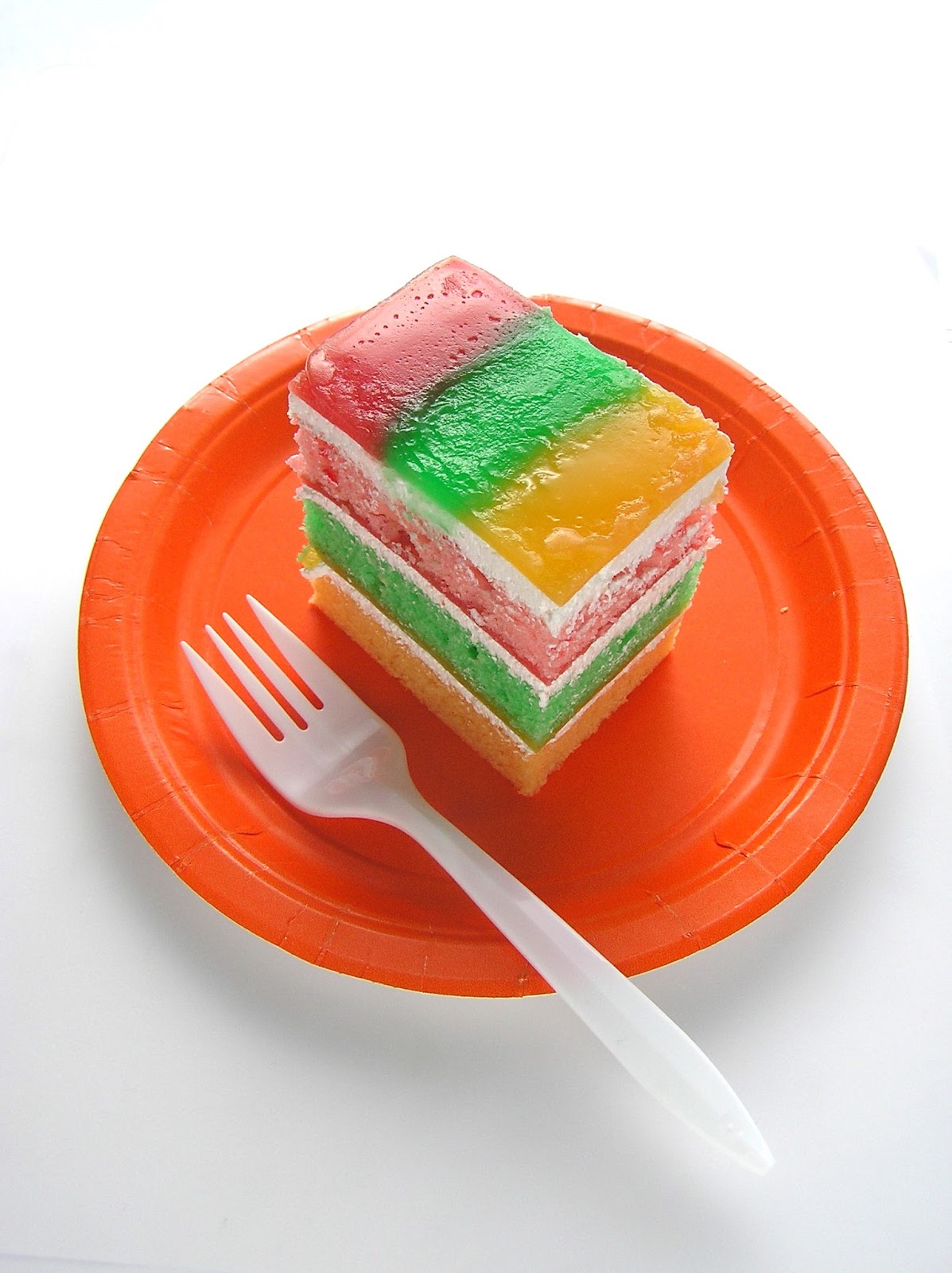
Cakes of Paradise


Rainbow Cake
Cakes of Paradise, $3.95/slice

Sink your fork into a little Aloha at either of Cakes of Paradise's two area locations.  Hawaiian baker Mary Buza-Sims' personal recipes were the starting point for this family business now run by her nephew and two sons.  The light, flavorful cakes feature tropical flavors like pineapple, passion fruit, and coconut.  Three-layer Rainbow Cake combines strawberry, lime, and orange cake, with guava, lime, and passion fruit topping.  You can pick up a slice or order a full sheet, which comes decorated with a fresh orchid. 

Cakes of Paradise 
Georgetown
6322 6th Ave S
Seattle, WA
206/763-1151

East Valley Business Park
281 SW 41st Street
Bldg # 13 East
Renton, WA
425/282-4972

Sunday, February 17, 2013

Tet Treats


Banh Kep La Dua (above)
Hue Ky Mi Gia, $1.50

Che Ba Mau (below)
Hue Ky Mi Gia, $3.00

Originally opened in Saigon in 1959, the Hue Ky Mi Gia noodle restaurant now has a massive menu and two Seattle-area locations--but only at a temporary stall at Seattle Center's Tet Festival does Hue Ky Mi Gia dish up these New Year's delicacies.   Banh kep la dua is special waffle that gets its color and aroma from the leaves of the screwpine or pandan plant.  Che ba mau is a drinkable dessert:  iced coconut milk with brown sugar syrup, red beans, and chewy green noodles made from rice flour and--again--that addictive pandan extract. 


Friday, December 28, 2012

Medovik Torte


Medovik Torte
European Foods, $7.49/lb

Although honey, sugar, and "sweetener" sit side-by-side on most coffee shop counters, each flavor represents such a different stage of human history that a book I'm reading distinguishes between the Ages of Honey, Sugar, and Science. 

The use of honey predates written history, and versions of honey cake are known from ancient Greece and Egypt.  In many parts of Europe, the baking of honey-rich breads and cakes was first associated with religious communities and then with regulated guilds.  In the middle ages in Slovenia, artisan bakers specialized in honey cake, and their daughters' dowries were barrels of cake dough with a 30-year shelf life.  

With the arrival of industrialization, sugar took a big slice out of honey's market share, but areas of eastern Europe have seen a recent revival of honey-infused foods.  The Czech or Slovakian medovnik is a decorated sweet bread, often heart-shaped and given as a sentimental gift.  The Polish miodownik or Russian medovik torte is sophisticated party fare; thin cakes of honey sponge spackled together with creamy caramel frosting and flocked with a fuzzy layer of its own crumbs.  

What these cakes have in common with each other and with those barrels of Slovenian dough is a remarkable longevity, thanks to honey's humectant and anti-bacterial properties.  Decorated medovnik bread harden into long-lasting decorations while mature medovik torte develops a richer flavor and more delicate texture--allowing Seattle's European Foods to import perfectly edible cake all the way from an East Coast bakery. 

European Foods
13520 Aurora Ave N
Seattle WA
206 / 361-2583