Day twenty-nine: Kawagoe
In his marvelous book Sweetness and Power, the historian Sindey Mintz shows how the demand for sugar shaped the political economies of Europe and the New World. Although Mintz doesn't discuss Japan, the little town of Kawagoe indicates that the link between power and sugar was just as strong here. Located outside Tokyo in Saitama Prefecture, Kawagoe is popularly known as "little Edo" (the previous name for Tokyo) and is hailed as a place where one can get an idea of what downtown Tokyo was like prior to the ravages of the last century.
Thanks to strong ties with the Tokugawa Shogunate and the establishment of a regional canal system Kawagoe became an early trading center. To protect the valuable wares passing through town, merchants petitioned for permission to build "fire-proof" kura storehouses like those in Tokyo, each with clay walls so thick that a kura could take 2 to 3 years to complete. Although the kura proved more vulnerable to fire than their builders had hoped, more Edo-era examples still stand in Kawagoe than in Tokyo itself. One kura that is now open as a museum was originally built to store one of the era's most valuable commodities: sugar.
The confluence of wealth, power, and trade was a boon for local confectioners. Kawagoe's most venerable confectionery house is Kameya, which was established in 1783 and served the Kawagoe fiefdom until the Meiji Restoration. Preserved company documents show that "extremely extravagant" confections were made during the boom times following the construction of the canals by the powerful Matsudaira clan. (Kameya's original premises now house the Yamazaki Art Museum, where the ¥500 entry fee includes tea and a rather nice monaka.)
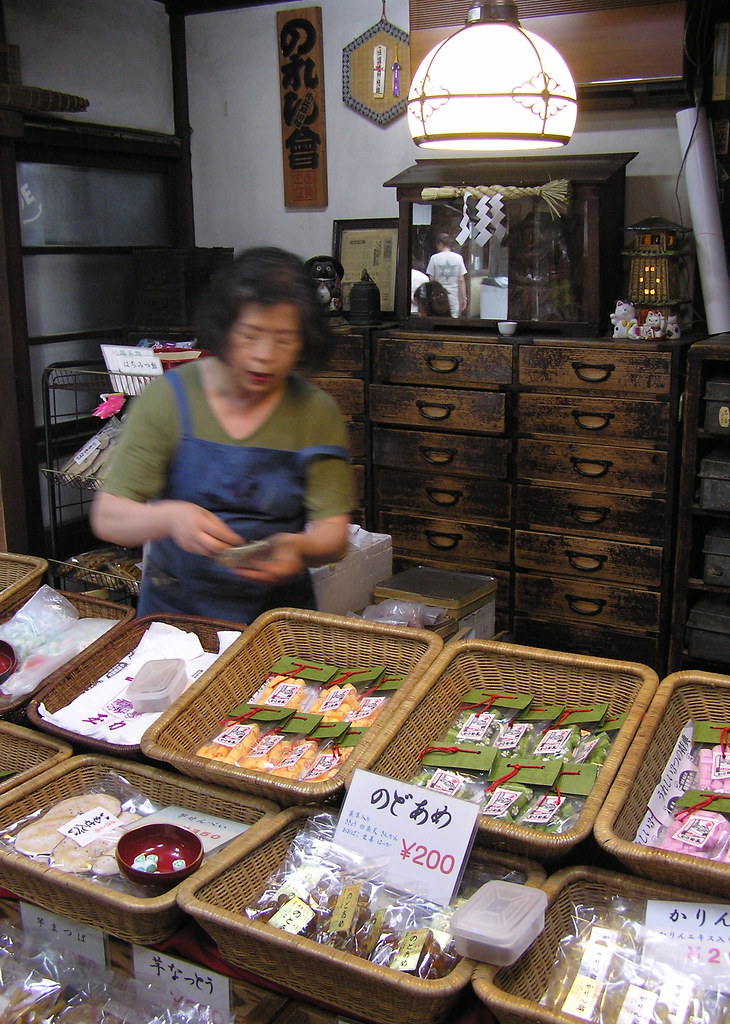
Kawagoe is particularly renowned for its sweet potato-based confections; fancy versions are available at Kameya and other high-street confectioners, but for sweet potato softcream or sugar-crusted sweet potato fries, tourists head to a winding side street known as Kashiya Yokocho, or Candy Alley. Door after door opens into shops like the one below, with drawers, baskets, and jars stuffed full of sweets that would make an Edoite's mouth water.