Showing posts with label Vietnam. Show all posts

Wednesday, July 17, 2013

Xôi Lá Cẩm II


Xôi Lá Cẩm
Lam's Seafood $1.50


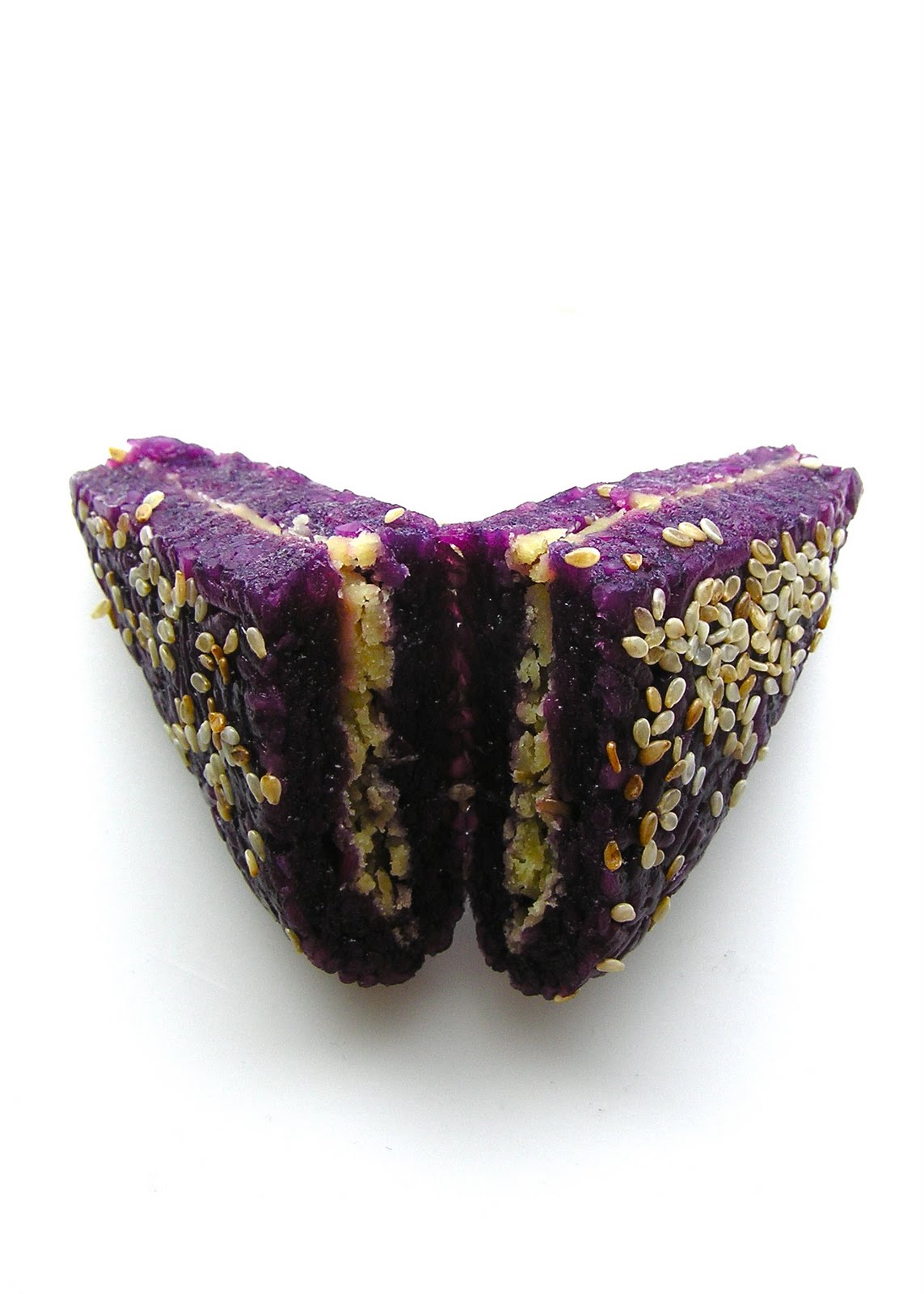
More usually bright purple from the addition of magenta plant leaves, xôi lá cẩm is a sweet-and-savory Vietnamese snack of tinted glutinous rice topped with shredded coconut, toasted sesame seeds, velvety mung bean paste, and salt.  A taco-like format makes this particular variation a little more user-friendly by encasing the extremely sticky steamed rice in an edible rice flour wafer. 

Friday, April 5, 2013

Xôi Sầu Riêng and Xôi Gấc


Xôi sầu riêng and xôi gấc
Deli Chu Minh, $1.75/each

Deli Chu Minh in Seattle's little Saigon neighborhood sells a variety of sweet and savory products featuring its own housemade tofu, as well as selected Vietnamese treats from local producers.  Made by Cô Thu Ba, these confections combine xôi, steamed sticky rice, with two potent flavorings. 

Golden yellow xôi sầu riêng is flavored with durian, the huge spiky fruit that's both a delicacy and an outlaw in Southeast Asia.  Known as "the King of Fruits" for its compelling flavor, it is also, in many areas, banned from hotels, buses, and subways due to its penetratingly fetid aroma. 

Rusty red xôi gấc also features a regional fruit.  An off-the-charts carotene content gives the pulp of the gấc or "baby" jackfruit an intense red color; the fruit stains any dish to which it is added (and also to the cook's hands, clothes, kitchen walls, etc.).  Because bright red is the color Vietnamese most associate with luck and celebration, xôi gấc is a staple of New Year's tables and wedding buffets.   

Deli Chu Minh
1043 S Jackson St
Seattle, WA
206/228-5449

Sunday, February 17, 2013

Tet Treats


Banh Kep La Dua (above)
Hue Ky Mi Gia, $1.50

Che Ba Mau (below)
Hue Ky Mi Gia, $3.00

Originally opened in Saigon in 1959, the Hue Ky Mi Gia noodle restaurant now has a massive menu and two Seattle-area locations--but only at a temporary stall at Seattle Center's Tet Festival does Hue Ky Mi Gia dish up these New Year's delicacies.   Banh kep la dua is special waffle that gets its color and aroma from the leaves of the screwpine or pandan plant.  Che ba mau is a drinkable dessert:  iced coconut milk with brown sugar syrup, red beans, and chewy green noodles made from rice flour and--again--that addictive pandan extract. 


Wednesday, December 12, 2012

Vietnamese Almond cookies


Almond Cookies 
Huong Binh, $4/bag

Huong Binh's housemade almond tuiles are like fortune cookies let off the leash:  free-form pools of delicately flavored batter, topped with a pinch of sliced almonds, and griddled until perfectly golden and crisp. 

Saturday, August 18, 2012

Shave Ice


Shave Ice
Shabu Chic, $3

Come summer, communities throughout Asia and the Asian diaspora keep their cool by eating man-made snow piled with with their favorite toppings.  In Hawaii, "shave ice" is drenched in neon-colored syrups, while the Japanese cover their kakigori with stewed fruit, rice dumplings, beans, or green tea, the Chinese eat their baobing snowballs with "eight treasures" such as grass jelly or peanuts, and Filipino halo-halo features bright purple ube and decadent flan.  In almost every case, condensed milk is the favored final touch.  

At Seattle's Little Saigon Fest, restaurant Shabu Chic was offering its own take on the pan-Asian treat:  shaved green tea ice with strawberries, mango, and red beans, glazed with a touch of the ubiquitous condensed milk. 

Sunday, July 15, 2012

Bánh Bò Hấp


Bánh bò hấp
White Center Supermarket, $1.25 

 Bánh bò, or "cow cakes", are the Vietnamese version of a steamed rice cake that originated in China.  Bánh bò batter includes rice flour, coconut milk, sugar, and a leavener--traditionally yeast, but baking powder is sometimes used as a shortcut--which causes the batter to bubble dramatically when cooked.  The resulting texture is as spongy as beef liver, earning these cakes their unexpected name.  

Baked bánh bò nướng has a thin golden crust and is usually cut into wedges before serving.  Steamed bánh bò hấp are usually smaller, round, and colorful; natural extracts of pandanus or magenta plant produce pastel green or purple, whereas the neon hues of the banh bo pictured hint at artificial food coloring.  As sold in Seattle's Asian groceries, bánh bò hấp come snuggled onto a deli tray along with a tiny cup of creamy dipping sauce (coconut milk thickened with tapioca flour). 

White Center Supermarket
9828 15th Ave SW
Seattle, WA
206/768-8087


Friday, March 16, 2012

Chè chuối


Chè chuối

Tan Tan, $2

Strip malls and pudding have one great quality in common: they both remind me not to judge solely on appearances. In a nondescript strip mall in Vancouver, WA you'll find Tan Tan, a family-run restaurant serving fresh Vietnamese food and desserts so palpably homemade you could imagine a mom whipping them up to welcome her kids back from a hard day at kindergarten.

Chilling in a glass case by the door, the desserts mostly fall into the "
chè" category of soupy or pudding-like Vietnamese sweets. On any given day there might be cơm rượu (rice balls in sweet rice wine), bukopandan (a sweet tofu tinted green pandanus leaf), Vietnamese yogurt, chè bắp (sweet corn, sticky rice, and coconut milk), or chè đậu trắng (black eyed peas, sticky rice, and coconut milk). All the blobs, lumps, and cloudy liquids are prepacked into clear plastic cups.

Slightly greyish and pocked with dark splotches, chè chuối may not be much to look at, but like all great puddings it offers an experience all the more transcendent for being unexpected. Sweet-tart slices of fresh banana and succulent spheres of tapioca swim in thick, silky, sweetened coconut milk. Tan Tan even provides a garnish of crushed, roasted peanuts, thoughtfully packaged in a tiny ziploc bag so that they stay fresh and crisp until the moment comes to provide the perfect counterpoint to all that unctuous richness.

Tan Tan
Ste A3316 SE 123rd Ave
Vancouver, WA
360/892-3400

Tuesday, September 20, 2011

Keo Me Xung


Keo Me Xung

Coconut Tree Brand, $0.79

Another discovery from Seattle's pan-Asian Rising Produce grocery, keo me xung is a Vietnamese treat with no easy translation. The label suggests either "sesame cookies" as an English equivalent, or the French for "sesame confection" (confiserie aux sesames). Neither quite fits the bill.

The size and thickness of a large tortilla, keo me xung is a floppy sweet crepe made of whole toasted sesame, ground peanuts, and sugar. Tearing it into bite-sized strips reinforces a fleeting resemblance to sesame-studded gum, but the initial chewy resistance quickly disintegrates into a mouthful of barely-sweet glaze and pleasingly pebbly seeds.

Friday, June 10, 2011

Xoi Vi La Cam


Xoi Vi La Cam
available at Viet Wah grocery, $1.95

I think that one of the most relevant measures of human ingenuity is the number of delicious ways in which we as a species manage to combine beans and rice. To that long list add xoi vi la cam, a Vietnamese sweet sandwich (and close cousin of xoi nep than).

A thin, crumbly layer of sweetened mung beans is held in place by chewy slabs of sticky black rice, which turns an intense violet color when cooked. Because of its pigmentation, black rice is up for membership in the fabled "superfood" club--but more importantly, it has a rich, nutty flavor that brings out the soft sweetness of the beans. A sprinkle of toasted sesame seeds on the surface adds crunch and more nuttiness.

Tuesday, September 15, 2009

Banh Xu Xe


Banh Xu Xe
Oaktree Market, $1.99/4

I try not to poke fresh produce, but since squishy treats won't bruise, I prod the little darlings with impunity until I find the tenderest batch on offer. Although I gave these banh xu xe a thorough once-over, the texture was a big disappointment. The padanus-tinted tapioca flour exterior was unpleasantly rubbery--just on the edible side of chewing on a fishing lure. Since another on-line review described banh xu xe as "jelly-like" (and "amazing" and "addictive"), I'm willing to belive that my experience wasn't typical. More likely the trip from Mai's Bakery in Montery Park, CA to the Oaktree Grocery in Seattle, WA didn't do the texture any favors. The paste inside was a tasty blend of mung bean, coconut and vanilla; I managed to think of the green part as just a disposable wrapper.

Banh xu xe appears to be a close relative of banh phu the, a sweet with very particular role in tradtional Vietnamese culture. Because the cakes' sticky texture is considered to symbolize the tenacious bonds of marriage, banh phu the can be given as part of a marriage proposal, distributed to announce an engagement, exchanged by new in-laws, or served at a wedding. The name refers to a tiny origami box folded from fresh coconut leaves for each cake; ideally, the box, lid, and cake should be a perfect fit.

Vietnam-beauty.com has a recipe for a cake that looks almost exactly like my banh xu xe, but calls for entirely different ingredients. Hmm...

Thursday, August 20, 2009

Xoi Nep Than


Xoi Nep Than
Mekong Grocery, $1.65

I recently took a joyride on Seattle's new light-rail train, which currently runs from downtown to almost Seatac airport (the airport terminal is due to open soon, followed by more northern stations). It was a great ride--smooth enough for my creaky bones, but bumpy enough to delight David, a talkative 12-year-old fellow joyrider seated across the aisle (he was so adorably excited to take his first train trip that he high-fived the ticket inspectors).

Somehow rocketing along either far above or far below ground level messes with my internal map, so it wasn't until the trip back towards town that I realized the Mount Baker station is mere blocks from one of my favorite Asian shops, the Mekong Rainier Grocery. When I was housesitting in the neighborhood several years ago I made almost daily trips for single-serving portions of spongy duck egg custard, cut in thick golden slabs and laid across a little bed of black sticky rice cooked with coconut milk.

Alas, things have changed. The Mekong is bigger and more bustling, but the slabs of custard are no more. The salesgirl I asked said that it just didn't sell well enough (starting the moment my housesitting gig ended, presumably). So I had a pack of xoi nep than instead; the same mass of coconut black rice, but topped with a schmear of sweetened mung bean paste and sprinkled with flaked coconut. Not quite as luscious as custard, but good enough fuel for a train trip.

Mekong Rainier Grocery
3400 Rainier Ave S
Seattle, WA

Wednesday, July 22, 2009

Banh Choux Creme


Banh Choux Creme

Than Brothers, free with entree


I will never get used to sitting down for a big spicy bowl of pho and receiving a cream puff as an appetizer.


I understand why a French pastry is featured in a Vietnamese restaurant (colonialism and confectionery); I understand why Than Brothers uses the "free cream puff" gimmick to stand apart from other pho joints (confectionery and competition). But why do they bring the cream puff first? Do choux and custard really prep your stomach for broth, tripe, and tendons?

Tuesday, May 12, 2009

Vietnamese Coconut Cake


Vietnamese Coconut Cake
Saigon Deli, $1.50

Another Saigon Deli sliced cake, this one is even moister and more coconutty than banh bo nuong, and again it has that plump texture that points to rice or tapioca flour. Sadly, I was in too much of a rush to ask what it's called and a Google search of "coconut vietnamese cake" is just too overwhelming. Does anyone out there know what this cake is called? Or where I might find a recipe?

Sunday, May 3, 2009

Banh Dau Xanh


Banh Dau Xanh
Huy Ky Bakery, $2.50

Every time I stop by the Saigon Deli I get the same sandwich (tofu) but a different kind of cake.   Today, in addition to the locally-made, plastic-wrapped cakes, they had a small assortment of more heavily packaged products from other commercial bakeries.  

This banh dau xanh came from the the Huy Ky Bakery in San Diego California.   The ingredients are pretty typical of Southeast Asian confections (sweet rice flour, mung beans, sugar, and oil), but they're combined in a less familiar way.   The rice starch forms thin foamy planks reminiscent of Japanese higashi or rakugan;  the bean paste filling is firm and buttery, and, unusually, scented with vanilla.

Monday, April 20, 2009

Banh Bo Nuong


Banh Bo Nuong

Saigon Deli, $1.50

Carried into the Saigon Deli on a tide of lunchtime traffic, I washed up in front of a table covered in plastic-wrapped desserts. I chose a huge wedge of alien-looking cake with golden skin and grass-green flesh the texture of lung tissue. When I asked the guy at the counter to identify the unlabeled slab for me, he shrugged: "Just green cake."

Thankfully, the all-knowing internet was able to provide more detail.
Banh bo nuong turns out to be a fairly common Vietnamese treat, similar in composition to sponge cakes enjoyed throughout Southeast Asia. This
recipe reveals that a combination of tapioca flour, single-acting baking powder, and numerous eggs gives bahn bo nuong its singularly succulent texture; coconut milk contributes a rich sweetness and pandan (screwpine) extract accounts for the chlorphyllic color and slightly herbal flavor.

Since it seemed like the done thing, I also bought my first-ever Vietnamese sandwich. I'd never really understood their appeal (slabs of tofu on white bread?) but oh, my! Now I see the light. It was like the innards of the best spring roll in the world had been re-housed inside a perfectly crunchy baguette: julienned vegetables, seared tofu, and a mouth-tingling sauce. And the cake, sandwich, and an iced Vietnamese coffee came to $5! Saigon Deli, you haven't seen the last of me.

Saigon Deli
1237 South Jackson Street
Seattle, WA
206/322-3700


Wednesday, March 25, 2009

La Boulangerie


Tarte Normande
La Boulangerie, $4.50

The need for carbohydrate comfort first steered me into La Boulangerie several years ago, when a movie I was desperate to see at the theater across the street sold out just as I got to the ticket window. Fast forward to now and I can't remember the name of the movie, but I can recall every bite of my consolation treat, a meltingly tender and spicy baked apple encased in a buttery croissant--a chausson au pomme.


Today, the knowledge that a chausson was waiting just down the street got me through a routine physical with a smile on my face. Sadly, by the time I got to La Boulangerie, my chausson had gone home with somebody else--probably while I was still reading a tattered Popular Mechanic in the doctor's waiting room. Although it was once a much larger business, La Boulangerie is currently a one-man show, and patchy selection is perhaps inevitable. Owner/baker/barista Xon N. Luong fires up the ovens at 5am daily (except Monday when the shop is closed and Luong allows himself to sleep as late as he likes), but things can and do sell out. (Some online reviewers have also reported inconsistent service and cleanliness, but I've never experienced these issues myself).

Scanning the cases for a chausson substitute I couldn't for the life of me remember: is it tarte tatin that I like....or tarte Normande?

Turns out it's not tarte Normande ($4.50). A beautiful thing with a crenellated crust and a filleted apple fanned out on top like a hand of cards, it was as golden as an ingot--but nearly as dense, weighed down by almond paste and a gummy glaze. It was just too heavy for my tastes, in terms of both texture and flavor.

A buoyant and balanced almond croissant ($2.70) was just the opposite, teetering between flavors and textures like a master tightrope walker. The crisp exterior cracked into shards (not that dust that just blows away when you try to eat it), tethered together by the chewier inner layers. The sweetness of the perfectly-proportioned almond paste seam was enhanced by the salted butter in the pastry.

As ephemeral as they are, Luong's pastries are also reminders of the enduring, widespread, and oddly quotidian ripples that emanate from political conflict. Chaussons, tartes, and croissants all belong to a culinary tradition introduced to Luong's native Vietnam in the 19th century under French colonial rule. Luong himself picked up the skills at age 13, when his father died suddenly, leaving Luong in charge of the family bakery. Although he has had many other occupations, baking helped Luong to cope with the upheavals of the Vietnam war and his later relocation to Seattle, where he has been baking (and telling fascinating true stories) at La Boulangerie since 1995.

La Boulangerie
2200 N 45th Street
Seattle, WA 98103-6904
206/634-2211