Sunday, September 14, 2008

Owara Tamaten


Day fifty-five: Owara Tamaten


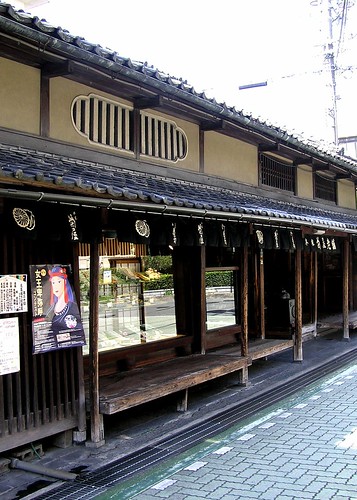
The town of Takayama sits so high in the mountains that you can't actually see any mountains as you wander around the quiet streets. All that altitude means clean air and clean water, and by extension, sake. The town has a preserved neighborhood of low wooden buildings that are or were sake breweries; some now sell tourist tat, but a surprising number are still brewing away.

Takayama has recently supplemented its tourist appeal by becoming as universally accessible as a olde worlde town can be. Most shops and restaurants and all public facilities have been retrofitted to accommodate a variety of disabilities. Brochures highlight the local attractions that can be enjoyed by those with mobility issues, including the two smorgasbordish local markets.

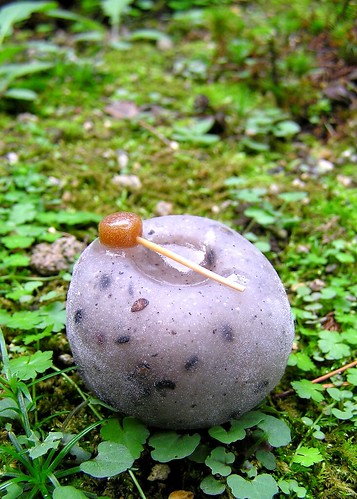
At the market nearest the river a woman in a small stall dispenses owara tamaten to slavering crowds. I'd never seen these luscious little cubes before, and I guess I wasn't alone in my ignorance, because two framed signs explained the treat in Japanese and in English [sic]:

"Owara Tamaten: I pass when it beats an egg white and enter and cut the honey which came to the boil of sugar and agar to a pip after cooling it an soak it in the liquid which addes sweet sake to and egg yolk, and it is the Japanese sweet that it is ununusual which baked 6."

Hmm...I can only offer a best-guess interpretation: Somehow the sake-infused meringue-like substance is made to stiffen up enough to be cut into near-perfect cubes. As customers look on, the cubes are grilled on a large, flat griddle until all sides have a golden skin. I can't imagine that much alcohol survived the heat, but the smell alone was totally intoxicating. The warm, gooey, crusty, perfumey cube was like a toasted marshmallow from a vastly-improved parallel universe. Note that mine did not survive long enough to have its portrait taken.

Saturday, September 13, 2008

Shakkei


Day fifty-four: Shakkei
Above:
Fujiya Hanakaida
Below: Omaya

One the of principles of Japanese garden design, shakkei ("borrowed scenery") entails bringing the surrounding landscape into a garden by deliberately incorporating views of distant mountains, castles, or other landmarks. This practice can add depth and complexity to even the smallest garden. I particularly appreciate how changing atmospheric conditions shift the relationship between the garden proper and the borrowed scene; personally, I see this as a reminder not to be so pig-headed about the correctness of my own perceptions.

I got to thinking about borrowed scenery when I found myself photographing the day's three sweets in the internal garden of Zenkōji, Takayama's most eccentric Buddhist temple and guest house. Through their forms and ingredients, all three sweets have such a strong relationship to nature that they themselves seem to bring the garden indoors with them.

At the 90-year-old Omaya shop (below, left) I paid ¥304 for two harbingers of the autumn harvest. The plump kaki-shaped sweet was filled with white bean paste and sweet-sour bits of diced persimmon. The more abstract kuri kinton was formed from chestnuts (kuri) that had been boiled, then mashed and mixed with sugar; it was very dry and slightly crumbly, with oily little reservoirs of crushed nut, sort of a less-sweet version of the pecan divinity my grandmother used to make.

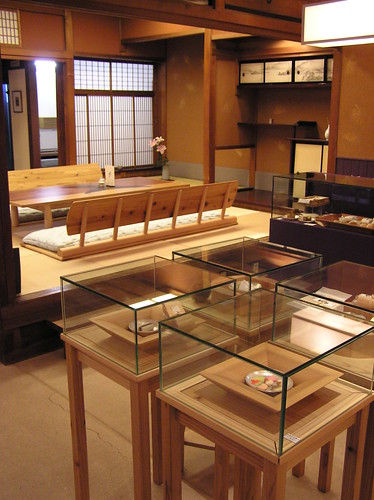
A few blocks away there's a 2-year-old sweetshop called Fujiya Hanakaida, which has a generous seating area and beautiful wood-and-glass fixtures (below, center and right). From a selection of equally craftsmanlike namagashi, I chose a tiny, totally edible model of a tsukubai (¥220), the outdoor stone basin at which guests clean their hands and mouths before entering a teahouse; they lift the water from the basin using a long-handled bamboo ladle. The "stone" is made of nerikiri (white bean paste stiffened with glutinous rice to make it more sculptable) and black sesame seeds, with a puddle of kanten jelly water and a ladle made of cinnamon nerikiri and a snippet of sweetened soba noodle.


Friday, September 12, 2008

Senpyō


Day fifty-three: Senpyō

The first time I ever drank matcha (whipped green tea) it was accompanied by one of these cigar-shaped little cookies. While visiting Kyoto, my mother and I had gone to the huge Daitokuji complex to see the famous dry garden at the Daisen-in subtemple. Since pondering rivers of gravel is thirsty work, we opted to take tea in Daisen-in's reception room. Next to each bowl of bright green foam the waitress placed a single senpyō. We had to talk each other out of asking for seconds.

The surface of senpyō is furred with a generous amount of powdered cinnamon, a spice that for some reason I haven't yet pinned down is strongly associated with Kyoto (a result of trips to and from the Asian mainland in the early days of Japanese Buddhism?). The core is a strip of crumbly white bean paste and the surrounding cookie is soft and fluffy on top, baked to a slightly glassy crisp on the bottom.

Happily, Daisen-in now sells small boxes of senpyō to go.


Thursday, September 11, 2008

Yatsuhashi


Day fifty-two: Yatsuhashi / 八橋 

I'm not sure whether it would be better to have a dollar for every temple in Kyoto, or a dollar for every shop selling yatsuhashi, Kyoto's most famous sugary souvenir (miyagegashi). While the city's confectioners are perhaps better known for their ephemerally lovely tea ceremony sweets, these don't travel so well. So while yatsuhashi may not look like a haiku made edible, they have the advantage of being vacuum packed and virtually indestructible.

Yatsuhashi dough is made from rice flour, sugar and cinnamon. To make the baked version shown above, rectangles of the translucent dough are slow-cooked on a flat griddle; as they cook they are turned from one side to the other and pressed flat with a wooden block. When the yatsuhashi are done, the baker deftly positions each hot cookie over a trough-shaped mold and forces it down with a dowel, leaving it to cool like a little curved roof tile. The cookies can then be glazed with icing sugar and various flavorings (the ones above are matcha flavored).

Until the middle of the last century, baked yatsuhashi were the only yatsuhashi; with improvements in packaging and refrigeration technology, it became possible to sell "raw" yatsuhashi. Like big ravioli, namayatushashi (below) are squares of soft, chewy dough folded over an ever-changing assortment of fashionable fillings (tofu, black soy beans, anko, black sugar paste, plum, etc.). I'm not ashamed to admit that my favorite is chocolate fondant; this box (¥1060) came from a stall at the train station and didn't make it as far as the next city. Today you can also buy boxes of raw yatsuhashi "skins", to eat by themselves or with some filling so perversely eccentric that it hasn't yet occurred to the yatsuhashi industry.


Wednesday, September 10, 2008

Nara no Kikuya


Day fifty-one: Nara no Kikuya

A few years ago I found a slim and beautifully designed book on kashigata (carved wooden confectionery molds). The pictures of the molds themselves were amazing but what really took my breath away was a panoramic shot showing the interior of what I guessed to be an old wagashi shop; taken from close to the floor, the photo showed the walls and ceiling of room literally covered in kashigata of all shapes and sizes, crammed on shelves or stuffed between rafters. The caption identified the shop as Kikuya of Nara, and I immediately added it to my itinerary.

Located a short way from the tourist attractions of central Nara, Kikuya is about a 10-minute walk from Koriyama station. The crumbly wood-and-stucco building anchors a narrow and otherwise unremarkable backstreet. I'm starting to get a little blase about these rifts in the space-time continuum, but luckily I was able to see Kikuya through the fresh eyes of my visiting friend Bernard, who hadn't yet gotten over jet-lag, much less gotten jaded.

It was lovely weather so the whole side of the shop was thrown open to the street and I spotted the kashigata ceiling from a block away. While Bernard and I were still gawking and taking pictures, an older gentleman in a typical craftsman's outfit came up and we started chatting. I belatedly realized that he was the current proprietor of this 450-year-old establishment, but I couldn't have made too much of an ass of myself up to then because he invited Bernard and me to follow him next door.

Next to the crumbling shop was a 4-story cast concrete rowhouse, its modernity tempered by antique furniture and an internal garden. I felt like Alice down the rabbit hole as the proprietor led us past a gazebo and a water feature, to a perfect little teahouse built into the back corner of the bunker. He arranged us on the tatami mats and for the next hour we "conversed" about the history and artistry of wagashi; I translated everything I could catch for Bernard and he obliged me with a few air-nods when I hadn't a clue what to say. One of the shop assistants came in at intervals, bringing bowls of tea and a stacked lacquer box full of the current line of namagashi, of which we ate a couple.

Finally, with a quick look behind the scenes at the mizuya (teahouse kitchen), profuse thanks, and much bowing, Bernard and I were back out on the street. We paused for a moment between the 15th and 21st centuries as I tried to explain what a rare treat we'd just stumbled into. I had no idea what had unlocked those doors to us. Had I used some magic password without knowing it?

"Yeah, that was great, " said Bernard. "Maybe we should actually buy something?"


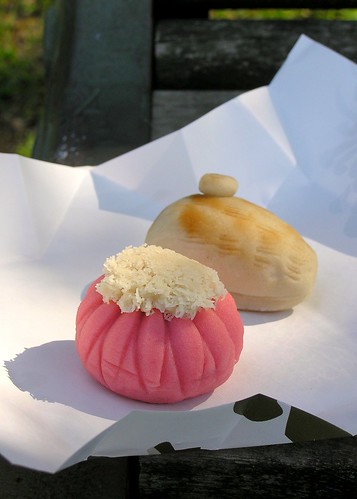
So we took away some souvenir sweets and two sculpted namagashi: a plump cotton-stuffed chrysanthemum and a knobby little potato of nerikiri smudged with cinnamon. We ate them in Nara park, sitting on a bench touched by the long shadows of a perfect late summer afternoon.


Tuesday, September 9, 2008

Taisho Era Designs


Day fifty: Taisho Era Designs


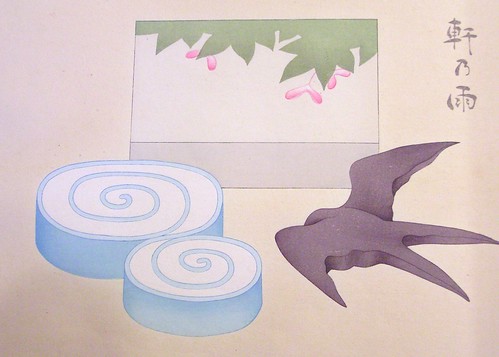
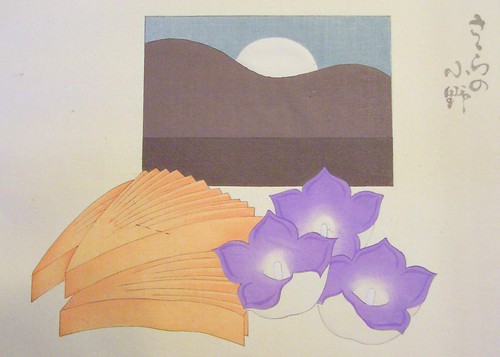
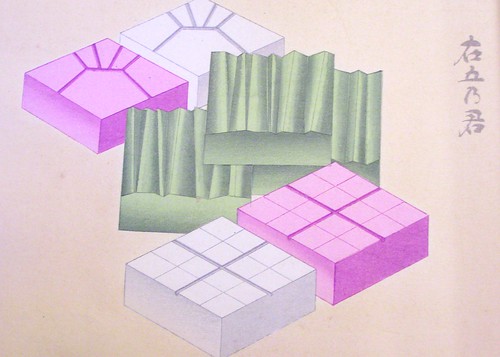
These wagashi designs come from books published in 1922, towards the end of Japan's Taisho Era (1912-1926). The bound and boxed set includes 5 volumes, one for each principal season and one for designs pertaining to special occasions. The woodblock printed images indicate that wagashi makers of the day used an enormous range of materials and techniques. The variety of aesthetic approaches illustrated by each careful grouping also hint at the range of influences impacting Japanese culture at that time.


The deep purple Chinese Bellflower is a favorite sight of late summer and early fall.


Together, plum blossoms, bamboo, and pine are known as "The Three Friends of Winter".


Taisho-era Japan was strongly influenced by Art Deco art and design. Here the spring season's iris and hydrangea look almost crystalline.

Monday, September 8, 2008

Wafers


Day forty-nine: Wafers

Left: Saganotsuki
Ryuen,
¥262 for three
Right: ?
Suetomi
¥1200 for twelve

On the left, d
iscs of thick rice paper are glued together with a schmear of yuzu, plum, or black miso paste--the flavors so subtle that the selection isn't as jarring as it might otherwise be. The sweets on the right are as delicate and crusty as frozen snow, with an initial crunch that melts immediately on the tongue; wafers of rice flour and sugar are frosted with more sugar and sandwiched together with yet more sugar, a gritty plum-flavored mixture with enough tartness to pull the whole thing back from the edge of insipidity. Best accompanied by a cup of hot green tea.

Sunday, September 7, 2008

Higashi II


Day forty-eight:
Higashi II

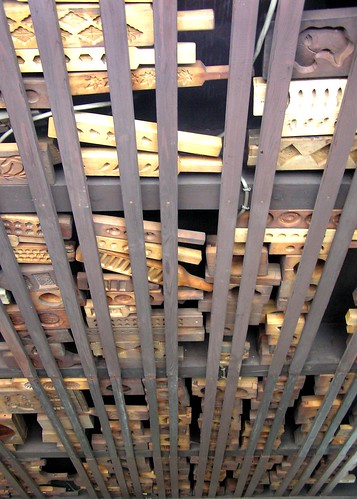
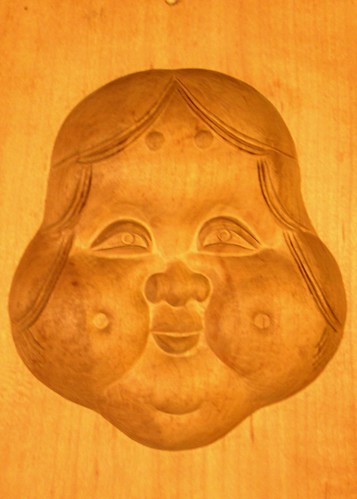
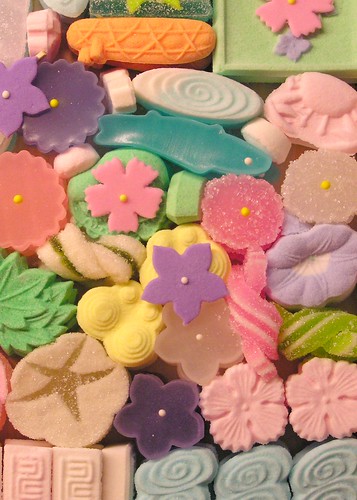
Because "dry sweets", or higashi, are so strongly associated with the tea ceremony, Kyoto has traditionally been a center for higashi production. Typically made of hand-powdered wasambon sugar (perhaps with some starch for added volume or moisture control) higashi are tinted and shaped to evoke a particular season or event. They are commonly formed by pressing the sugar mixture into a carved wooden mold known as a kashigata. Antique kashigata show that higashi were once quite large, but today's higashi is typically a bite-sized serving weighing around 2 grams.

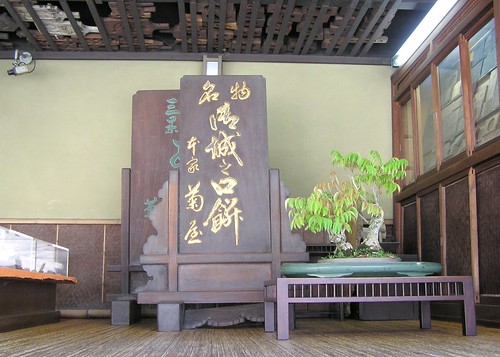
For 200 years, Kamesuehiro has specialized in high quality higashi; the shop even supplies the Kyoto Imperial Palace. In the old days, new kashigata were commissioned for each occasion and the used ones were simply thrown away. A few generations back it occurred to one of Kamesuehiro's proprietors that throwing such skillful carvings away was a waste, so he began to mount them around the shop's large wooden sign. The sign is now framed by dozens of antique kashigata, weathered and stained by the Kyoto air.

Although the majority of old molds are either too odd or too large to be of much use, Kamesuehiro still uses a few old kashigata for special ocassions. At around 9 inches in length, the jovial Okame face above is much larger that today's higashi, but it is still used for once-in-a-lifetime events such as an 88th birthday celebration (consequently the mold is in almost pristine condition). Because a sweet of this size would be very expensive and delicate if made of wasambon alone, the sugar is packed around a bean paste core. The eyes are made of wasambon mixed with dye and carefully pressed into the mold, while the hair and lips are painted onto the molded sweet with shokubeni, natural food coloring.


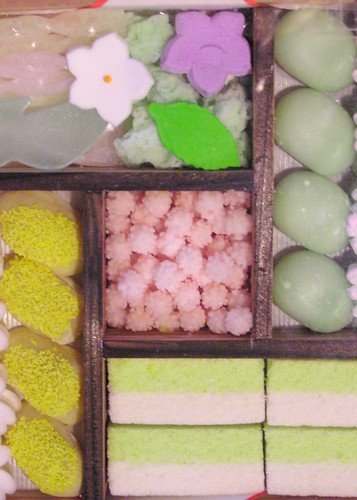
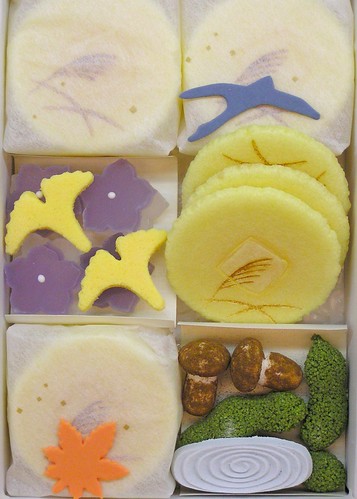
Many shops sell assortments of artistically arranged higashi in small boxes. Elaborately wrapped by the shop, such boxes make elegant gifts. The late summer assortments pictured above are from Kamesuehiro, Tsuruya Yoshinobu, and Kagizen Yoshifusa.


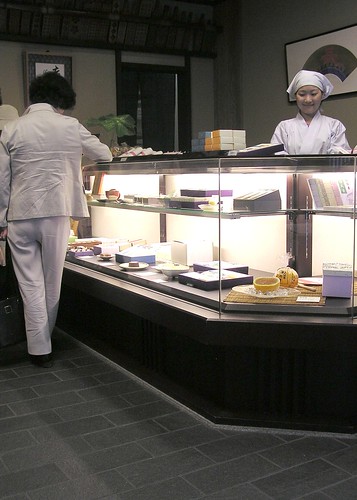
At Oimatsu, my friend Oya gave such a persuasive description of my project that we were invited back to the kitchens to look around. While the showroom (above, left) is decorated with a frieze of impressive but obsolete kashigata, the kitchen walls are covered in racks of those kashigata still in regular rotation.

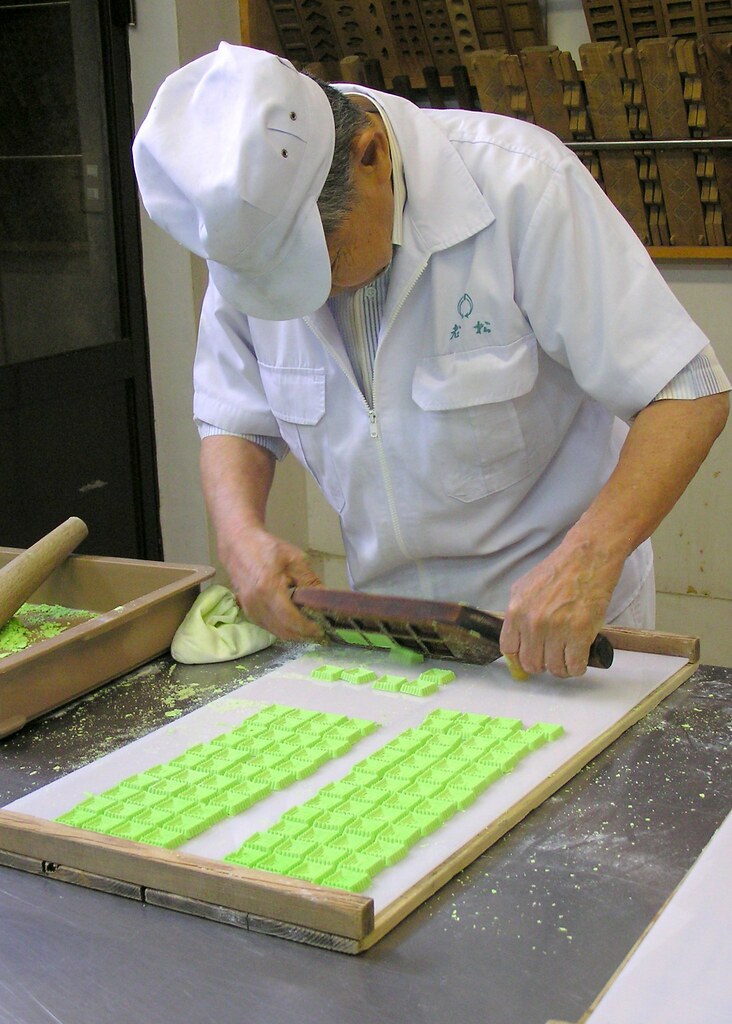
We were just in time to see one being used, an Edo-period mold depicting markers from
kō awase, an archaic incense-identification game (right). The Oimatsu employee was packing the green-tinted wasambon into the molds with such care that it took him about 10 minutes per batch, and with such force that the periodic "CRACK! CRACK!" as he whacked the mold to free the sweets made me jump every time. He also slipped us a few of the broken ones, which were delicious and incredibly delicate.

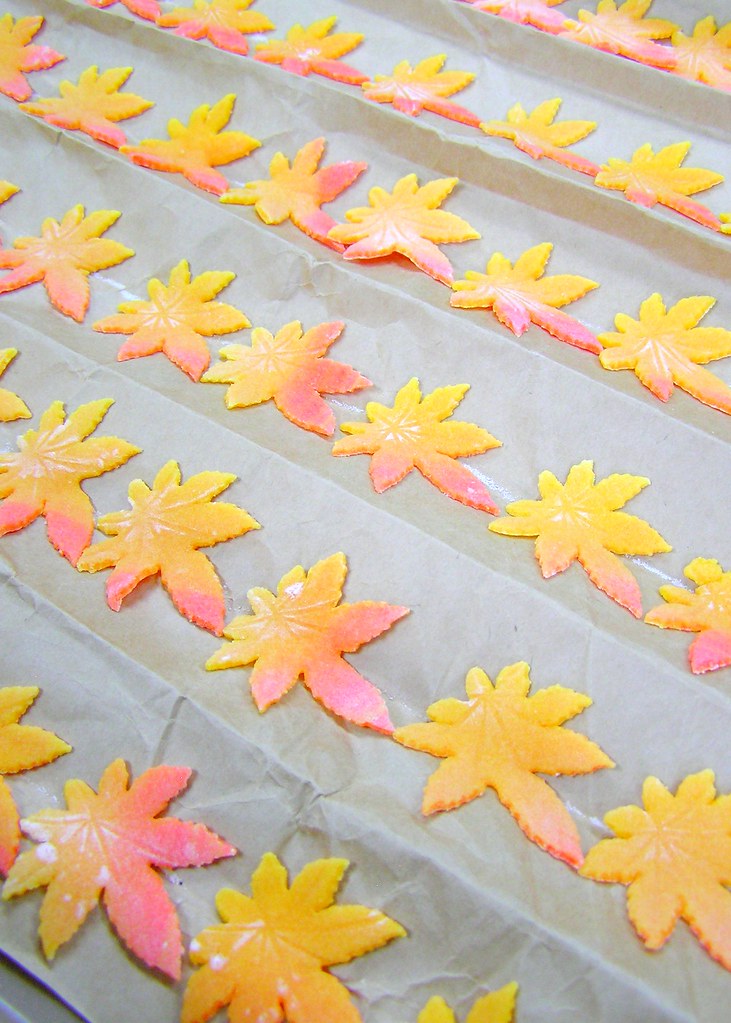
On another table, racks of higashi made with a maple-leaf cutter were curing on folded wax paper (center) to give them a life-like curl.


Wakasa-ya is another shop that deals almost exclusively in higashi. It
was founded 85 years ago and is now run by the original owner's 80-year-old son; it continues to be the official supplier for the Myōho-in Temple. The shop offers a rotating lineup of sweet, somewhat retro designs, such as the one above (center) showing two adorable bunnies doing what bunnies do...pounding mochi inside a full moon. Individual higashi are ¥40 and small assortments start at ¥220.

Some of Wakasa-ya's molds (right) are carved by Jiro Noguchi, Kyoto's only active kashigata carver, and someone I've been trying to ingratiate myself with for about 8 years. When I told Wakasa-ya's proprietor that Noguchi-san has never responded to any of my letters, he wasn't at all surprised: "Maybe...he is not such an easy person."

Saturday, September 6, 2008

Kuzu Kiri


Day forty-seven: Kuzu Kiri / 葛切

Oimatsu

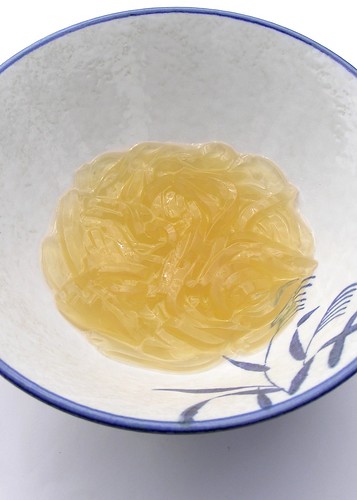
Similar to kanten-based tokoroten, kuzu kiri is a hot weather treat of gelatinous noodles served chilled with a sweet sauce. Although other, cheaper starches are sometimes used, the best kuzu kiri are still made of the powdered root of the kudzu vine. The best kuzu reputedly comes from the mountainous area around Yoshino in Nara Prefecture, not too far from Kyoto, where sticky summer weather ensures a ready market for kuzu producers.

In wagashi shops, kuzu kiri is most often sold inside a long rectangular container; a bar of kuzu jelly sits inside the plastic or wood box that is open at one end and covered with a grid of horizontal and vertical wires or plastic bars at the other. When the customer is ready to eat the kuzu, he or she fits the plunger provided into the top of the box and pushes down, extruding the square-sectioned kuzu noodles into a bowl. The package also includes an envelope of syrup (black sugar, plum, green tea, etc.) that can be squeezed directly onto the noodles or used for dipping. The plum-flavored example above, from Oimatsu, was tart and a perfect balance of soft and chewy.

The Kagizen Yoshifusa tearooms in Kyoto's Gion area serve a variety of treats but specialize in kuzu products. Heading back to the tables you pass through a curtain decorated with a kuzu kagi, a tool for harvesting kuzu, and an alcove display of huge kuzu roots and other associated tools of the trade. Kagizen Yoshifusa's kuzu kiri are thick and irregular, cut by hand. They arrive at the table in tall, lidded lacquer bowls full of cold water; the pale, translucent noodles swirl against the black lacquer like a swarm of jellyfish. The noodles are served with an accompanying bowl of black sugar syrup that is as viscous as tar and tastes of minerals.

Friday, September 5, 2008

Shinko Mochi II


Day forty-six: Shinko Mochi
¥120 each

Apparently unrelated to the deep-fried shinko mochi I previously ate in Tokyo, these little dough bars came from a tiny stall in a covered market near Shimogama. If I understood correctly, they are made of joshinko, a flour ground from non-glutinous rice (as opposed to the more common glutinous mochiko)--which is odd, considering these shinko mochi were
devilishly sticky, as rubbery as fishing worms, and so chewy I could probably have blown bubbles. The green tea one was kind of bland, but the cinnamon was hot and mellow and I could have happily gnawed on it all day (but then I'm a fan of Big Red). I also find the form delightfully (if oddly) fleshy, with its dimples and fat rings and that weird little orifice at each end.

Thursday, September 4, 2008

Fu Manju


Day forty-five: Fu Manju

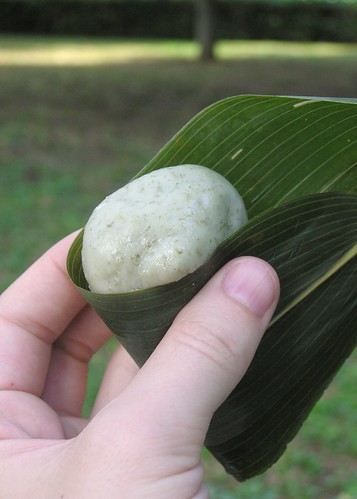
Above: Hanbei Fu, ¥210
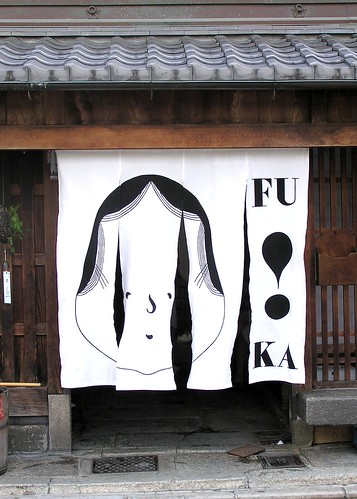
Below: Fu-ka

In the days when most Japanese were vegetarians, processed wheat gluten (fu) was an important source of protein, particularly in Buddhist temples. Along with mochi, fu is one of Japanese cuisine's most stalwart chameleons; it can be called on to resemble vegetables, meat, leaves, blossoms, animals, and even toys. It can be eaten fresh, dried, or reconstituted. It can also be persuaded towards either the sweet or the savory end of the spectrum.

Fu manju--dumplings of silky-smooth fu, stuffed with sweet red bean paste and steamed inside a fresh bamboo leaf--were near the top of my Kyoto must-try list. When I told my hostess, Miko, of my craving she said, "Of course, you must go to Hanbei Fu. The best."


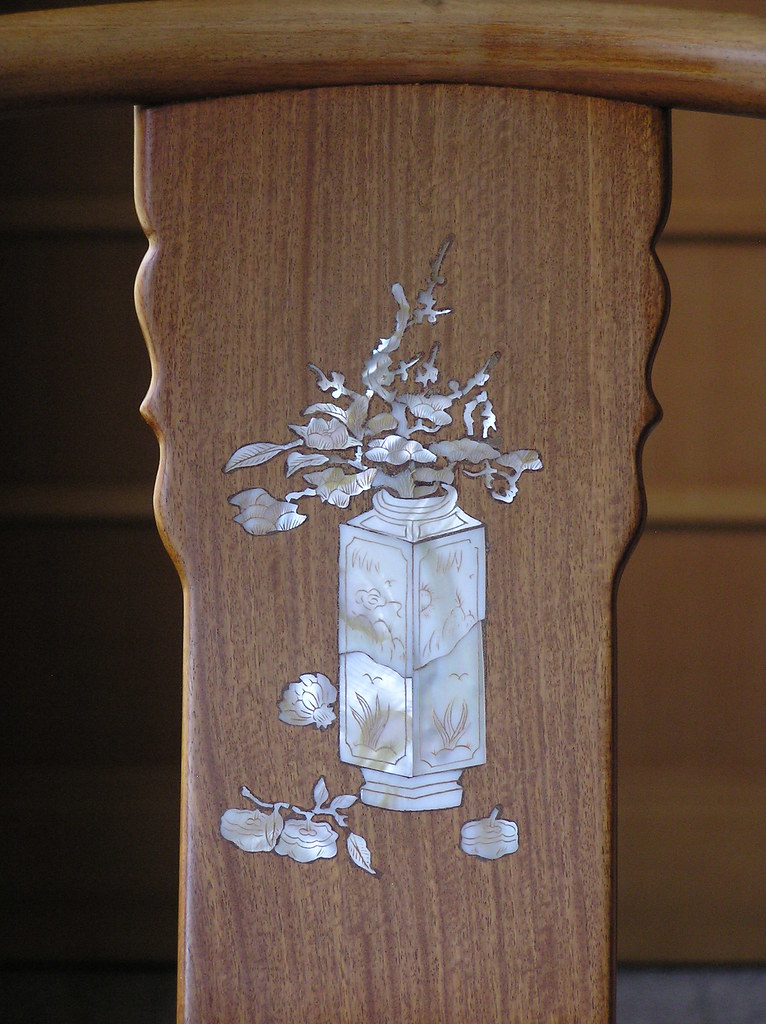
For about 10 minutes I loitered outside Hanbei Fu's silent entrance, wondering if I had come on a vacation day. Finally a woman from inside was dispatched to bring me in to the (air conditioned!) showroom. It was recently and tastefully decorated, with lots of blocks of foamy white fu piled up on polished wooden shelves, and a reception room full of Chinese rugs and inlaid furniture, where I had a cup of cold barley tea while gazing out onto an interior garden with an original well. In hushed tones, the shopkeeper guided me to the cooler full of bamboo-wrapped manju and tried not to look horrified as I struggled to pull a pre-scored chunk from the sacrificial sample (I swear the cut had healed over; maybe fu has superheroic powers of regeneration?).

Like the shop interior, Hanbei Fu's manju was restrainedly luxurious. It clung coyly to the bamboo leaf, but I was relieved to find the first bite didn't glue my teeth together. The anko was wet and only slightly sweet; the fu was totally smooth, chewy, and as elastic as well-kneaded bread dough.

Then I spent a day on wagashi safari with my friend Oya, a traditional carpenter and tea ceremony student. When we met in the morning to go over our itinerary, Oya was surprised that I had already found some of his favorite shops, and pleased that there were some I had missed. And although I had already had fu manju, I hadn't tried "the best": Fu-ka. And besides, Oya had made reservations.


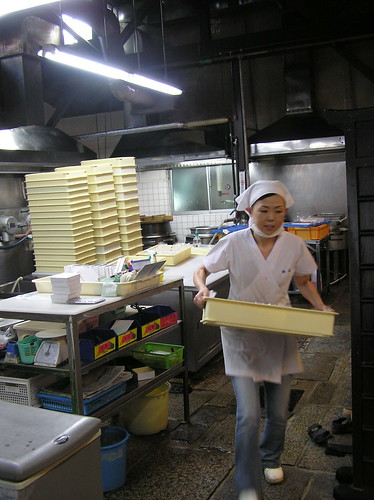
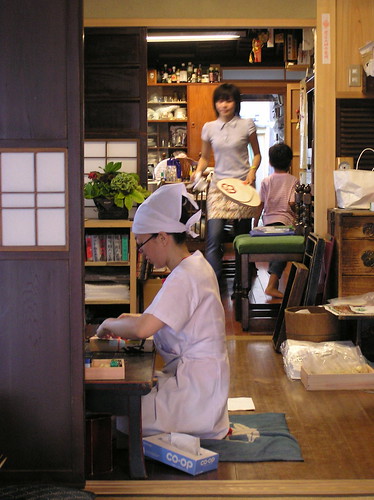
Reservations?? As we approached Fu-ka I was picturing a fu shop even swankier than Hanbei, but the Fu-ka premises turned out to be a cavernous and rather shambolic wooden warehouse. We parted the noren (shop curtains) and stepped inside to wait for our order to be wrapped. The shop is also a home, and through one corner of the waiting area I could see all the way back to a domestic kitchen, complete with kids clamoring for a snack. Turning my head slightly, I could see into a huge industrial kitchen, where a couple of women rushed around with trays of manju. They had already sold out for the day, and if Oya hadn't known to call ahead, we would have been out of luck.

Fu-ka's fu manju are also stuffed with red bean paste, but the fu is mixed with mugwort, an herb that gives the fu extra flavor and appears to break up its elastic texture. So which fu manju is the best? Maybe I'm playing fu politics, but I wouldn't want to say. Both were great treats resulting from interesting experiences.


Wednesday, September 3, 2008

Jōnamagashi


Day forty-four:
Jōnamagashi /上生菓子
7jyo-Kanshundo, ¥2100 for 4 sweets and lesson
Tsuruya Yoshinobu,
¥800 for sweet and tea


Of the many different ways of categorizing the range of Japanese sweets (wagashi), one of the most prevalent is the division between higashi, "dry" sweets with a low moisture content and a relatively long shelf life, and namagashi, sweets that are fresh, raw, or "rare" (in the bloody steak sense). Out of the moisture content criterion grow other, less quantifiable characteristics, with namagashi tending to be more seasonal, more artisanal, and more expensive.

Jōnamagashi, then, are the freshest of the fresh, soft, sweet symbols of the present moment, tenderly made by hand, and, ideally, eaten immediately thereafter. Kyoto is famous for its namagashi makers, a few of whom also offer tourists the rare opportunity to try their own hand at jōnamagashi.

The Gion branch of Shichijyo-Kanshundo offers regular classes to groups of any size who book ahead. The lesson takes between 60 and 90 minutes, and since the materials are ready and waiting, is less a cooking class than a sculpture workshop. For ¥2100 you get the lesson, enough raw materials to make 4 sweets, a cup of matcha with which to wash down your ugliest creation, and boxes for all the rest. Not bad at all when you consider that the sweets themselves could cost ¥300-450 each.

I talked my hostess Miko and one of her friends in coming with me and they were good sports and great translators. The class took place around a low table in a tatami room on the top floor of what must have been an old house. Our teacher, Suganuma-sensei, was a surprisingly young man with a ponytail like a long silk tassel trailing from under his uniform cap (below, left).

Sensei got us started on the sweet in the foreground of the picture above, "Hanano" (花野). The exterior is nerikiri, a mixture of gyuhi (a more delicate, less common cousin of mochi) and shiroikoshian (smooth white bean paste) that's as smooth and elastic as Play-doh, and as dyable as those white satin prom shoes. After watching sensei turn out a perfect example, we each started in on a large green ball, adding a yellow section by smoothing the perimeter of a flattened yellow ball onto the green, then rolling the thing between our palms to make it spherical again. The we flattened it out, placed a ball of red bean paste in the center, and stretched and coaxed the nerikiri until it completely enrobed the core (below, center). We pressed three small pink dots onto the top, then held the ball aloft and upside down, draping a damp cheesecloth over it. Finally, we brought the ends of the cloth together at the top center of the ball and twisted gently (this technique is called "chakin shibori") while giving the bunched cloth a three-fingered pinch.

We also made "Kikuyo", a deep purple Chinese bellflower, and "Shukaidou", a haystack of kinton extruded through a bamboo screen and gently arranged over a ball of tsubuan paste. Everyone was very complimentary about my output and I may or may not have mentioned that this was not my first attempt at sculpting jōnamagashi. When the ladies explained the extent of my love for wagashi, Suganuma-sensei gave me one of the sculpting tools that he had carved himself from aged bamboo.

I was still feeling a little full of myself the next day, when I headed over to
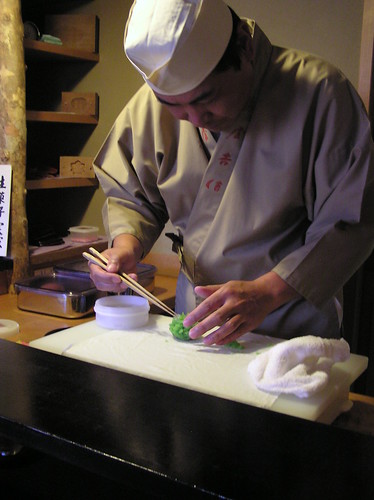
Tsurya Yoshinobu's beautifully appointed jonamagashi "bar" with Oya, a new friend and fellow enthusiast. For ¥800 you choose one of a small selection of sweets, then belly up to the bar as the master on the other side does a low-key Benihana routine (below, right). As you watch he creates complicated and poetic seasonal sweets; mine depicted a just-opened chrysanthemum stuffed with cotton wool, an old aristocratic method of collecting perfume to tuck into their kimonos. The impassive wagashi maker went about his work with balletic grace and a minimum of fuss as I sat, elbows on the bar, mouth hanging open, savoring just how easy he made it look.


Tuesday, September 2, 2008

Kameya Hironaga


Day forty-three: Kameya Hironaga

If you're ever in Kyoto and need to give someone the slip, just tell them to meet you for sweets at either Kameya or Tsuruya. Because kame (turtle) and tsuru (crane) are auspiciously long-lived, there are at least a dozen shops named after each in central Kyoto alone.

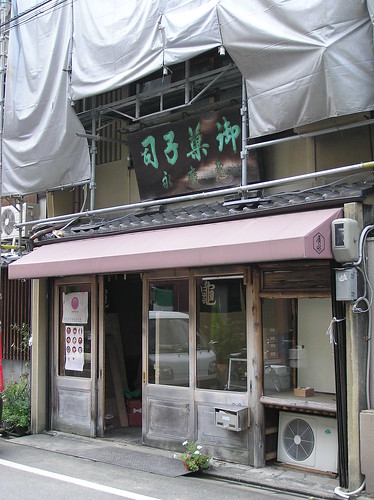
Kameya Hironaga is tucked away on a small street in the Nakagyo district; on my way I was distracted by stray cats, crumbling buildings, and a shop selling specialty toilet papers ("Silltty Roman" brand, and one printed with English lesson vocabulary) before I spotted the sign I was looking for, half-hidden by scaffolding. I approached cautiously, not sure I was ready for a gritty, real-life sweets experience. The window displays were not encouraging; the sweets were so sun-bleached, parched, and fly-spotted it was hard to tell what they had once been. I looked in the door noncommittally and was about to give the closet-sized shop a miss when a tiny woman appeared out of the gloom and gave me the biggest and most genuine smile I've ever seen in wagashiya. She coaxed me in and started chatting as I looked around for something sanitary to buy.

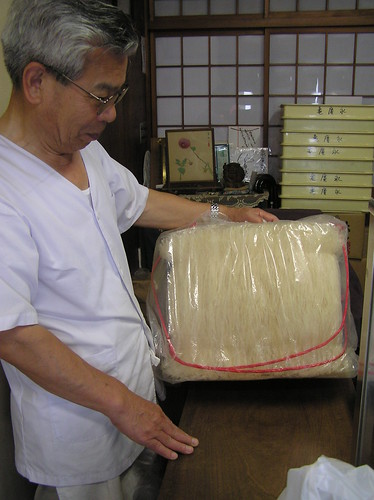
Happily, it turns out that proprietors of this 90-year old shop funnel their funds into making sweets rather than displaying them. They make simple products of the best ingredients, and are particularly known for producing slabs of silky, coffee-colored kanten jelly flavored with kurozato, a black sugar from Okinawa (¥1050 for a large bar). The shop master explained that when he was young, white sugar was rare and desirable while kurozato was just what was on hand. Now the situation has reversed drastically, with dire consequences for many wagashi makers who want to stick to the old ways; he says the customers who keep coming are the ones who understand the difference between one sugar and another. His kanten is also of higher quality than the grocery store kind, and a block like the one he's showing off below costs ¥30000 (around $300).

So many of Kyoto's wagashi shops are gleaming showplaces that it can be hard to remember that wasgashiya have, at times, been as much a part of community as the corner shop or dive bar. When I say that Kameya Hironaga is a hole in the wall, I mean it in the nicest possible way. My hostess invited a few friends for dinner tonight and after the feast I served up small slices of the chilled jelly; it was just the right ending to a big meal and a hot, dusty day.

Monday, September 1, 2008

Seijo Kankidan


Day forty-two: Seijo Kankidan

Kameya Kiyonaga, ¥525

A kind of confectionery coelacanth, seijo kankidan was among the earliest Chinese sweets to arrive in Japan, and is still available today in one Kyoto shop. The exterior is a flour-and-cinnamon wonton, deep-fried in aromatic sesame oil until the sculpted swirls at the top are crunchy enough to threaten delicate dental work. Inside there's a pocket of the smoothest koshian bean paste mixed with five types of powdered incense. It was rich, satisfying, and--even though I ate it while sitting out next to the river--so heavily perfumed that sesame and incense lingered in my hair for the rest of the day.


Sunday, August 31, 2008

Zunda Mochi


Day forty-one: Zunda Mochi

I learned a new Japanese saying recently: Miyagemono ni umai mono nashi, or "Among souvenirs, there are no delicious things". I found this a little hard to get my head around; given the Japanese emphasis on giving souvenirs, packaged delicacies wallpaper every train station and airport; historically, local food souvenirs have been seen as giving the folks at home a way of participating in the journey; and surely, food gifts, no matter how undelicious, gather less dust than a snow globe?

But today gave me a little more insight. I spent most of it backtracking to Tokyo in order to take my ailing computer to the Mac store. Several hours into my train journey (I'm still stuck on local trains) I realized that I had somehow managed not to pack the fresh, delicious and expertly-made sweets that my friends at the Tokinoka Yawargi shop had set aside for me; it was like waking from a dream where you're lolling on a pile of treasure to find yourself in a single bed on IKEA sheets.

Rooting around in my bag, I managed to find a box of souvenir sweets that had been with me since Sendai. On the north end of Japan's main island, Honshu, they make something of a speciality of zunda, young, fresh soybeans that are boiled, sweetened, and ground into mealy paste. Zunda shows up in a number of incarnations, but here it is slathered over tiny balls of mochi.

There's no denying that the package was attractive, sturdy, and a welcome respite from a sweets-free day on the trains. The zunda was bright green on a scale somewhere between hi-lighter and fava, smelled of fresh chlorophyll, and tasted inoffensively sweet. But while the color shouted "freshness", the stiff, gluey texture of both the paste and the mochi whispered "extended shelf-life".

Perhaps the trick to getting delicious souvenirs is not buying foods that are packaged specifically as souvenirs?