Day forty: Tokinoka Yawaragi
5-4-20 Minami Surugadai
Fujieda-shi, Shizuoka, 426-0078
Since my obsession with Japanese sweets took hold, I've trained myself to blab about it to anyone who'll listen; after all, I never know where leads will come from. My brazen behavior is only encouraged by luck like this: last summer, while teaching at the Penland School of Craft, I happened to mention my project to a fellow teacher...whose nephew had just opened his own wagashi shop.
More luck still, Kazyuki Miura turned out to be a kind and generous wagashi maker. He invited me to spend the better part of three days at the shop, staying with his family, shadowing his activities, and asking convoluted questions in broken Japanese.
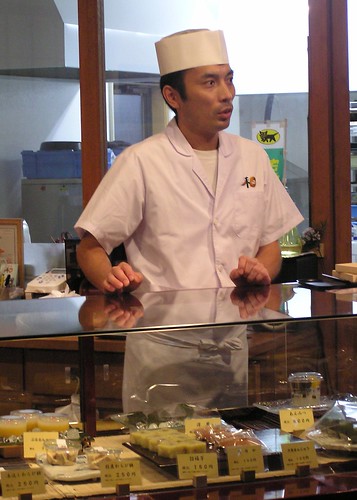
Tokinoka Yawargi is located in a modern building in Fujieda, a small city near Nagoya. Fujieda is a center of tea production and was one of the post towns on the old Tokaido road between Kyoto and Tokyo. The ground floor houses both the shop and the kitchen, easily seen through a large window. Although they do a thriving special order and takeaway business, a classy seating area invites customers to relax over cups of tea and bowls of sweet bean porridge, served up by Kazuyuki's wife Chika.

Kazu and Chika met back when he was performing in a heavy metal band and she was a fan. After hearing from wagashi-maker Niimura-san that one reason he retired early was to spend more time with his children, I was curious to see how the Miuras balance the demands of work and family. Living upstairs from the shop seems to be a huge advantage (although I'm sure it doesn't always feel that way). Granted, I visited during a school holiday, but all three kids seemed happy to help out with wrapping, stirring, or setting out serving trays--plus they sanitize their hands more often than most doctors.
Tokinoka Yawaragi offers a huge range of products, from the traditional sculpted bean paste sweets to wafers, cakes, and puddings. During the hours I spent in the kitchen I learned a great deal about the making of particular products, but perhaps more importantly, I was able to gain some insight into how a single confectioner is able to produce such a varied lineup.
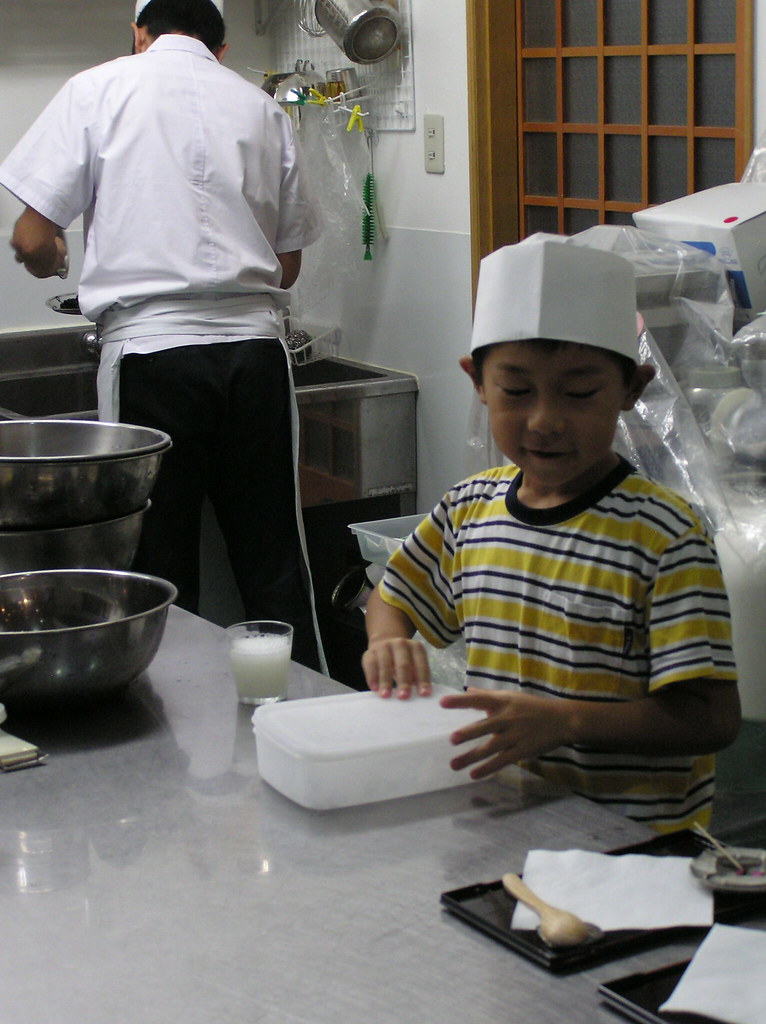
Kazu and Chika met back when he was performing in a heavy metal band and she was a fan. After hearing from wagashi-maker Niimura-san that one reason he retired early was to spend more time with his children, I was curious to see how the Miuras balance the demands of work and family. Living upstairs from the shop seems to be a huge advantage (although I'm sure it doesn't always feel that way). Granted, I visited during a school holiday, but all three kids seemed happy to help out with wrapping, stirring, or setting out serving trays--plus they sanitize their hands more often than most doctors.
Tokinoka Yawaragi offers a huge range of products, from the traditional sculpted bean paste sweets to wafers, cakes, and puddings. During the hours I spent in the kitchen I learned a great deal about the making of particular products, but perhaps more importantly, I was able to gain some insight into how a single confectioner is able to produce such a varied lineup.
Although nearly all the shop's offerings are made in house, some components are frozen or refrigerated (dates are clearly marked and strictly followed). Over and over in my research, I have read that for a confection to be considered "wagashi" (that is, a true Japanese confection), it must be produced and consumed on the same day; therefore, a frozen product would be disqualified. But while this criterion derives in part from a general cultural emphasis on timeliness (e.g. seasonality, freshness, raw food products) it may also owe something to the historic unavailability of refrigeration and consequent risk of food-born illness. Technology is changing, and so are some attitudes, and it seems that it is increasingly up to each wagashi-maker to define "wagashi" for him or herself. At the London branch of one major wagashi maker, absolutely everything arrives flash-frozen on a plane from Japan; at that shop wagashi is defined as something made on Japanese soil, of Japanese ingredients, by Japanese hands.


An (or anko) bean paste is a key ingredient of so many Japanese sweets that it behooves confectioners to whip it up large batches. Koshian is a creamy smooth paste of red azuki beans that are cooked hard and thoroughly strained; shiroan is a velvety variation using white beans. Like koshian, tsubu-an is made from azuki beans, but a good proportion of the beans remain intact during cooking, giving the paste a pebbly texture. Because I tend to prefer creamy to chunky in all things, I had always sort of dismissed tsubu-an as half-assed, rustic koshian, but several hours of watching Kazuyuki set me straight. For tsubuan, he uses special beans whose skins are delicate and without any bitterness, at five times the price of their grocery store cousins. All of the stirring and mixing must be done by hand rather than with an electric mixer, and tsubu-an requires trick timing and several extra steps, as beans must be separated and re-added at exactly the right moment.

This tsubuan makes the shop's monaka (stuffed wafers) hugely popular. They keep batches of tsubuan and fresh baked "skins" on hand and when customers drop with for a large order everything else stops for a few minutes as Kazuyuki fills the monaka and his wife or daughters fit each one into a small paper sleeve.


Although it's no excuse for my poor Japanese, many craftspeople such as Kazuyuki are (thankfully!) advocates of the practice of learning through observation and imitation. During a lull in the kitchen, Kazu pulled out some bean paste and demonstrated sculpting a blossom. First, red food coloring is mixed into a ball of stiff white bean paste to achieve a perfectly uniform pink. A tiny white blob is gently smoothed on to make a blurry bullseye, and then the whole is wrapped and sealed around a red bean paste core using a spidery, rythmic hand gesture not unlike that move where a conjurer walks a coin from finger to finger. A bamboo tool is used to score the slightly conical ball into 5 (5!) even sections, each of which is given a gentle finger-tip dent and notched at the outer edge with the same tool. The final touch is tiny white ball balanced just in the center. In the above picture, Kazu's blossom is on the right and mine is on the left.

Customers special order these boxes of large, fresh sweets to commemorate anniversaries and other auspicious events. Kazuyuki is something of a specialist in coming up with appropriate and aesthetically pleasing arrangements; he keeps portfolios full of gorgeous designs. Here he is adding the finishing touches to a flower petal with a polished crab claw, which makes exactly the right kind of line.

The morning I left, Kazuyuki was up early to fill the steamer with glutinous rice and azuki beans; the sticky, savory, pink-tinged result,o-sekihan, is one of Japan's most common celebratory foods. It is usually sprinkled with black sesame seeds and sea salt and sold in large trays or rolled into fist-sized rice balls. O-sekihan is not considered to be a confection (although savory items such as rice crackers are) but it is frequently made and sold by confectioners. The connection is purely pragamatic: o-sekihan provides another source of income from the same equipment and raw materials.
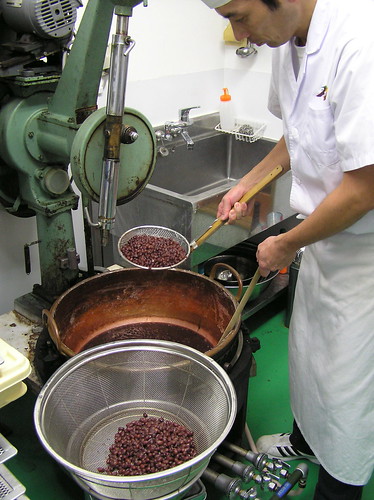
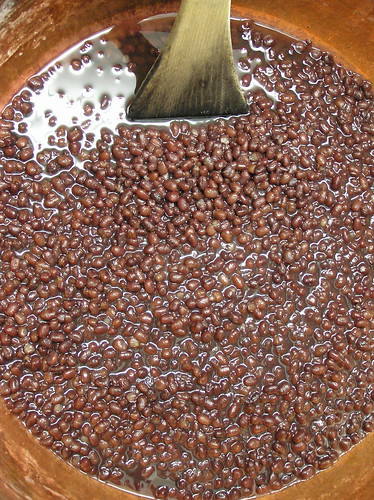
An (or anko) bean paste is a key ingredient of so many Japanese sweets that it behooves confectioners to whip it up large batches. Koshian is a creamy smooth paste of red azuki beans that are cooked hard and thoroughly strained; shiroan is a velvety variation using white beans. Like koshian, tsubu-an is made from azuki beans, but a good proportion of the beans remain intact during cooking, giving the paste a pebbly texture. Because I tend to prefer creamy to chunky in all things, I had always sort of dismissed tsubu-an as half-assed, rustic koshian, but several hours of watching Kazuyuki set me straight. For tsubuan, he uses special beans whose skins are delicate and without any bitterness, at five times the price of their grocery store cousins. All of the stirring and mixing must be done by hand rather than with an electric mixer, and tsubu-an requires trick timing and several extra steps, as beans must be separated and re-added at exactly the right moment.

This tsubuan makes the shop's monaka (stuffed wafers) hugely popular. They keep batches of tsubuan and fresh baked "skins" on hand and when customers drop with for a large order everything else stops for a few minutes as Kazuyuki fills the monaka and his wife or daughters fit each one into a small paper sleeve.


Although it's no excuse for my poor Japanese, many craftspeople such as Kazuyuki are (thankfully!) advocates of the practice of learning through observation and imitation. During a lull in the kitchen, Kazu pulled out some bean paste and demonstrated sculpting a blossom. First, red food coloring is mixed into a ball of stiff white bean paste to achieve a perfectly uniform pink. A tiny white blob is gently smoothed on to make a blurry bullseye, and then the whole is wrapped and sealed around a red bean paste core using a spidery, rythmic hand gesture not unlike that move where a conjurer walks a coin from finger to finger. A bamboo tool is used to score the slightly conical ball into 5 (5!) even sections, each of which is given a gentle finger-tip dent and notched at the outer edge with the same tool. The final touch is tiny white ball balanced just in the center. In the above picture, Kazu's blossom is on the right and mine is on the left.
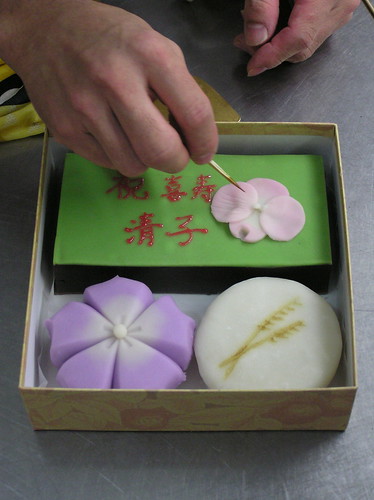
Customers special order these boxes of large, fresh sweets to commemorate anniversaries and other auspicious events. Kazuyuki is something of a specialist in coming up with appropriate and aesthetically pleasing arrangements; he keeps portfolios full of gorgeous designs. Here he is adding the finishing touches to a flower petal with a polished crab claw, which makes exactly the right kind of line.

The morning I left, Kazuyuki was up early to fill the steamer with glutinous rice and azuki beans; the sticky, savory, pink-tinged result,o-sekihan, is one of Japan's most common celebratory foods. It is usually sprinkled with black sesame seeds and sea salt and sold in large trays or rolled into fist-sized rice balls. O-sekihan is not considered to be a confection (although savory items such as rice crackers are) but it is frequently made and sold by confectioners. The connection is purely pragamatic: o-sekihan provides another source of income from the same equipment and raw materials.
--
And what did the Miuras think of my visit? Read about their story (in Japanese) on the Tokinoka Yawaragi blog...