Saturday, March 30, 2013

Honey Coconut Marshmallows


Honey Coconut Marshmallows
Sweet Coconut Bakery, $7.75/bag

A single bag of fresh honey coconut marshmallows from Hazel Lao's Sweet Coconut Bakery can cancel out a lifetime's reluctant memories of stale, chalky Stay Pufts.  Hazel uses honey instead of corn syrup, and dusts her marshmallows with velvety shredded coconut instead of cottonmouth-inducing starch.  The plus-sized squares are as plump as a toddler's tummy, meaning that you don't have to dissolve them in cocoa or melt them over a fire to render them edible. 

Monday, March 25, 2013

Abu Afif Sweets


Assorted nougat
Abu Afif Sweets

Established in Baghdad in 1973, Abu Afif Sweets makes a wide range of traditional Arabic pastries and candy.  The descendants of founder Mounir Jamal's have continued to expand into new markets, adding more modern sweets such as chocolate to their offerings at a growing number of retail stores. 

Luckily at least a few of Abu Afif's fresh sweets travel well, making plastic-wrapped bites like those pictured a great souvenir of the region.  On the top left is a square of something that may be called helawa (I'm guessing--it's not identified by name on the Abu Afif website), pistachios held together by a dense, chewy, slightly sticky, and translucent brown gel.  To the right, the same helawa is surrounded by milky nougat and a strip of qarmar-el-deen, a tart apricot fruit leather.  On the bottom is a ball of the same nougat simply caked in pistachios. 

Versions of nougat have been made and enjoyed throughout the Arab world for centuries.  In Iraq it's known at min el sama (or mann al-sama, etc.).  In Iran, it's gaz, derived from from gaz-angebin, a reference to an indigenous tree.  White, nut-studded panish turrón was probably the product of long-ago Moorish settlement, and it likely influenced the development of Italian torrone

Since nougat is such a tradition in the Middle East, I wondered why all of the recipes I found online called for corn syrup, a relatively modern ingredient.  Wikipedia to the rescue!  The sap that gives gaz its name is found on the plant but doesn't come from it:  "The sticky white substance, exuded from the anus of the last instar nymph of a small insect which lives on the plant, is collected annually and is combined with other ingredients including pistachio or almond kernels, rosewater and egg white."  Corn syrup is a modern substitute for the insect excretion. 

Saturday, March 23, 2013

Norwegian Heritage Day


Rømmegrøt
Leif Erikson Hall, $4

Although the programming at the annual Norwegian Heritage Day at Seattle's Leif Erikson Hall focused on parades, prizes, dances, and speeches, it was sometimes be hard to hear what was happening over the sounds of crispbreads being crunched, lutefisk being sampled, and spoons scraping the bottom of bowls. 

Visitors to the upstairs lunch buffet could cap off a light meal of soup and open-faced sandwiches with one of the most stupefying desserts ever created.  Rømmegrøt is literally "sour cream porridge," a soup of sour cream, whole milk, and butter thickened with flour, seasoned with salt, and dressed for the table with melted butter, sugar, and cinnamon.  It's an historic and traditional Norwegian dish, eat both as a meal in itself, and as a special occasion dessert.  

I could barely keep my eyes open after finishing my bowl, an one woman I spoke with suggested that might have been part of the point.  During Norway's short but glorious summers it was common practice to send young people out to country to keep an eye on the grazing herds.  Back in their camps for the evening, a bowl of sleep-inducing rømmegrøt served as dessert might have helped to discourage the young people from engaging in any late-night hanky panky. 


At the Kaffestua downstairs, a busy team of volunteers offered made-to-order Norwegian treats.  Lacy krumkake wafers ($.50/each) were cooked in a special iron, then wrapped around conical wooden forms while still warm and pliable. 


Another specialty iron produced Norwegian waffles ($.50/section or $2/whole) with a distinctive heart shape.  


Over at the lefse station, rounds of dough were rolled out paper-thin, griddled until puffy and covered in brown patches, then covered in butter, sugar, and cinnamon and rolled into tubes for convenient snacking.  

The volunteer pictured made it look so easy that I imagined she must have been making lefse since infancy--but not so.  She explained that rolling out the dough was considered by her family to be such an important task, it was only entrusted to the most mature and responsible women.  Her own grandmother refused to teach her the secrets of the rolling pin until she was married with children of her own. 

Thursday, March 21, 2013

Cakes of Paradise


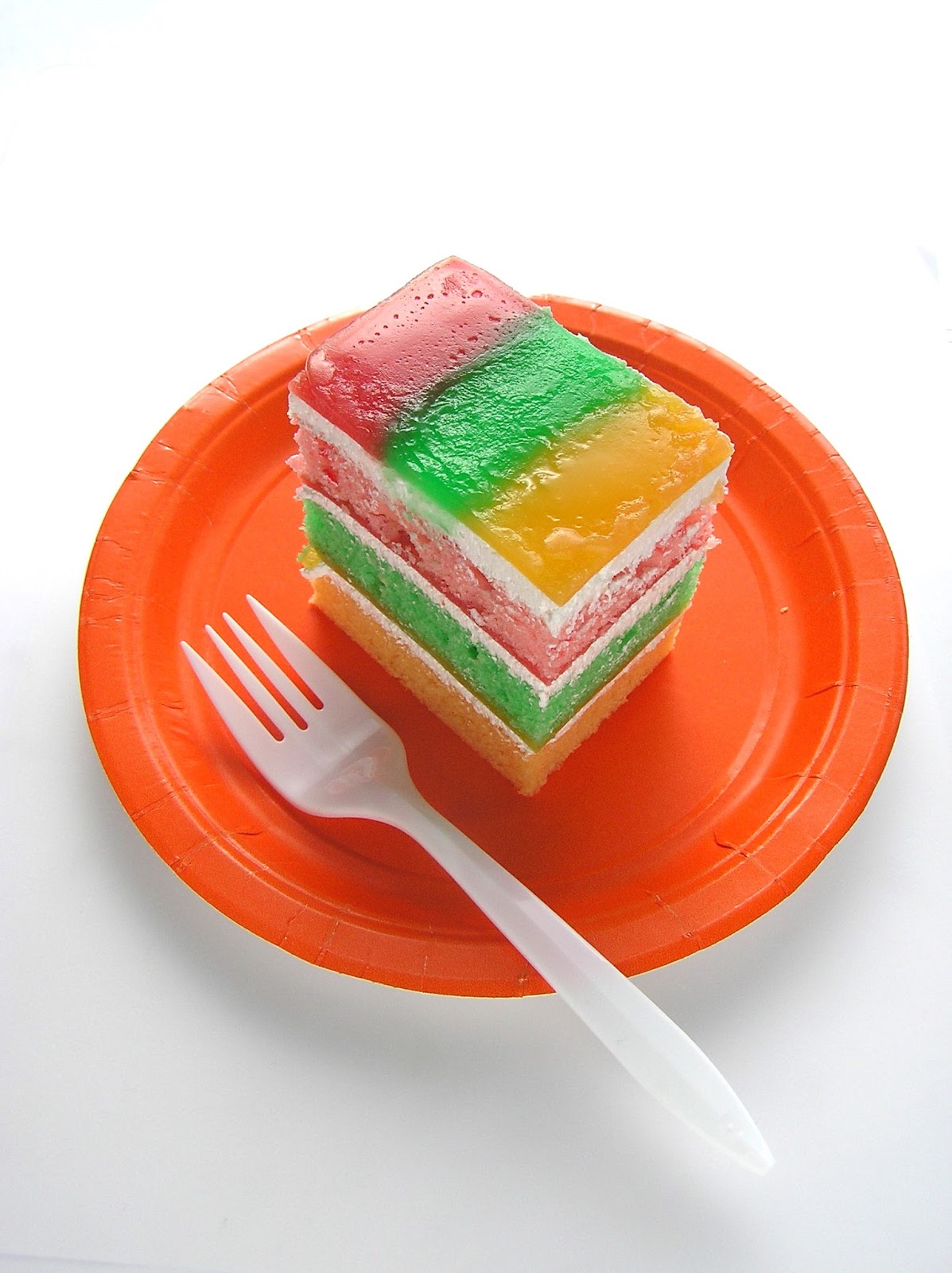
Rainbow Cake
Cakes of Paradise, $3.95/slice

Sink your fork into a little Aloha at either of Cakes of Paradise's two area locations.  Hawaiian baker Mary Buza-Sims' personal recipes were the starting point for this family business now run by her nephew and two sons.  The light, flavorful cakes feature tropical flavors like pineapple, passion fruit, and coconut.  Three-layer Rainbow Cake combines strawberry, lime, and orange cake, with guava, lime, and passion fruit topping.  You can pick up a slice or order a full sheet, which comes decorated with a fresh orchid. 

Cakes of Paradise 
Georgetown
6322 6th Ave S
Seattle, WA
206/763-1151

East Valley Business Park
281 SW 41st Street
Bldg # 13 East
Renton, WA
425/282-4972

Saturday, March 16, 2013

Survival Crackers and Shelter Candy


Puget Sound Coast Artillery Museum

Built in 1902, Fort Worden is one of three bases that make up the Northwest's "Triangle of Fire," an interconnected artillery system designed to repel any attempts at a sea invasion of the Puget Sound.  Although the Fort was decommissioned in 1953 without a single aggressive shot ever having been fired, today's Fort Worden State Park and museums contain countless reminders of just how tense times could get for the hundreds of men once stationed in the Fort's damp concrete bunkers. 

While sweets can often appear frivolous, a couple of displays at the Coastal Artillery Museum remind us that as sources of quick, comforting energy, sweets are ideal to have around when the s**t hits the fan.  The Museum's mock fallout shelter is stocked with 31.5-pound tins (photo above) of 756 long-lasting "Bulgur Type" survival wafers; they're made from wheat, shortening, and salt--with a generous amount of corn syrup to make them more palatable. 
 
The Museum also displays small cubic "Carbohydrate Supplements" (photo below):  "In addition to the three types of survival crackers there was also a Carbohydrate Supplement which became known as 'Shelter Candy' and is shown above.  This came in two flavors, Cherry and Pineapple, and was basically hard sugar. "

Other displays reveal that even everyday life at Fort Worden had its sweet side.  One case contains illustrated cookbooks designed for military mess halls; the books are opened to recipes for cinnamon rolls and "sugared snails."  A collection of souvenir menus testify to the lavish nature of the Fort's annual Christmas feast;  the dessert section of each menu features up to a dozen different cakes and pies--along with fruit and cigarettes. 

Puget Sound Coast Artillery Museum 
Fort Worden Building 201
200 Battery Way
Port Townsend, WA 

360/385-0373

Friday, March 15, 2013

Pippa's Real Tea


Scone and clotted cream
Pippa's Real Tea, $2

In the ranks of things that taste better than they sound, clotted cream is right up there with fish fingers.  Thick and insanely rich, this luxurious spread is a staple treat in Britain's dairy-farming regions. 

There are a couple of ways of making clotted cream, the easiest being to slowly reduce cream until it's as thick as spackle.  A friend's grandmother used to make a new batch nightly, setting the saucepan of cream in a bain marie over low heat before going to bed; she woke each morning to find the perfectly thickened cream topped with a golden crust of crystallized milkfat--as cheerful and more reliable than the morning sun!

There are even more ways of enjoying clotted cream, in or on baked goods or ice cream, in fudge, on fruit...An Afghan version is mixed with tea and aerated to yield a fuschia beverage enjoyed on special occasions. 

At Pippa's Real Tea in Port Townsend, a container of clotted cream accompanies small, fresh scones and strawberry jam.  You can also order a pot of one of Pippa's dozens of loose-leaf teas to create the classic mid-afternoon snack known in England as a "cream tea."   The farther you get from Devon and Cornwall, the greater your risk that the "cream" component of a cream tea will whipped rather than clotted--but Pippa's doesn't disappoint!

Pippa's Real Tea
636 Water St
Port Townsend, WA
360/385-6060

Thursday, March 14, 2013

Pastry by Anca


Shortbread
Pastry Design by Anca, $4.75/bag

Anca Hasson has been making Port Townsend a sweeter place since first starting to sell her pastries at the local farmers market in 2007.   As a child in Romania, Anca entertained herself by making desserts out of the limited ingredients available under rationing; as a young adult she was studying nursing in Alaska when a part-time job at a bakery reignited her childhood passion. 

Today Anca's products are available from many Olympic Peninsula outlets, including the Chimacum Corner Farmstand, Port Townsend's Co-op and Farmers Market, and the Tyler Street Cafe, a downtown PT restaurant owned by Anca's husband, John.

Her massive, tender shortbread cookies (above) come in a range of flavors, including espresso-pecan, and lemon with cornmeal. 


 The chocolate ganache cookie ($2.50 at Tyler Street) has a delicate crust, a gooey chocolate core, and a belt of buttery chopped pistachios. 


The pine nut cookies ($5.25/bag at Chimacum Corner) are perfumed pillows of egg white and almond flour studded with extravagant quantities of toasted kernels. 

Pastry Design by Anca
40-C Seton Rd
Port Townsend, WA

(360) 440-7534

Sunday, February 17, 2013

Tet Treats


Banh Kep La Dua (above)
Hue Ky Mi Gia, $1.50

Che Ba Mau (below)
Hue Ky Mi Gia, $3.00

Originally opened in Saigon in 1959, the Hue Ky Mi Gia noodle restaurant now has a massive menu and two Seattle-area locations--but only at a temporary stall at Seattle Center's Tet Festival does Hue Ky Mi Gia dish up these New Year's delicacies.   Banh kep la dua is special waffle that gets its color and aroma from the leaves of the screwpine or pandan plant.  Che ba mau is a drinkable dessert:  iced coconut milk with brown sugar syrup, red beans, and chewy green noodles made from rice flour and--again--that addictive pandan extract. 


Saturday, February 16, 2013

Khapse


Khapse
Tibetan Association of Washington, $15 with Losar dinner

Seattle's tiny Tibetan community puts on a Losar celebration that's everything I like a New Year's bash to be:  colorful, well catered, teeming with raucous children, and equal parts mystery and welcome.

I wandered into the Shoreline Senior Center shyly, not knowing a soul, but in under a minute I was offered at seat at a friendly table.  As we made introductions, a man came by with a large box and tongs, topping a paper plate already full of extra-spicy Cheetos with a delicacy I'd only ever read about, a treat both mysterious and hospitable:  Tibetan "cookies", or khapse

Made from dampened wheat flour and small amounts of salt, sugar, or both, khapse's appeal has more to do with appearance and texture than with flavor.  The dough is rolled into sheets, cut into strips, and wrought into a variety of traditional or whimsical shapes.  Finally, a dip in boiling oil gives the flimsy sculptures structural integrity and crunch.  

In Tibet, Losar season calls for vast quantities of khapse, from elaborate coils and curls that are stacked into offering towers, to simpler twists stored in a tin and brought out to eat with tea whenever a visitor stops by.  In the lead-up to Losar, professional khapse makers will make house calls, using portable deep fryers to create temporary outdoor kitchens for the freshest cookies.  

My first bite wasn't promising; my butterfly-shaped khapse was so hard and dry that my jaw ached after two chews.  Then a new acquaintance arrived back at the table with a round of hot, milky tea and some advice.  A quick tea-bath transformed my khapse into something much more enjoyable, and I polished it off wing by wing as the adults around me discussed the difficulties of the past year and their brightly-dressed children dashed around the room, laughing.  
 

Thursday, February 14, 2013

Raw Milk and Live Cookies


Raw Milk 
Dungeness Valley Creamery, $1.50/pint

Live Chocolate-Walnut Cookie
The Cookie Jar, $3

Whatever the dairy equivalent of "bread basket" might be, the Sequim-Dungeness Valley would have earned the title for much of the 20th century.  The arrival of the first cows in 1860 inaugurated a thriving industry; eventually the area boasted hundreds of dairy farms and thousands of cows, most of them Guernseys and Jerseys producing buttery high-fat milk.  

Over the last fifty years, though, Sequim-area dairying has declined.  The new norm emphasizes larger farms, industrialized techniques, lower-fat milk, and higher-yielding cows (typically Holsteins). 

One of two dairies remaining in the Valley today, the Dungeness Valley Creamery is extremely choosy about which trends it follows and which it bucks.  Located on the bluff above the Dungeness Spit, the creamery facility was built in 1992 by a family who have been in the dairy business since the 1970s.  The farm's 38 acres are home to 60 vintage Jersey cows, each with her own name and personality.  Their milk is sold unpasteurized and unhomogenized, so that the cream rises to the top, and since 2006 Dungeness Valley Creamery milk has also been certified raw.  

The milk is cold and frothy with the sweet-clean aftertaste of mown grass.  It begs to be put to work washing something down, and the Creamery has the perfect partner on hand:  Live Cookies.  Available in a number of flavors, these substantial treats feature flours ground at the last minute and stored cold in order to maintain their nutrients.  

The Creamery's stock of Live Cookies is limited to what was left over after Live Bread Shoppe owner/baker Sherry Fry closed her Sequim-based business in 2012.  Fry's new nutritional counseling business in Puyallup will eventually offer Live Cookies, along with a cookbook, Nutrition From the Cookie Jar

(If you're navigating using Sequim's free tourist map, note that the Creamery's location is marked incorrectly.)

Dungeness Valley Creamery
1915 Towne Rd
Sequim WA
360/683-0716

Wednesday, February 13, 2013

Lavender Ice Cream


Lavender Ice Cream
Purple Haze, $4

Around 1850 settlers who reached the Sequim and Dungeness Bays at the northern end of Washington's Olympic Peninsula began to take advantage of the flat plains and fertile soil left behind by retreating glaciers and the protective "rain shadow" cast by the Olympic Mountains.  They cleared, irrigated, planted, and harvested handsomely, eventually shifting their focus from vegetables to small-scale dairies. 

A little over a century later, a new wave of settlers began to arrive, drawn to the same favorable conditions but for different reasons.  After a syndicated newspaper column for retirees published a letter praising the area's mild weather and low cost of living, the small town of Sequim experienced a population boom.   One struggling dairy farm after another was replaced by housing developments and chain stores. 

But just when it looked like nothing could check the spread of the cul-de-sacs, a Sequim civic committee convened in 1995 with the goal of revitalizing the area's agricultural traditions.  Like the settlers and the retirees, they looked at the landscape and the weather and saw yet another new solution:  lavender. 

Today Sequim has positioned itself as "America's Provence," with more than 30 local farms collaborating on events like the annual Lavender Festival, which attracts thousands of tourists in mid-July.  But visitors who arrive outside the high season don't miss out:  farmstands and shops feature a wild variety of value-added products, from sniffable sachets and soaps, to edible lavender-laced cheeses, cookies, and chocolates.  The Purple Haze farm's mainstreet shop even sells lavender and white chocolate ice cream, produced by Elevated Ice Cream in nearby Port Townsend.  

Purple Haze Lavender Shop
127 W Washington St
Sequim WA
360/683-1714

Crumb Grabbers Birthday Cupcake


Birthday Cupcake
Crumb Grabbers Bakery, free (!)

Crumb Grabbers Bakery is a popular spot for light meals and treats located in a friendly-looking house on a side street just off Sequim's main drag.   I had to elbow through the lunch crowd to reach the bakery counter, but that effort quickly paid off.

"It's our one-year anniversary," said the woman behind the counter, "Would you like a free birthday cupcake?"

Giddy with good fortune, I rushed out to the less-crowded parking lot to enjoy my freebie.  The chocolate-on-chocolate cupcake was moist and not too sweet, with a good balance of frosting to cake--even factoring in the frosting that mysteriously ended up on my face and shirt.
 
Crumb Grabbers Bakery 
492 W Cedar St
Sequim WA
360/504-2031

Thursday, January 24, 2013

Calico Cupboard


Cream Puff
Calico Cupboard, $6.49

I learned about Calico Cupboard from a rabid fan of their apple cake who was loudly talking smack in a rival bakery.  Visiting lovely little La Conner on a day trip, I reckoned I'd judge that apple cake for myself--but it turns out only to be available "in season".  So instead I had (part of) a cream puff the size of a kickball but much more toothsome:  flaky pastry, glassy chocolate, rich custard, and airy whipped cream. 

And I added "apple cake" to my fall calendar.

Calico Cupboard
720 S 1st St 
La Conner WA
360/466-4451 


Sunday, January 20, 2013

Buttermilk Lemon Sorbet


Buttermilk Lemon Sorbet

While I can vividly remember resenting buttermilk for not tasting like melted butter, I've since either matured enough killed off enough taste buds to appreciate this tart, old-fashioned dairy stalwart.  

Buttermilk in pancakes?  Yes!  In bran muffins?  Of course!  In this crazy-easy buttermilk lemon sorbet?  Don't get between me and my spoon!  

The buttermilk contributes an easy-to-digest but velvety richness that comes through even if you skip using an ice cream maker.  Meyer lemon juice adds another layer of tartness, so mix in just enough sugar for balance. 

Don't be put off by the large number of variables in this flexible recipe.  Using regular lemon juice instead of Meyer?  You might want a little more sugar.  Trying to cut back on the sugar?  You might want to go for the cream or milk option instead of full-on buttermilk.  If it comes out too tart, just serve with shortbread or a little chocolate syrup.


Buttermilk Lemon Sorbet

2/3 c freshly squeezed Meyer lemon juice
1 1/4 - 1 1/2 c sugar (to taste)
2 c buttermilk + 2 c other dairy (more buttermilk, cream, whole milk, kefir, etc) 

Combine the sugar lemon juice and either whisk in a bowl or shake in a sealed jar until the sugar completely dissolves. Whisk the juice together with the buttermilk and any other dairy products. Pour into a large tupperware container and chill for an hour. Transfer to the freezer and rake with a fork every 45-60 minutes to break up the ice crystals as they form.

I based my recipe on Katie at the Kitchen Door, who based hers on Rozanne Gold's Radically Simple cookbook. 

Sunday, January 6, 2013

Nata de Coco


Nata de Coco
Chakoh, $1.68/jar

In the Philippines, around a third of the population makes a living from coconut-related activities and products.  Known affectionately as the "tree of life", the coconut palm yields an astonishing range of goods, from buttons and building materials to a store's-worth of edibles including coconut flesh, cream, milk, jam, curd, sugar, flour, and oil.  

One of the simplest coconut products is the basis for one of the most complicated.  To make coconut water all you do is poke a hole or two through the hull and pour out the refreshing drink sloshing around inside.  To make nata de coco, you combine that water with a specific bacteria, acetobacter xylinium, and let it ferment.  The bacterial colony produces a thick, squishy mat of coconut-flavored cellulose.  Cleaned, sweetened, and cut into pieces, that gel is a high-fiber, low-fat delicacy enjoyed in drinks, pudding, fruit salad, or shaved ice desserts.  

Although nata de coco is Spanish for "coconut cream", these cubes have a uniquely rubbery texture.  Nata de coco is chewier than agar, less sticky than tapioca, and much tastier than an eraser.